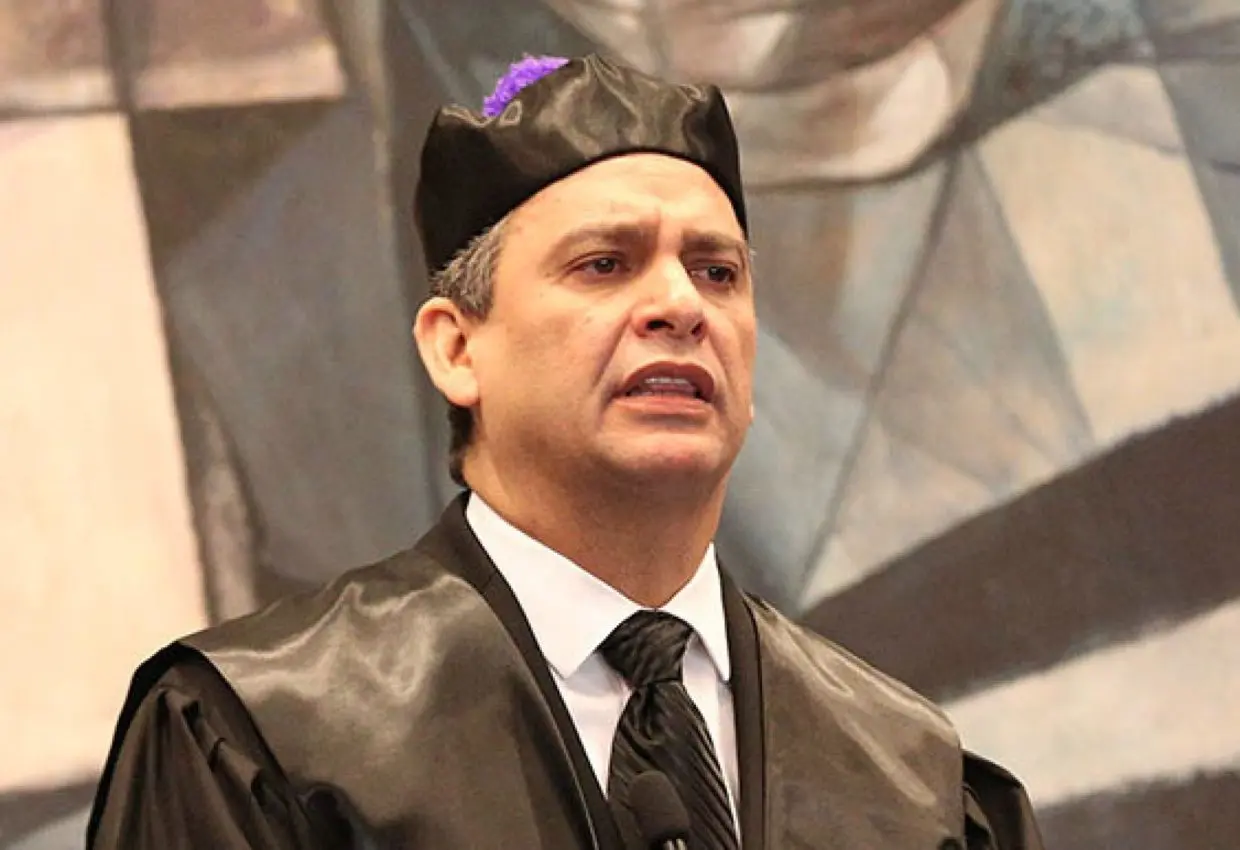
The president of the Supreme Court of Justice, Luis Henry Molinawarned that Artificial intelligence I would put in risk the legitimacy of justice, if there is no regulationsince, through systems, decisions with normative and doctrinal foundation could be issued, limiting the role of the judge.
“Now, If there are no clear frames For all these interaction scenarios, The risk is that the jurisdictional function is diluted or loses legitimacy. Something unacceptable in a democratic system, ”said the president of the Judicial Branch.
He maintains that in the face of these scenarios, the priority should not be speculated with dates or dispute about the degree of technical realism.
“The priority is to assume that these possibilities are already under discussion in the technological world and that, regardless of their exact schedule, It is urgent to develop the normative and political capacity to govern them. The challenge is to expand these uses with clear principles, robust governance and vision of the future, ”says the magistrate an information published in his official blog, under the title of”The in accelerated development and justice: between automated efficiency and the guarantee of the law”
Equality
He considered that if the State does not guarantee accessible public artificial intelligence there will be an inequality with the use of that tool, compromising procedural inequality, which contradicts the constitutional principle that consists of equality before the law.
In that tenor, the magistrate points out that another aspect that will be impacted has to do with the democratization of advanced legal tools that would be possible from the launch of agent-3-mini.
You can read: CNM holds a meeting this Friday at the National Palace; They agree to review current regulations
“These would allow anyone to write legal documents, calculate probabilities of procedural success or challenge judicial decisions with a technical assistance superior to that of many professionals,” he said.
Given this situation, Molina argues that this implies an equity dilemma: “Those who access these tools will have a substantive procedural advantage over those who do not have them. If the Judiciary does not provide accessible public services, access to justice could become more unequal”
He pointed out that with the acceleration that IA carries, one of the impacted areas could be the automation of the writing of sentences.
He pointed out that in a few years there will be systems capable of producing complete judicial decisions, with normative foundations, doctrinal analysis, evaluation, in unattainable times and precision for a human.
“At this point, the judge’s role is transformed again, only as a prospective exercise, it is no longer the one who writes, but who validates, adjusts and supervises what the AI has already facilitated,” explains the representative of the Judiciary.
You can read: Procurator Berenice Reynoso: New strategies for drug boom
He added that another case of adaptability is the appearance of autonomous legal assistants who fulfill functions comparable to those of a prosecutor or a public defender.
“These systems learn in real time, adjust their reasoning and maintain ethically acceptable behavior through self-monitoring systems. From the institutional point of view, the question is not only if this is possible, but if the system is prepared to define how far the delegation comeshow the use of these agents is controlled and how due process is protected against errors or biases. Here we connect with the concept of I-Justiciawhich can guide this transition. It is not just about digitizing processes or accelerating procedures, but about building a justice that incorporates artificial intelligence from institutional sovereignty, public ethics and commitment to human dignity ».