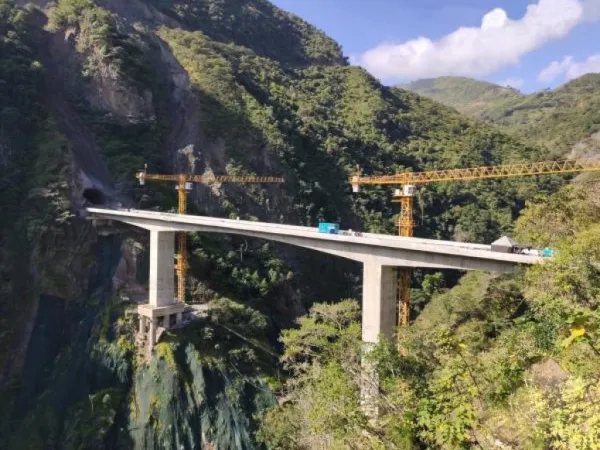
The National Infrastructure Agency (ANI) announced The relocation of the toll wasmia as part of the interventions planned within the Autopista Al Mar 2 project, One of the strategic corridors that seeks to improve the road connection between Medellín and the Urabá region of Antioquia. The announcement was made during an inspection visit made within the framework of the strategy “Ani in territory.”
You can see: With popular action, they seek to stop the construction of Vive Claro Bogotá
The relocation of the toll was confirmed by Roberto Uparela, Executive Vice President of the ANI, who reported: “There were some commitments to the concessionaire, the slope will be treated in km 10+400 in Dabeiba, the relocation of the fouhmia toll will be carried out, as well as the construction of the additional section of false tunnel in Uramita. ”
The decision is part of the final phase of the Mar 2 project, which has 254 kilometers in length and an advance of 99.32%. This corridor consists of six functional units and extends from the municipality of Cañasgordas to necoclí. The relocation of the FUMIA toll is added to the technical measures adopted by the entity in response to particular conditions of the land and operation needs of the road section.
During the tour, the president of the ANI, Óscar Torres Yarzagaray, and his technical team reviewed the progress of the infrastructure and held meetings with regional actors. “We want to highlight in the social field the project of the Eco -Environmental Educational Institution ‘Los Almendros’, delivered by the ANI and the concession devimates to the municipality of Sopetrán, where more than 130 children strengthen their learning and learn from good practices for the protection of the environment and its environments,” Torres Yarzagaray pointed out.
See also: More than half of municipalities do not supply drinking water in rural areas: why?
Mar 2 Highway
In addition to the relocation of the FUEMIA toll, two exemption events of responsibility (EER) are contemplated that are still pending in the Mar 2. One project is located in Functional Unit 1, where the termination of the false tunnel between the points K29+380 and K29+600 in the municipality of Uramita is advanced. The other corresponds to the Mutatá variant, with an approximate extension of 1.7 kilometers.
In parallel, lAni reported that in September a vehicular counting system will be installed in Cirilo toll, located in Functional Unit 6 of the same project, In the municipality of Turbo. The entity clarified that this system “is not linked to the reactivation of any toll collection today.” According to the report, the objective is to obtain precise data on the quantity and type of vehicles that travel through that corridor, without affecting the circulation.
The works executed in the Mar 2 project include the construction of the 15.5 -kilometer Fuemia variant and the 2.2 -kilometer Fuemia tunnel. According to the information delivered by the ANI, these interventions will reduce the displacement time between Uramita and Dabeiba from 45 to 15 minutes. In addition, a double road of 45.8 kilometers was built between the tiger and necoclí.
The Mar 2 Corridor will benefit more than 600 thousand inhabitants in the municipalities of Cañasgordas, Frontino, Uramita, Dabeiba, Mutatá, Chigorodó, Carepa, Apartadó, Turbo and Necoclí. The work is part of the Fourth Generation Program of Concessions (4G) and is complemented by the High School 1 and Pacific Highways 1, 2 and 3.
It may interest you: Modernization works of the Tolú Airport advance: When will they deliver it?

Private archive
In the case of the Highway to Sea 1, 182 kilometers, currently in operation and maintenance, the ANI announced scheduled minor works. “For minor works we want to announce that together with the concessionaire we already have the designs and in 2026 we will begin the works of the return of Ebéjico and the pedestrian bridge and mestizal whereabouts,” said Torres Yarzagaray.
This project benefits more than 280 thousand inhabitants in the municipalities of Medellín, Ebéjico, San Jerónimo, Sopetrán, Santa Fe de Antioquia, Buriticá, Giraldo, Cañasgordas, Anzá, Concordia, Betulia, Salgar and Venice. Among the works stand out the West tunnel and the new Cauca bridge, the latter located between Sopetrán and Santa Fe de Antioquia.
Currently, the travel time for a truck from the coffee axis to Urabá is 21 hours. With the completion of these runners, a reduction of up to 12 hours is projected on the way, facilitating the transport of goods and access to strategic ports of the Caribbean and the Pacific.
The ANI will continue to supervise the final stages of the projects and the required operational adjustments, including the relocation of tolls as part of its technical and contractual planning.
Paula Galeano Balaguera
Portfolio journalist