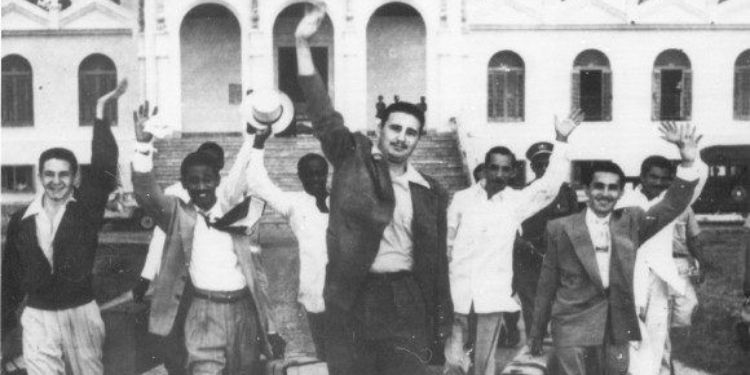
The assault on Santiago Barracks Moncada, an action carried out with nocturnality and alevosía, turns 72 a day like today.
Puerto Padre, Cuba – controversial, ampulosa at times, a protectionist perhaps, thus and the entire Constitution of 1940, influenced by the letter and spirit of the Mambisa Constitution of Guáimaro of 1869 and without excluding readings of the Constitutions of the United StatesMexico and the Declaration of the Rights of Man and the citizen of the French National Assembly of 1789, was, without a doubt, our most estimated first law, justified as one of the most progressive constitutional texts of the Americas for their time.
In force in Cuba until the coup d’etat by Fulgencio Batista in the early hours Castro, who replaced her with the appointed “Fundamental Law”, of February 7, 1959, which was in force until February 24, 1976, when a constitution-consulted of the stalinist constitutional texts imposed by Moscow was promulgated in the Kremlin satellite countries in Eastern Europe. World War IIwhile in Cuba, the Constituent Convention had concluded its legislative works on June 8, 1940, signing the final text in the city of Guáimaro, _ of the Cuban Constitutionality_ on July 1, to finally promulgate in Havana, in the National Capitol and before the sovereign people on July 5 of that year.
Now it is possible to ask: on July 26, 1953, with the assault to the Moncada barracks, what did Fidel Castro look for in Santiago de Cuba?
Assuming his own defense as a lawyer, accused of the assault on the Moncada barracks in the early hours sovereignty and proclaimed the 1940 Constitution as the true Supreme Law of the State, as long as the people decided to modify or change it. ”
But, going against the doctrine of your own acts, (you cannot go against your own acts) and passing on the exception of him for “legislating”, “provisionally”, just 37 days after taking power on January 1, 1959, Fidel Castrowith constituent powers similar to those of Fulgencio Batista, that is, de facto, caused the Council of Ministers to replace the 1940 Constitution with the Fundamental Law of February 7, 1959. But, retracting ourselves to the trial for the assault on the Moncada Barracks, let it be the lawyer Castro Ruz who in his allegation before that forum clarifies the legitimacy of the Council of Ministers. It produced the fundamental law in force in Cuba 17 years, until February 24, 1976, and, of course, that it also shows us the legitimacy of the constituent power that produced the 1976 Constitution, that of 2019, and … yes, that it tells us the constitutionality of the so -called “National Assembly of Popular Power”, by reforming the current Constitution at the proposal of its brother Raúl Castro, in a matter of form (the age of the “president”) substantial in the background, as it is in itself a constitutional reform, understand, a fold to sovereignty, I say, when sovereignty resides in the nation and not in a mere pile of people doing as if they were homeland.
Well … defending themselves by the assault on Moncada barracksoccurred on July 26, 1953, 72 years ago a day like today, and that was perpetrated with nocturnality and alevosía, wearing the same uniforms of the adversary and using prohibited weapons such as the cut shotguns, which, in about 15 minutes, killed 19 military and wounded 25, producing to the attacked about three casualties per minute, which makes the lethality of the assaults, which makes the lethality Trying to defend that fact, Fidel Castro Ruz told the judges of the Emergency Court for Cause 37:
“It is an elementary principle of public law that there is no constitutionality where the constituent power and legislative power reside in the same body. If the Council of Ministers makes the laws, decrees, regulations and at the same time it has the power to modify the Constitution in ten minutes, damn the lack of a court of constitutional guarantees! Its ruling is, therefore, irrational, inconceivable, contrary to the logic and the law You, gentlemen magistrates, you swore to defend. “
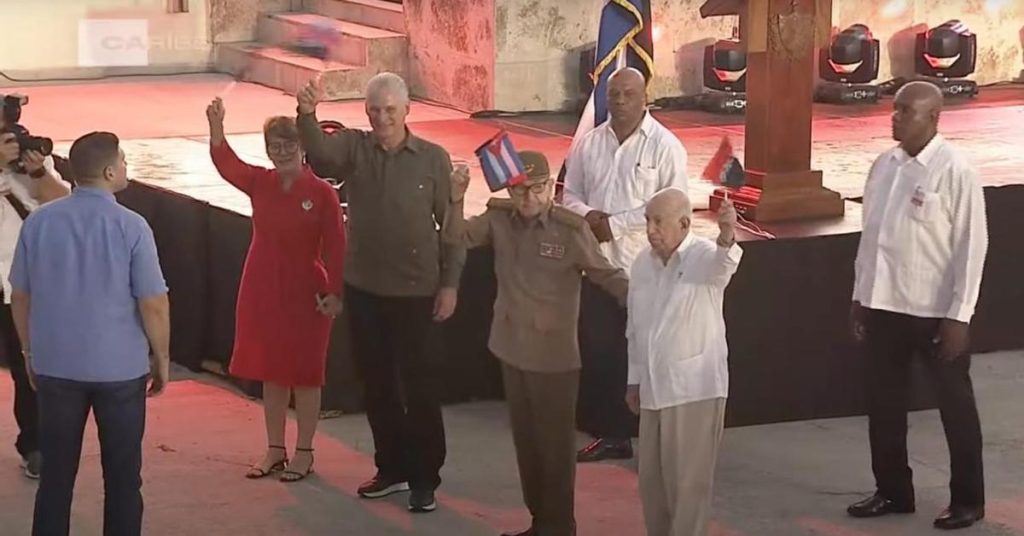
Good. Those words said by Fidel Castro in Santiago de Cuba in October 1953, will soon turn 72, portray the Castro -Munista totalitarian regime that he devised, planned and built and launched in 1959, inherited by his brother Raúl Castro, and that at his death, he will inherit Miguel Díaz-Canel And the general that sustains it and owns economic and political power, being them, and only them and at the same time, “the Council of Ministers”, “The Constituent Power and the Legislative Power”, making laws, decrees, regulations and modifiers of “the Constitution in ten minutes”.
Fidel Castro sought totalitarian power, life, and not only did he get it for himself, but he transferred him in inheritance to his brother Raúl Castro, who at 94 years old, is transferring that omnimous power to his unconditional as if he were the administration of the wallet of roosters that he had in his youth. Poor Cuba. Poor Cubans!