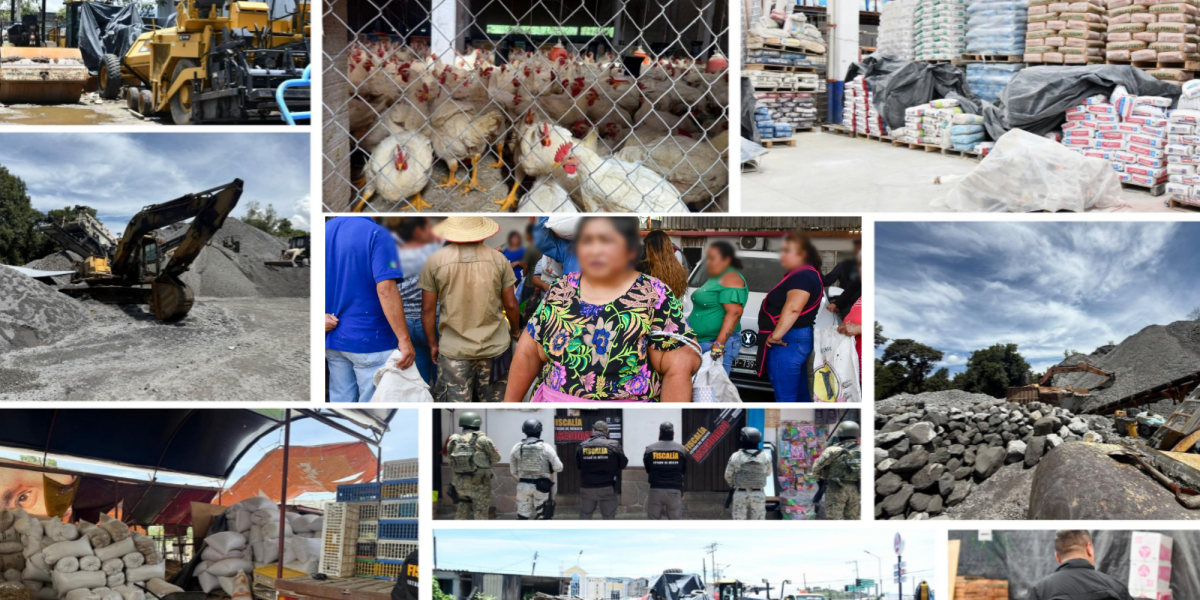
This week, the Attorney General of Justice of the State of Mexico (FGJEM) announced that a criminal network with alleged links with The Michoacan family It was dismantled in the south of the State of Mexico after years of extortion, imposing fees, controlling markets and artificially altering the prices of essential products.
Next, some key points of what the operation called “Operation Liberation” that It led to the arrest of several key members and the assurance of more than 60 establishments where extortion practices were exercised directly on the pockets of thousands of Mexicans.
1. Economic control with legal facade
For at least six months, the Attorney General of the State of Mexico (FGJEM) documented a criminal structure that had captured Complete economic sectors.
This network operated through Apparently legal economic units: Houses of materials, unions, traces, butchers and wood, from where forced purchase conditions, surfaces and threats were imposed.
The group intervened mainly in 14 municipalities, including Valle de Bravo, Ixtapan de la Sal, Temacaltepec, Sultepec and Tejupilco.
Photo: Special
2. Network that controlled sale and material prices
One of the main actors was Eli “N”, owner of the “Jimex” warehouse in Valle de Bravo. According to investigations, this businessman served as the only one authorized by the criminal group to distribute cement and construction materials in the region. The people who tried to stock up on another channel were intercepted and, in at least one case, kidnapped.
According to the authorities, last January, Eli would have forced a victim to climb a vehicle, where he demanded an initial payment and a weekly fee of his income, in addition to channeling all his purchases exclusively towards his establishment.
Photo: Special
3. Infected prices up to 400% under construction
The framework had strategic allies like Gonzalo “N”, leader of the “Bradasva” union, who controlled the distribution of sand, gravel and rod.
Photo: Special
According to the Mexican Prosecutor’s Office, he charged quotas of up to 15,000 pesos for income of materials and 2,500 pesos for each trip, intimidating with destroying works or hitting operators that did not meet.
A police report revealed that this union inflated prices up to 400% compared to base prices in Tolucawhich severely affected housing, infrastructure and local public works.
Photo: Special
Photo: Special
Photo: Special
4. Financial Front
The administrative and financial tasks of this coercive model were in charge of Alicia “N”, who operated in Ixtapan de la Sal and surrounding areas.
She was responsible for Apply 20% overprices in construction products and to threaten those who will not accept the conditions imposed.
To convince the merchants, they lodged them in a hotel under their control, where they were even shown a high -value horsepower hatchery, allegedly belonging to criminal leaders, as a symbol of power that supported threats.
Photo: Special
5. Monopoly in wood and family ties
Alicia did not act alone: she was a couple of Jorge “N”, leader of the timber business in Valle de Bravo, Who was responsible for monopolizing the sale of wood, including fine products for cabins.
He demanded initial payments of up to 100,000 pesos to other merchants and charged monthly installments based on his sales.
Photo: Special
In turn, José Fernando “N”, Another involved operated wood in Ixtapan de la Sal, where prices increased by 20% and used taxi operators for logistics work, all for the benefit of the same criminal group.
Photo: Special
6. Food control: meat, chicken and threats
The network was not limited to the construction branch. Also It extended its control to the supply of meat and chicken.
According to the Prosecutor’s report, the detainee Antonio “N” distributed Meat in Texcaltitlán, Sultepec and Almoloya de Alquisiras. He imposed an extra charge of five pesos per kilo and forced buyers to acquire their products exclusively, under death threats.
Photo: Special
Something similar did Bernardo Alejandro “N”, arrested in Quintana Roo, who directed the sale of chicken in Ixtapan de la Sal. It threatened to cause physical damage to the merchants who tried to stock up on another way.
Photo: Special
Photo: Special
Photo: Special
7. Coercion as an economic model
All these operators were part of a Business appearance structurebut that worked under the logic of extortion.
Some of them were even visible figures in their communities: merchants, councilors or union leaders. Such is the case of Yareli “n”, who served as a fourth municipal governor and allegedly participated in an express kidnapping to demand the payment of fees to a furniture merchant.
The governor, next to Alicia “N” and Jorge “N”they fulfilled the Delg Rupo Criminal Encomienda to convene merchants of Ixtapan de la Sal, Tonatico and municipalities surrounding themselves to stay in a well -known hotel in the area where they were told about “the importance of being aligned” with the criminal group and if later they did not obey what the now detained imposed them, the merchants were deprived of their freedom by groups of people
Photo: Special
8. Beyond materials: parcel and digital trade
In addition to the economic impact, the authorities emphasize that this network had control in logistics and parcel activities. In Tejupilco, for example, the group established a center where it intercepted packages of companies such as Mercado Libre or Estafeta, demanded illegal payments to free the products or simply stayed with them if they were of interest to them.
Photo: Special
9. Insured and redistributed goods
After the simultaneous cateos carried out on July 21, the authorities They secured thousands of goods: More than 4,000 birds, almost 4 tons of meats, 137 tons of rod, 5,000 lumps of cement, machinery, fodder, cattle and 128 vehicles.
For the first time in the entity, a scheme of “Early disposition” backed by the Judiciary, which allowed these products to be delivered to the affected population through the Ministry of Welfare.
Photo: Special
Photo: Special
The intervention was deployed in municipalities such as Amanalco, Donato Guerra, Ixtapan de la Sal, Malinalco, Sultepec, Texcaltitlán and Valle de Bravo, where it is estimated that prices will return to their reference level after the fall of this criminal network.
The FGJEM indicated that it maintains the investigation open and asks victims and witnesses to submit complaints through number 089, the mail [email protected] or the FGJEDOMEX app.