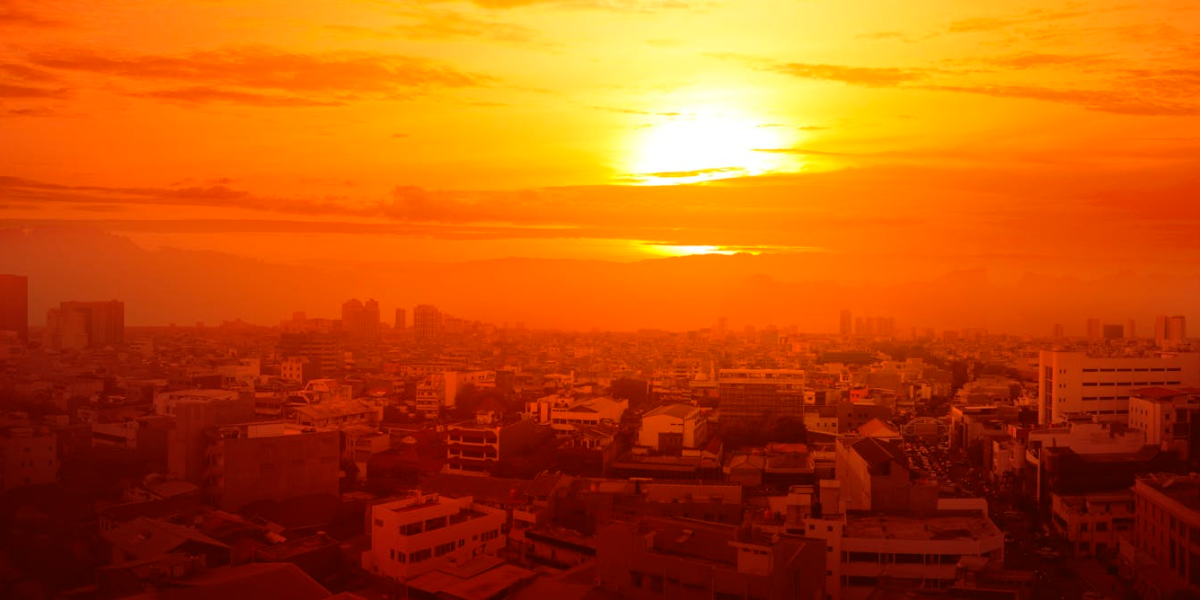
He Report on the 2024 climate status of the World Meteorological Organization (OMM) confirmed that the average global annual temperature in 2024 was 1.55 ° C higher than the average of the 1850-1900 period, which is taken as a reference to measure the heating of the planet.
The average global temperature exceeded 1.5 ° C briefly for a month or more in 2016, 2017, 2019, 2020 and 2023. However, last year it was the warmest in the 175 of which you have registration. But does all this mean that we have already exceeded 1.5 ºC that establishes as threshold the Paris Agreement?
The ambiguities of the Paris Agreement
He Paris Agreementapproved at the UN climate change conference of the 2015 (COP21), more than ten years ago, it determines that “the increase in world average temperature should be maintained well below 2 ° C with respect to pre -industrial levels, and continue efforts to limit that increase in temperature to 1.5 ° C, recognizing that it would significantly reduce the risks and effects of climate change”.
This is a political-diplomatic agreement between the countries that have ratified the United Nations Framework Convention on Climate Change (CMNUCC).
However, its writing contains ambiguities and generates two fundamental questions:
- What does “regarding pre -industrial levels” mean? For this period defines the reference base temperature to delimit its increases, its variations, unambiguously.
- When will it be considered that the temperature has exceeded 1.5 ºC of increase? That is, how long should that threshold be exceeded?
Annual anomalies of the world average temperature in relation to the pre-industrial levels (1850-1900) from 1850 to 2024. Data from the sources indicated by the Legend/Global State of Climate 2024, CC By-SA
What is considered “pre -industrial period”?
The pre -industrial level refers to the average global temperature before the industrial revolution, which is used as a reference for the effects of global warming. The CMNUCC commissioned the intergovernmental group of experts on climate change (IPCC) that defined what would be considered as pre -industrial levels: the answer It was the Special Report on Global Heating of 1.5 ° C.
The period chosen was from 1850 to 1900, fifty years. Its selection is due to the fact that the time represents during which observations are available with sufficient quality of the surface temperatures of the earth and the ocean, which allows a precise comparison. In addition, the global air temperature was relatively stable, with an approximate average of 13.84 ° C.
With a human influence on the climate still relatively small before the progressive and intensive use of fossil fuels, it was considered a good reference to assess the effect of human activities.
This period increases by the 30 -year classic period defined by the World Meteorological Organization (OMM) by 20 years, which results from the standard normal data and OMM standard normal data, which had already been defined in 1872.
An increase in the temperature sustained for 20 years
The truth is that we still cannot affirm that we have exceeded the threshold of 1.5 ° C as established by the Paris Agreement.
Global temperatures do not increase gradually. We must consider the difference between the natural variability of the climate – by the phenomena of El Niño and by volcanic activity – and the variability that defines its tendency in time – the current warming process. He Climate system oscillates in different time scales with short and long term temporary frequencies.
Therefore, the 1.5 ° C figure refers to an average planetary heating sustained, not only at the value of a single year, which could only be abnormally warmer or colder than the average long -term average. But how long should that temperature increase be maintained to consider it a trend?
The second periodic review of the long -term global objective of the Convention clarified that “the objective is evaluated over decades” (COP22 of Sharm el-Veikh, Egypt, in 2022). The IPCC, in Your report on the physical bases of climate changedefines the moment of overcoming as “the midpoint of the first period of 20 years in which the global surface air temperature averages more than the threshold temperature.” The use of this average helps to ensure that warming trends are due to human intervention and not to natural variations.
Thus, we will have to wait 20 years to confirm whether to overcome the threshold of 1.5 ° C is maintained as a trend. Humanity will only know with certainty if we have reached the limit of the Paris Agreement in retrospect. Which implies the risk of delaying its recognition and the corresponding reaction.
Read more: Contradictions that carry compliance with the Paris Agreement on the climate
Consensus is needed
Heating is accelerating. In the 2021 report of the IPCC, a range of 1.5 ° C “in the early 2030” was indicated, in almost all emission scenarios. And, the recent report of the OMM Annual Climate Update Global Decenal 2025-2029 It indicates that it is likely (with 70 % probability) that the quinquenal average of 2025-2029 exceeds 1.5 ° C.
Addressing the question of when we will enter a period of 20 years with an average heating of 1.5 ° C is not, therefore, only an exercise of monitoring of the global temperature record. It has a fundamental relevance for climate risk management and adaptation planning.
Evaluating the increase in global average temperature using the average heating of the last decades will delay formal recognition of when the Earth exceeds the limit of 1.5 ° C. This probably generates distractions and delays just when climatic action is more urgent.
It is necessary to define and agree on a unique and consensual metric that clearly describes the overcoming of the threshold of 1.5 ° C –There are some alternatives– and anticipate the events that will precede it. The associated impacts will be serious. Such an increase might seem a distant reality, but we could be reaching before what we imagine according to the available observations.
The occurrence of the first year with a heating of 1.5 ° C would imply that the 20 -year period that reaches the lower objective of the Paris agreement has already begun and that The expected impacts with this heating level are already being manifested.