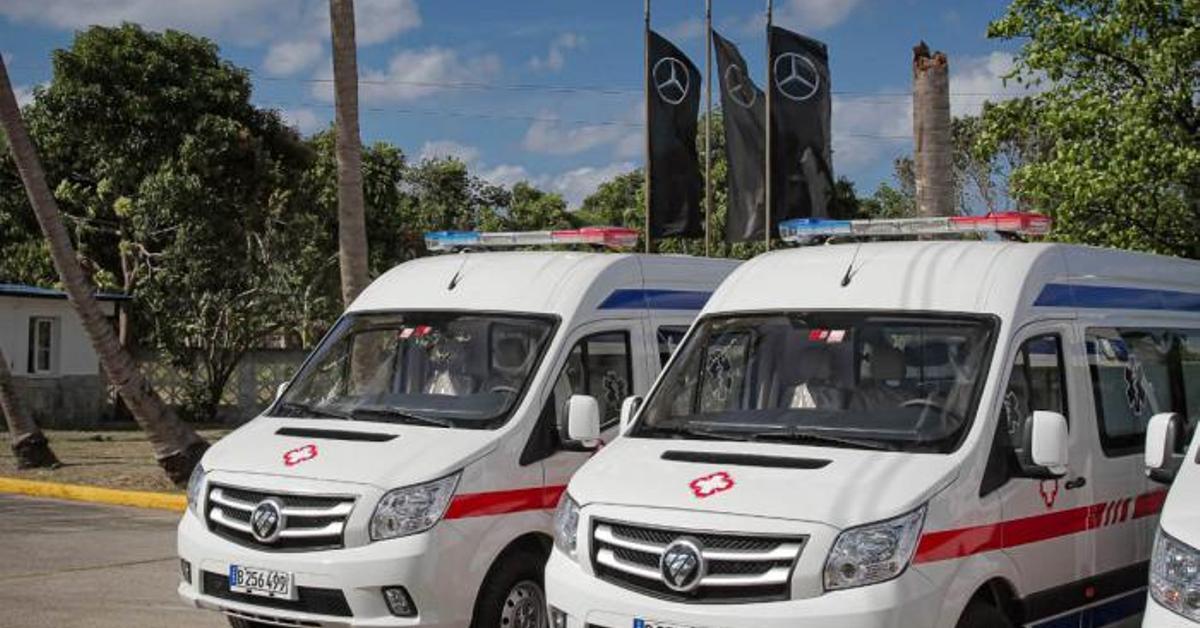
Havana/We must admit it: Eduardo Rodríguez Dávila gives the impression of being the only minister in Cuba who really moves, although his solutions are partial and do not supply in front of a ruined system – and in ruin. The official medium Havana Tribune He has announced today the incorporation of 15 new ambulances for the capital. And the head of Transportation published on their Facebook page that they plan to acquire 120 vehicles for funeral services.
In this environment we have followed closely The case of the 100 Chinese microbuses of the Foton brand that joined public transport. It is true that initially it was thought to be filmed only through Havana streets. But then they rectified, before the flood of criticism from the other provinces, which must always settle for used vehicles.
Each territory showed such an enthusiasm with its new Chinese guagüitas that seemed to receive a “caravan of victory”
Solomonically, the minister “sensitized” to complaints and The lot left: 50 for Havana and 50 for five other provinces. The local media of the beneficiary territories enthusiastically celebrated the arrival of 20 units to Santiago de Cuba, 10 to Holguín, the same number to Camagüey, five to Villa Clara and another five blind from Ávila, the champion province in the national emulation for July 26. Each territory showed such an enthusiasm with its new Chinese guagüitas that seemed to receive a “caravan of victory.”
The ambulances They are just fifteenfor now. They seem identical to microtaxis, but without rear seats, with red crosses and sirens lights. The note of Grandstand He hastened to clarify that later another 50 will arrive, which will be distributed by the rest of the island. Yes, they say they constitute an “innovative operational modality.” What did they mean by that? They do not clarify it. According to the official medium, this system has shown “positive results in efficiency and coverage”, although the report itself recognizes that all existing needs are not yet met.
Although coordination between the Ministries of Transportation and Public Health stands out, the control mechanisms are not explained, nor are public data on response times, availability by municipalities or real coverage areas. In a context where citizens denounce the lack of health transport daily, the ads seem more a communicational strategy than a structural response.
/ Facebook / Eduardo Rodríguez Dávila
While the modernization of these services is procured, the funeral transport system – another sensitive issue – also tries to reform, with the purchase of 70 funeral cars of combustion motor and 50 electric, according to the Minister’s statement Rodríguez Dávila. It is a late response to years for the deterioration of the service, which has caused such painful scenes as the transport of coffin into trucks used for construction.
Now, on the other hand, the Minister publishes images of modern tricycles, with the appropriate colors for its function, aerodynamic body and less need for spare rubber. In the comments there are few who thank the minister. And one of his 73,000 followers says: “At least … there is a ministry that works.”
“At least … there is a ministry that works”
These efforts, all funded by the Fund for the Development of Public Transportation, reflect an attempt to modernize within the country’s economic limitations. But they also show a fragmentary vision, focused on palliative more than structural solutions. The purchase of small capacity vehicles – like Chinese microbuses or electrical carts Zycarrecently incorporated in some tourist areas – responds more to the shortage of fuel and currencies than to a deep redesign of the transport system.
The decision not to use these new micros for tourism, according to the minister, is because they were acquired specifically for the public sector. But that separation between tourist transport – privately, with access to modern vehicles and insured fuel – and citizen transport – in permanent crisis – only reflects the enormous gap between sectors within Cuban society.
The ads of ambulances, microbuses and funeral tricycles, although necessary, should not serve as a smoke curtain before reality: a collapsed system that requires – at least – truly deep and urgent reforms.