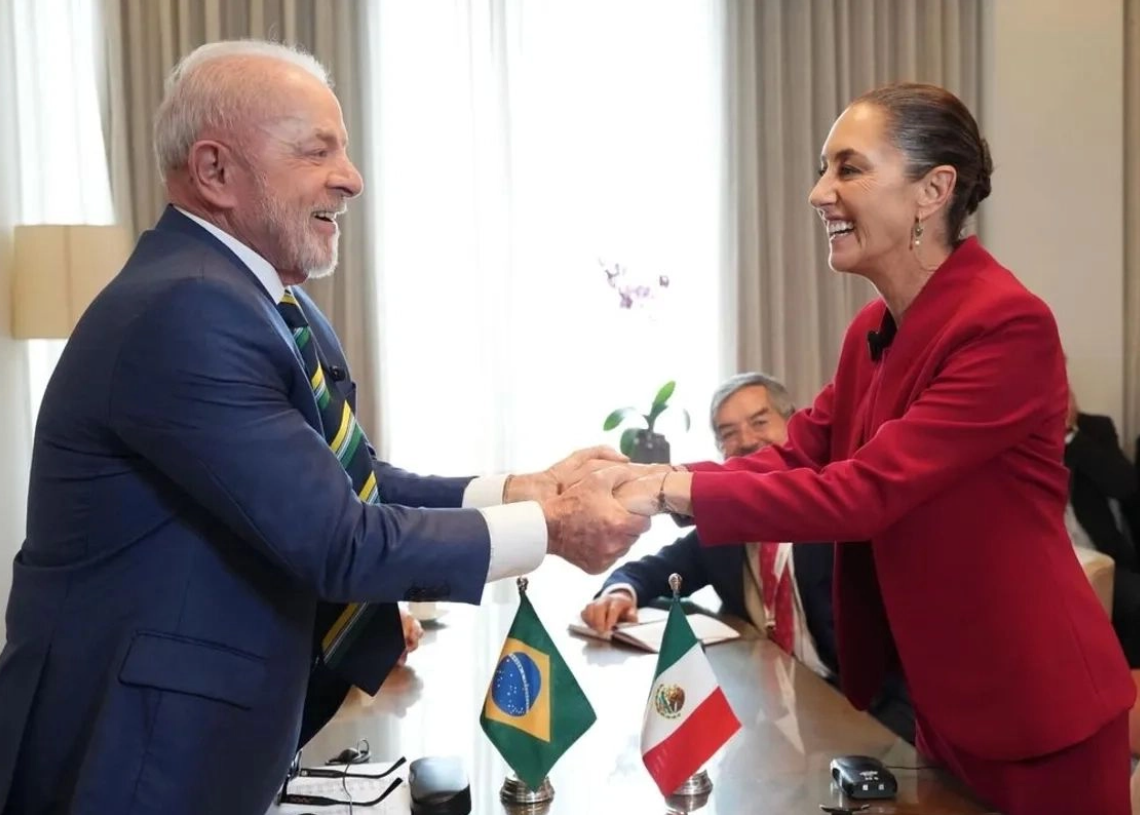
In a moment of strong tension by the Tariff load Announced by the Trump administration against both countries, the governments of Mexico and Brazil decided to deepen their commercial, scientific and technological collaboration, in what is emerging as one of the most relevant responses in Latin America to the US protectionist policy.
The cooperation reinforcement agreement was confirmed after a telephone conversation between the Mexican president, Claudia Sheinbaum Pardo, and her Brazilian counterpart, Luiz Inacio Lula da Silva, in which both leaders ratified the importance of a strategic alliance in the face of global economic uncertainty and punitive actions adopted by Washington.
The convergence between the first and second economy of Latin America has been catalyzed by the recent White House measures, which announced 30 % tariffs for Mexican products and 50 % for Brazilian exports, with entry into force planned for August 1.
According to President Donald Trump, taxes respond to different motivations. In the case of Mexico, contain the traffic of fentanyl and weaken the cartels, while for Brazil the decision is mainly linked to the judicial process against its political ally, the ex -president Jair Bolsonaro.
Both nations have described the arbitrary and unjustified measures, also warning of the high risk of the stability of global value chains and the possibility that an international recession is triggered.
In multilateral forums such as the World Trade Organization (WTO), Brazilian diplomats have denounced that American unilateral commercial policy “undermines legal coherence and predictability of the multilateral trade system.”
Brazil reacts to 50 % tariffs announced by Trump, Lula says that the measure “will be answered”
Alliance strategy: complementarity and new sectors
President Sheinbaum stressed on Thursday the importance of strengthening alliances outside the classic American axis. “The idea is that Mexico, in addition to the commercial treaty itself with the United States, strengthens other alliances of collaboration and cooperation … especially with Brazil,” he said during his morning conference, according to press reports.
In that same journalistic environment, the president emphasized that the horizon is not a formal free trade agreement, but schemes of productive complementarity, cross investment and institutional coordination.
Among the priority sectors identified by both governments include the pharmaceutical industry, agricultural innovation, especially in biotechnology and access to markets; the development and transfer of technology for ethanol and biodiesel production, taking advantage of the Brazilian experience in the sector; and the Mexican sugar and industrial potential.
Likewise, other identified areas are the aerospace and innovation industries, high -added issues for both economies, as well as the education and science sectors, with mobility and university cooperation programs.
As part of the collaboration agenda, the Brazilian vice president, Geraldo Alckmin, will visit Mexico on August 27 and 28, accompanied by ministers and business leaders.
The objective will be to specify joint investment agreements and explore public-private alliances in key sectors, both in Mexico and in Brazil, as reported.
“The idea is that we meet the Mexican cabinet and businessmen interested in commercial and cooperation agreements, working on joint investments,” said Sheinbaum, who added that the ratification of this road map responds to a dialogue process initiated from the first meeting between both leaders.
https://www.youtube.com/watch?v=u-oncakvoee
Answers to Washington and Potential Impact
The acceleration of bilateral cooperation occurs in a scenario of efforts of both countries to mitigate the impact of Trump’s decisions.
President Sheinbaum assured that her administration works to avoid entering the taxes, even exploring a possible call with her US counterpart to seek a negotiated solution.
However, the Mexican strategy is to diversify partners and investment sources. “We trust to reach an agreement, but we also seek to strengthen the economy and cooperation with all the countries we have, or not, commercial treaties,” said the president.
Lula, on the other hand, urged from Brazil to strengthen South-South solidarity and highlighted the urgency of a Latin American common front to face global challenges.
Economic analysts estimate that American tariffs could subtract to a percentage point of growth to Mexican GDP in 2025, while Brazil would be affected by their commercial balance and expansion prospects, in a regional environment marked by high volatility, inflation and risk in currency and values markets.
However, several experts argue that the expansion of cooperation between Mexico and Brazil can serve as a shock absorber against deceleration and offer real alternatives to markets traditionally dominated by the United States.
On the other hand, talks between Sheinbaum and Lula have also included agreements for scientific development, educational cooperation and the promotion of health innovations, in order to raise regional competitiveness.
To this is added the recent opening of the Brazilian market to the Mexican avocado, as an example of the practical market opening approach.
The alliance also occurs when Mexico projects diplomatic visits to the European Union and Canada to consolidate a global collaboration network, and while the Brazilian government encourages new agricultural and technological exports.