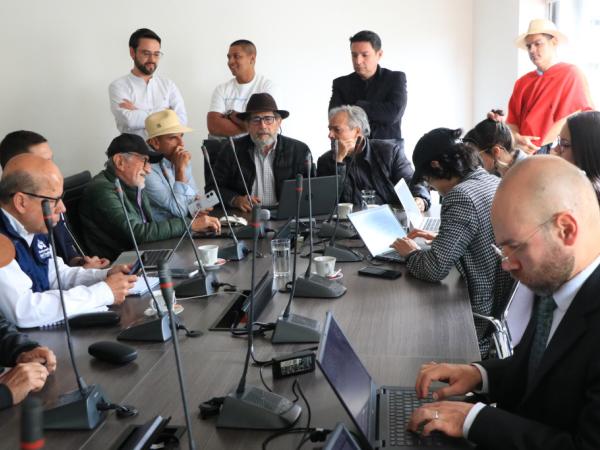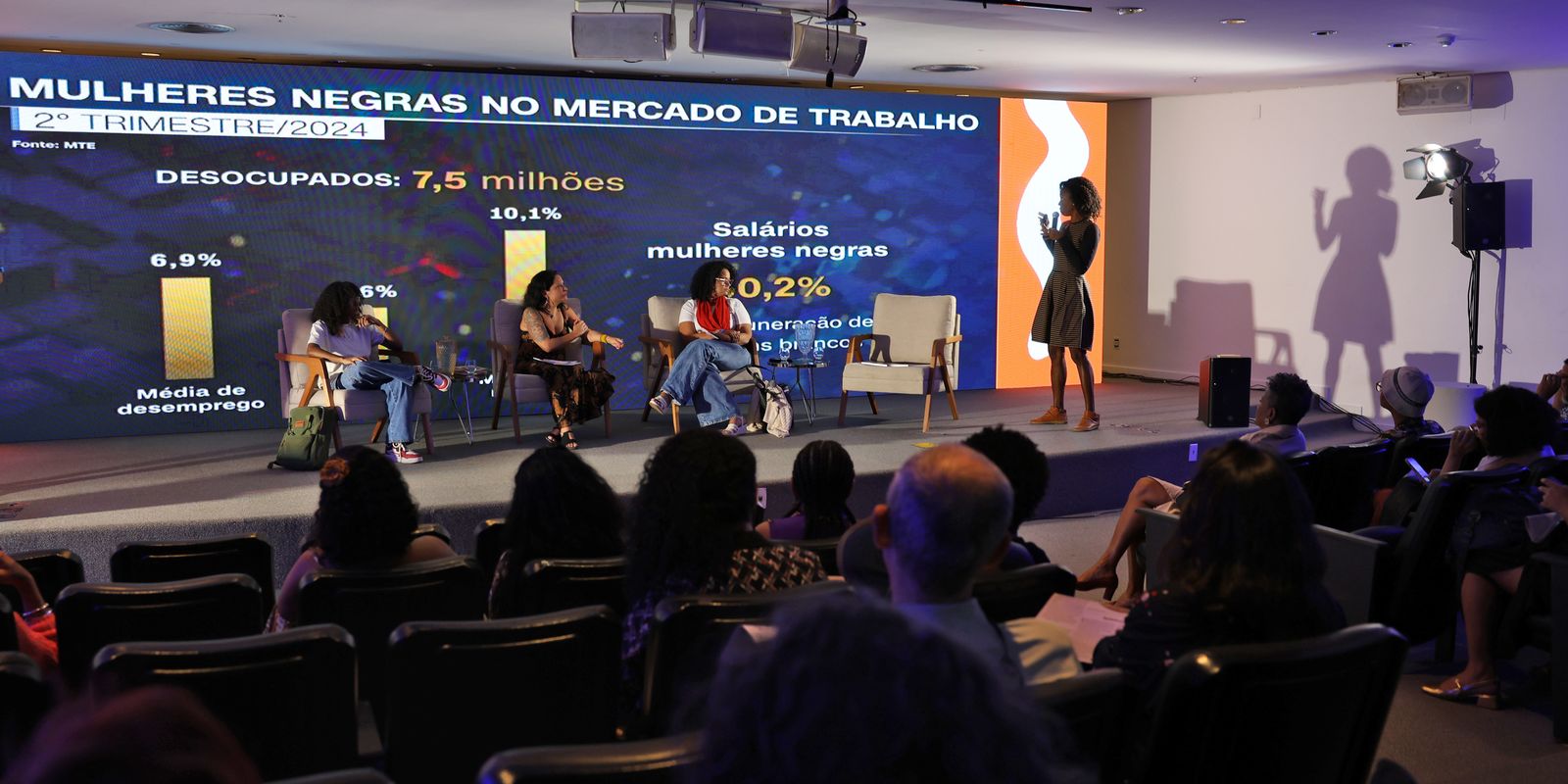
The publication of the Federal Official Gazette, this Thursday (24), of the decree that regulates how the National Care Plan-PNC should be (Law 15.069/2024) was celebrated by the participants of the 18th Latinity Festival during the 2nd National Meeting of the Multiatitors Network with the theme young women and the challenges of worthy work at the National Museum of the Republic, in the center of Brasilia.
The founder of the Latinities Festival and director of the Afrolatinas Institute, Jaqueline Fernandes, told the Brazil agencythat the meeting held in partnership with the Center for Study of Labor Relations and Inequalities (Ceert) discusses the decent work and opportunities for young black people. “This activity is focused on black youth and black women in the job market. Years ago, Latinidades has dedicated an entire edition to think black women in the job market, and now we came with this specific youth cut through Ceert, with great expectation of deepening this debate.”
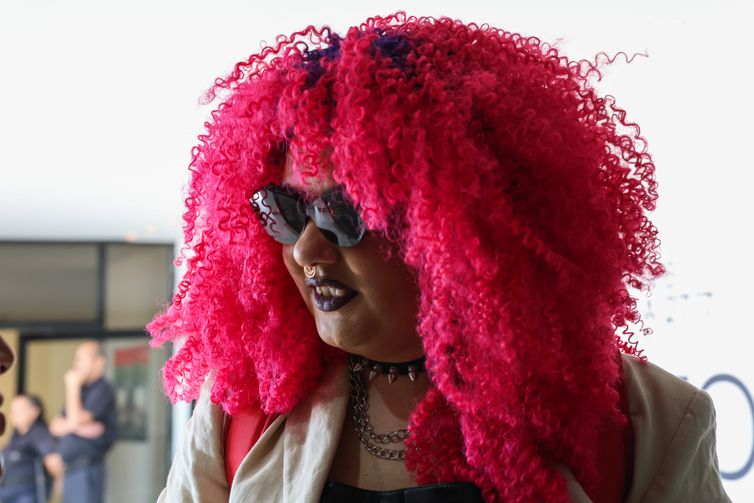
Jaqueline Fernandes says that the meeting discusses the decent work and opportunities for young black people Photo: Antonio Cruz/Agência Brasil
Disproportionate work
At the first discussion table of the day, those present debated the redistribution of the responsibilities of the work of care, which historically fall disproportionately on women.
In participation, the National Secretary of Care and Family of the Ministry of Development and Social Assistance, Family and Hunger Fighting (MDS), Laís Abramo, detailed data from the portfolio that point out that 75% of the work of care in Brazil is exercised by women, 45% of them black women and 25% domestic workers.
The secretary of MDS also recalled that the disproportionate load of care work was theme of the writing of the National High School Examination (ENEM) 2023. And that the new national care policy establishes the right to care and defines that work must be guaranteed through the division of responsibilities “between men and women, between the family, the community, the private sector and the state, facing multiple cultural inequalities that are of gender, race, ethnicity, social class, territory, age and disability”.
“Although it was historically thought out as unimportant, invisible, we understand that care is a work, a necessity and a right of all people. The idea is that it enables the accomplishment of any other work, so it is a central theme in the organization of society,” says Laís Abramo.
Colonial inheritance
From the perspective of a black person, the associate professor at the University of Brasilia (UnB) Breitner Luiz Tavares explains that the care work done, above all, by vulnerable black women was inherited from the colonial period in Brazil. “Care work is domestic, emotional or community is not a racialized destination. It is a colonial heritage that still imprisons black bodies, especially women.
The teacher mentioned policies such as the Quota Law, the PEC [Emenda constitucional nº 72/2013,] of the domestic.
“Policies that have shown that changes are possible, but we know that they will only advance when they are designed with you. Not for you. No policy will be legitimate without the voice of those who live for their consequences.”
Already the coordinator of the Black Youth Area of Ceert, Luanda Mayra, spoke about decent work, fundamental rights and the need for care policy to recognize that this is a work and needs to be paid, and then that work between men and women is redistributed.
“We are talking about real opportunities for young women and women to have access to quality education, employability with justice and work environment free of racism and violence.
For the coordinator, the transformation is only possible when the youths are at the center of politics.
“And more than occupying spaces, these young black women have been making solutions, denounced violence and built ways. Without black women, without young black women, there is no possible justice or democracy.”
Another present speaker who agreed that the care work has always been a slave, was the member of the Malala Fund activist network in Brazil, Gisele Santos.
By praising the trajectory of her black ancestors, she sought examples of the past to the present. “I think this care is a slave inheritance, a colonial heritage. For white women can have desire and have the right to care. Black women, there is no choice. Care is imposed on us from the moment we are gestating, from the moment we were born.”
As a way out today, activist Gisele Santos argues that the state, through the new national care policy, is in fact, based on the reality of black women and that Brazilian society divides responsibilities. “This challenge is not only ours. We need to understand our intersectionalities, which are gigantic, because we are plural, but that must be taken into consideration in this construction.”
The executive director of the Polis Institute, where he coordinates the axis of racial, gender and LGBTQIAPN+justice, Cássia Caneco, revealed that she is the daughter of a black maid, who since she was 10 years old took care of her brothers and at 19, was a head of household.
When citing the Brazilian Drama Movie What time does she come back?2015, Cássia Caneco questioned who takes care of those who take care of other families. “Who are the people who, having the right to care, do not have a structure that guarantees existence, development, education? Therefore, I think this policy of care has the reparatory meaning. It is an important policy and a historical agenda of feminism in Brazil. It is also a policy that proposes to be careful. We redistributes work.

Entrance to the 18th 2025 Latinities Festival, at the National Museum – VALTER CAMPINATO/AGENCY BRAZIL
Black economy
The producer of the Latinidades Festival, Kellen Vieira, brought data from a market research conducted by Pretahub and the Locomotivas Institute that identified that among workers in the areas of creative economy and event production, 90% are autonomous, ie without formal work ties; 56% of them have production as the main source of income and 97% of blacks working with culture have already passed or witnessed situations of racism. “This is an issue that we need to put so that companies can understand and accept us,” argues Kellen Vieira.
She also mentioned that six out of ten professionals are women up to 29, black, single, straight and higher education. And therefore, Kellen Vieira asks if, after more than a decade of the Quota Law (No. 12.711/2012), which reserves vacancies at universities and federal institutes for black people, if the job market is prepared to receive those leaving undergraduate, without racism. “Having a lot of people knowing higher education plays at a sensitive point: is the job market prepared to welcome black people who have higher education? This number is growing. But are they being placed in the job market properly, with a suitable salary for this?” He asked.
Private market
The head of the advice on promoting racial equality at work, the Ministry of Labor and Employment (MTE) and university professor, Ronaldo Crispim, highlighted current federal government policies, such as the law that expands from 20% to 30% the reserve of public tenders to black people and brown, indigenous and quilombolas, sanctioned in June by President Luiz Inácio Lula da Silva.
Ronaldo Crispim details that the private sector does not follow the same rhythm of racial and gender equity, as attested by the salary transparency report and remuneration criteria, with data from companies completed by the semester since 2024, with RAIS data. “A black woman receives less than half a salary from a white man, even in management positions. We need to advance a lot, even with the compliance policies, the ESGA [Ambiental, Social e Governança, em inglês]and UN gender equality objective (United Nations]. ”
For Ronaldo Crispim, the federal public administration model must be replicated in the private sector. “Giant – national and multinational companies – have already been able, for example, to have gender parity in the direction. But when this report asks: Do you have policies that value women and black women?
Hope and good living
Bearing a ride on the concept of “Well Living”, adopted by indigenous peoples, Advocacy in the Educational Action company, Andreia Alves, argued that life centered only on survival can make room for the construction of new possibilities, from putting itself in the place of others. “We have to be in the place of empathic identity and rethink the logic of the way of life and build this reality.”
For her, the moment is of “hope” that is, to have hope, but without a passive wait, as she identifies in the song Good hopeof the São Paulo rapper Emicida.
“I see a lot of potential in young black women. Despite knowing that everything is not very good, we have a very beautiful and fighting way. We have to keep fighting,” says Andreia Alves.
Latinic Festival
The 18th edition of the Latinidades Festival also had two debates tables on decent work and guarantee of the rights of young Brazilian black women. The first of these: young black people in the center: challenges and advances in the learning law. The last wheel of conversations of the day dealt with black girls and climate change: will we have dignity in the future of work?
>>>> Check out the full program of the festival;
THE 18th Festival Latinities: Black women move the world! runs until July 31st;