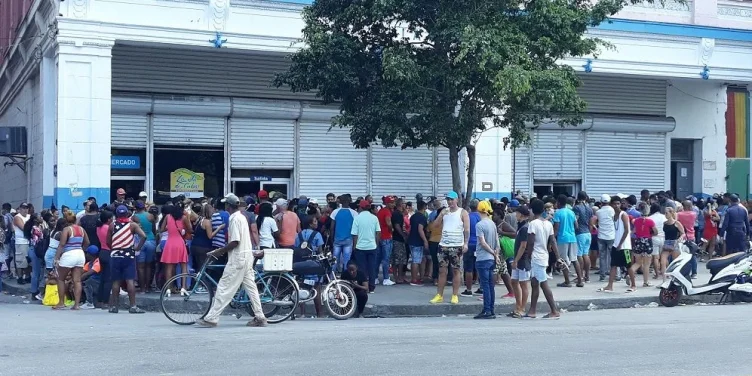
Today those who do not roam in Cuba are those that have cars assigned by the State. The rest wanders for food or move from one place to another.
Havana, Cuba.- The use of euphemisms has always caught my attention due to the high regime figures, sometimes even alter its etymology.
A few days ago, President Miguel Díaz-Canel incurred one of those fouls to the language. Trying to amend the flat to the Minister of Labor and Social Security, Marta Elena Feitówhen he said derogatory that in Cuba there were no beggars, but people disguised as beggars, which caused a great popular repulsion, Díaz-Canelin the National Assembly of Popular Power, he committed a dislate by expressing that in Cuba there were “roosters and wandering.”
The president thus demonstrated his little knowledge of the Spanish language, by incorrectly using the term “wandering”, which is not recognized by the Royal Academy of the Spanish Language, and on top of that, to pose of inclusive, feminizing it.
The Larousse Dictionary and the Dictionary of Synonyms and Antonyms of Sainz de Robles agree that wandering is walking, traveling, winging; And beggar are the people who ask for alms, homeless or pordiosos.
Let’s analyze the word “wandering” applied to our context.
People in Cuba today have an imperative need to go outside to look for food and things they need for their home. It is a fairly difficult task, because many times they have to walk long distances to find them, and if possible to look for a better and cheaper offer, that relieves the expense, because the budget never reaches, due to the very high prices of the items and the meager salaries paid by the State.
That is the most common way that Cubans currently wandered.
The other is to move from one place to another, because the guaguas scarce and can take hours to pass. Therefore, many times you have to walk kilometers to go to work, the study center or any other desired place.
I usually move on foot from one municipality to another, because I cannot pay collective taxis and less individuals, and take a minibus is a feat. As I am born and raised in Havana, and I know her in the heart, I have become an expert in looking for the shortest routes.

Cubans are forced to wander, but not in the sense of walking aimlessly, as sometimes interpreted, but looking for something or to go to a certain place.
I also think of families, especially those with minors, who, in search of recreation, must go for a walk, even to a park, especially if there are recreation devices there; But since it is not always close to their home, that implies a walk.
Traditionally, Havanans come to drink fresh air and to contemplate the sea to the Malecon, especially in summer. But, as they say, they plan to lease spaces from the Malecon, which is bad news for the capitalists who roam there.
In past times, many people went out to see the stores, were going to buy or not, just for spending a while, and perhaps snack in one of the multiple coffee shops and shops dedicated to selling food. Today that distraction disappeared, like most stores.
Not always going for a walk had a marked goal. I remember that as a child my parents led me to take walks, which consisted of riding in the Rule boatgo to the zoo or any other place to “leave the house for a while,” as they said.
We can affirm that today in Cuba who do not roam they are the owners of cars, own or those assigned by the State to officials, and the senior leaders, who have luxury cars with air conditioning for their tours.
There are many beggars, although officially they do not want to call them that way, and prefer to call them euphemistically “roosters” or “people in street situations.”
We see people with dissimilar ages and physical condition on public roads, who ask for money, or something to eat. There are many and more and more, as the country’s economic situation is getting worse.
It is no longer strange to see men and women with posters who say “help me to eat” or who register in the garbage in search of objects that can sell, and even devouring waste. Their presence is undeniable, whether or not they like the senior leaders of the regime, who prefer not to call them by name.