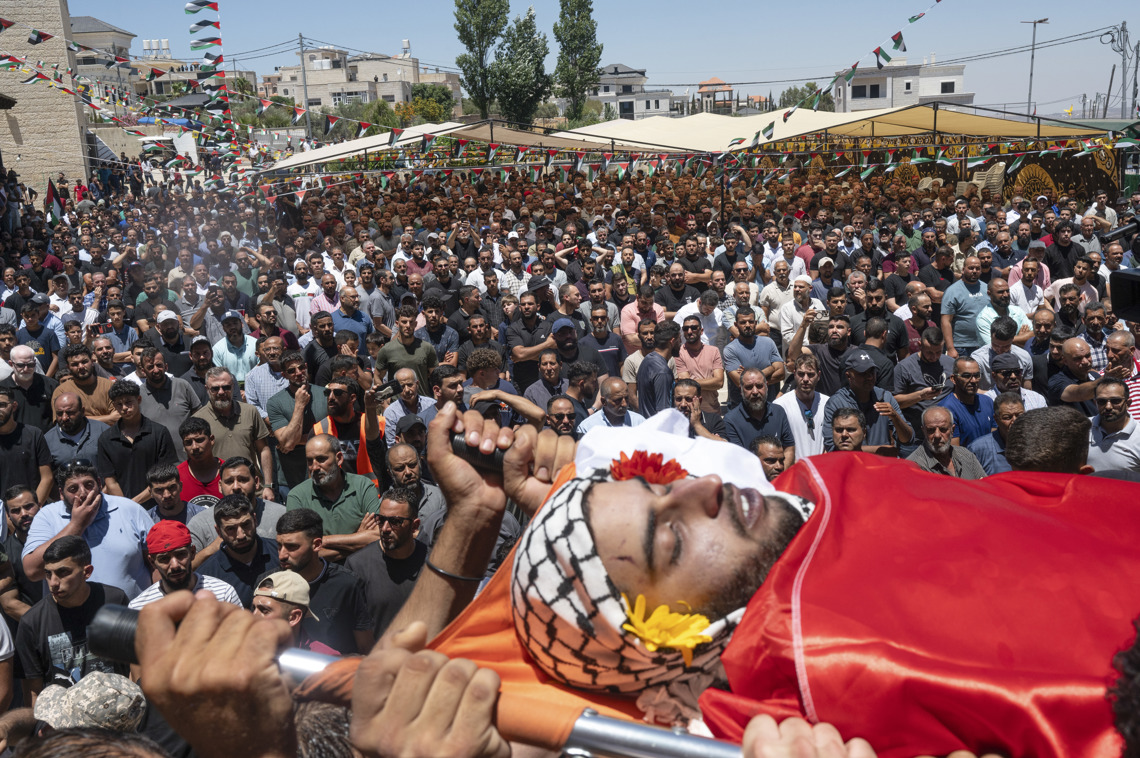
On a day marked by persistent tension and violence against the Palestinians, the Israeli Knesset or Parliament approved on Wednesday a non -binding motion in favor of the annexation of the West Bank, only hours after a 14 -year -old Palestinian child died from gunfire of the Jewish army in the city of Arraba, in the north of the occupied territory.
The resolution, lacking immediate legal effects, quickly turned on the criticism and rejection of the Palestinian authority and multiple international actors, amid an environment that adds civil victims and deepens the humanitarian crisis.
A controversial vote in a region in vilo
With a majority of 71 votes in favor and only 13 against, the Knesset supported the statement that Judea, Samaria and the Jordan Valley – zone internationally recognized as the West Bank – are “inseparable part of the historical homeland of the Jewish people”, according to the text promoted by legislators of religious Zionism, Likud and Yisrael Beytenu and replicated by the newspaper The Times of Israel.
The motion, presented by Simcha Rothman, Dan Illouz and Oded Foreer, asks to apply Israeli sovereignty in these areas, where millions of Palestinians live since 1967 and around half a million Israeli settlers.
“The land of Israel belongs to the people of Israel,” said Amir Ohana, president of the Knesset, after the vote.
“In 1967, the occupation did not begin; it ended, and our homeland was returned to its legitimate owners. The Jews cannot be the occupants of a land that for 3 thousand years has been called Judea,” he added before the applause of nationalist sectors.
According to the ruling party, the measure makes clear to the world that Israel “will not accept solutions that imply dangerous territorial concessions” and manifests a “commitment to the future as a safe Jewish state.”
However, the vote, although symbolic and without immediate legal consequences, is a reflection of the growing consensus between the government coalition and a good part of the opposition to rule out the solution of two states and formalize the presence in the West Bank.
Prime Minister Benjamin Netanyahu voted in favor of the resolution, although he did not promise to take additional steps in the short term. The center and left opposition was mostly absent, showing internal polarization.
Overwhelming reactions: “A dangerous climb”
From Ramela, the Palestinian authority described the Knesset motion of a “dangerous escalation” that undermines the perspectives of peace, stability and the solution of two states sponsored by the international community.
Hussein al-Sheikh, Vice of President Palestinian Mahmud Abbas, denounced that the Israeli decision constitutes a “direct attack on the rights of the Palestinian people” and called on countries to “recognize the Palestinian state in response to Israeli violations.”
The Palestinian Foreign Ministry warned that annexation, even if it is not immediately formalized, feeds the climate of hostility and serves as a “smoke curtain” in the absence of advances in negotiations or hostage release in Gaza.
For its part, the Islamic Resistance Movement – there – cataloged the vote of “null and lacking value”, registered it as an episode more in a succession of “generalized violations” such as the expansion of settlements, the confiscation of land and repression and murders in the West Bank.
The annexation of occupied territories, including the West Bank and Jerusalem, would violate fundamental resolutions of the UN Security Council and the General Assembly, in addition to being a violation of the Fourth Convention of Geneva (1949), and the International Court of Justice, which in 2024 declared the occupation illegal and demanded the dismantling of all Israeli settlements in the area.
https://www.youtube.com/watch?v=pmyjo_mz1ti
The death of a child exemplifies daily violence
While the votes were counted in Jerusalem, the bloody reality of the occupation was manifested at a few kilometers.
In the city of Arraba, in southern Yenín, the Israeli army fired and killed Ibrahim Imad Ahmed Mahmoud Hamran, a 14 -year -old teenager.
According to the Palestinian Ministry of Health, Hamran received direct shots even when there were no clashes in the area at that time. Another minor was shot in the thigh in the same event. The Palestinian red crescent reported that both children were transferred to Yenín Hospital, but Hamran did not survive.
The death of Hamran elevates more than 930 the Palestinians, including at least 200 minors, who have lost their lives in the West Bank and Jerusalem is since the intensification of Israeli military incursions after October 7, 2023, according to the United Nations data.
Only in the first six months of 2025, more than 120 civilians have lost their lives in the context of occupation and armed conflict.
Hunger and poverty in the West Bank
The socioeconomic background in the occupied territory deteriorates with the same rapidity as the political situation.
The latest survey of the NGO World Vision exposes an unprecedented crisis: 74 % of families in the West Bank lives below the minimum subsistence threshold, compared to 21 % reported only one year ago.
The report, entitled “The Invisible Crisis”, points out that three out of four homes cannot even cover their basic needs, 70 % of children skip foods frequently and 9 % have abandoned the school due to the economic crisis and safety risks.
Collapse is also reflected in the mental and physical health of children: one in five girls and boys lacks access to medical care or medicines, while one in four families recognizes behavioral changes related to fear, anxiety or trauma.
While the humanitarian situation aggravates, the Israeli government also hardens the conditions for international work in the field.
This Wednesday, the Israeli ambassador to the UN, Danny Danon, announced a one -month limit in the visas for the staff of the Office of Coordination of Humanitarian Affairs (OCHA), and the refusal to renew the residence of the head of the mission, Jonathan Whittall, who must leave the country at the end of the month.
Meanwhile, Philippe Lazzarini, at the head of the United Nations Agency for Palestinian refugees (UNRWA), denounced the growing visa blocking and the closure of access to both Gaza and the West Bank for humanitarian staff.