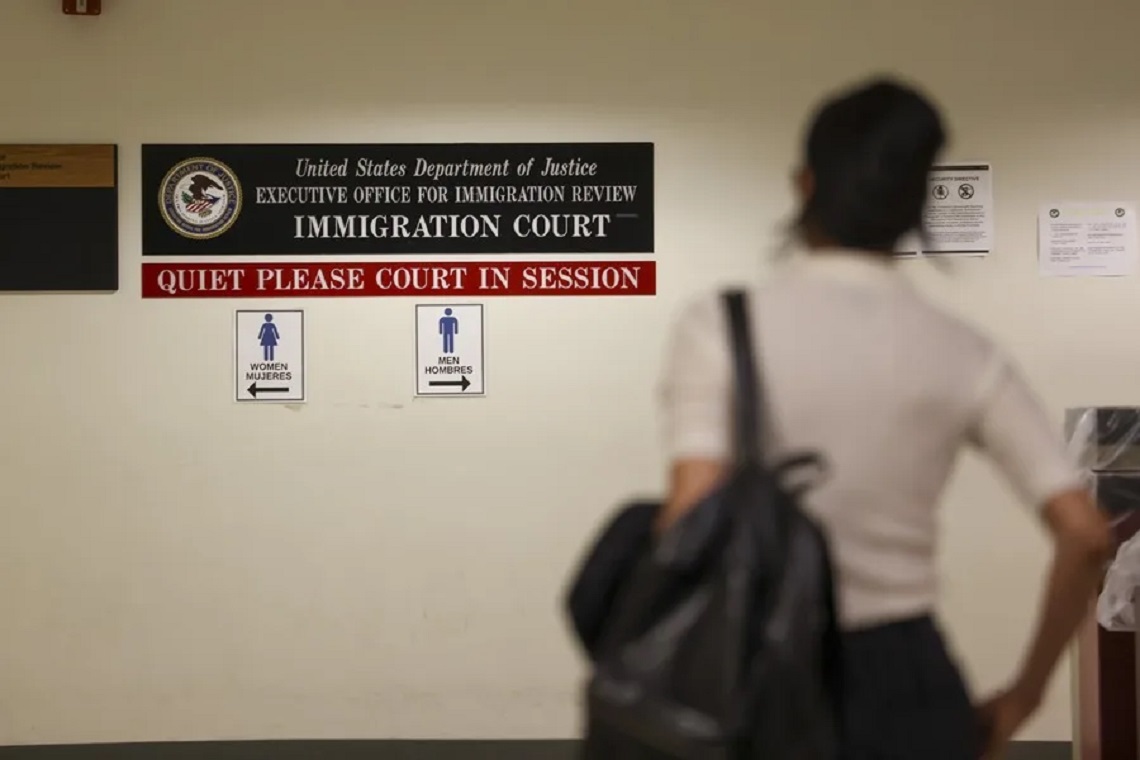
In another twist against immigration, the United States Citizenship and Immigration Service (USCIS) began applying new and high rates for key migratory procedures, marking a hardening in the immigration policy promoted from the Trump administration.
These measures, approved by Congress in Law HR-1, significantly raise costs for those who request asylum, work permits, temporary protection status (TPS) and humanitarian benefits such as special youth status (SIJ), and eliminate any possibility of exemption or reduction by socio-economic conditions.
The official implementation, announced by a notice in the Federal Registry, adds to the current rates and govern for applications submitted with Matasellos from July 22, 2025, with the warning that any procedure submitted since August 21 without the payment of the new installments will be automatically rejected.
This strict norm especially affects Cuban, Venezuelan and Latin American communities in general, which now face a substantial cost that limits their access to migratory legal processes.
New amounts that trigger the cost of legal migration
The rates imposed by Law HR-1 are a considerable increase in the forms most used by immigrants with direct impacts on their ability to request refuge and work legally.
Some examples are revealing. The initial asylum application (form I-589) rises from 0 to 100 USD; The annual rate for pending asylum applications is now 100 USD for each calendar year that lasts the processing, and the initial work permit (I-765) is increased from 410 USD to 960 USD. A spectacular up 550 Usd.
On the other hand, the renewal of the work permit rises from $ 410 to $ 685 (with a 275 USD rise); The TPS application (I-821) of a total cost of 135 USD rises to USD 665 (with additional USD 500).
Meanwhile, the special youth status (I-360): previously free, now with a cost of USD 250.
In addition, an extra mandatory collection is incorporated by biometric services of 30 USD when applicable.
The accumulation of these positions, which do not allow exemptions for low income or humanitarian situations, represents a significant economic barrier for those who seek to regularize their immigration situation or access basic protections.
https://www.youtube.com/watch?v=gmodrswlfa
Reduction of the validity of permits and hardening conditions
Beyond the rates, Law HR-1 has also established modifications in the duration of certain work permits.
Varole beneficiaries (humanitarian probation) and TPS will now receive employment authorizations with a maximum unlimited validity of one year or for the period that lasts their status. In any case, it will be what happens first.
This limitation forces frequent renovations, which increases costs and generates uncertainty and difficulties for workers.
Such an measure is added to the “hard hand” policy in immigration matters that has characterized the government of President Donald Trump and consolidates a restrictive scenario of access and legal permanence for thousands of migrants.
Who suffers from these increases?
The new rates affect a broad spectrum of immigrants, including applicants or beneficiaries pending political asylum; who process or renew work permits under various categories; Immigrants under the status of temporary protection, mainly from countries affected by natural conflicts or disasters.
Likewise, the receptors of humanitarian parole programs and the young applicants of the Special Youth Immigrant (SIJ) are victims.
There are no exemptions for these new rates imposed directly by Congress, which threatens the previous mechanisms of relief or subsidy in cases of vulnerability.
Such scenario has generated strong criticism for organizations defending the rights of immigrants, which ensure that these financial charges further hinder access to justice and protection.
This adjustment is the culmination of a legislative package known as HR-1, signed by Donald Trump in July 2025, under the name “One Big, Beautiful Bill Act”.
The authorities have justified the increases as a necessary mechanism to cover the growing processing costs and guarantee the sustainability of the migratory system.
However, their critics argue that the real objective is to discourage asylum requests and complicate the legal stay of immigrants, especially in a context where immigration policies are one of the most polarized and sensitive issues in national politics.
The Congress Budget Office (CBO) estimates that these rates could reduce the federal deficit by almost 29 billion dollars in the next decade, a figure that highlights the financial dimension of the reform.
For their part, specialists warn that the social cost can be high, especially for vulnerable communities that already face precariousness.
More costs in the non -immigrant visa
These rates are added to new rates for non -immigrant visas, which will affect all foreigners entering the United States temporarily, such as tourists, students or temporary workers, with an additional charge of at least 250 dollars per visa issued.
Rates, otherwise, do not admit returns for those who do not use the visa or exemptions for low resources, which further increases the economic weight for visitors and immigrants.
The emergency application to the Supreme Court and the Parole Program
Reactions and perspectives
The American Immigration Council (AIC) denounced in a statement that “these high rates block access to services that are fundamental for the protection and legality of thousands of people.”
The organization warns that for many immigrants the total cost can easily exceed one thousand dollars, excluding them from the possibility of carrying out legal procedures.
For particularly affected communities, such as Cuban and Venezuelan, already beaten by humanitarian and economic crises, these new costs translate into substantial limitations to seek protection and continue their processes in the United States.
Immigration specialized lawyer María Castro warned that these rates “strangle the financial and access possibilities of migrants, making regularization and legal employment difficult.”
In addition, the fact that rates increase while asylum processes extend indefinitely unsolved, generates a financial burden that can force many to give up or resort to irregular mechanisms.