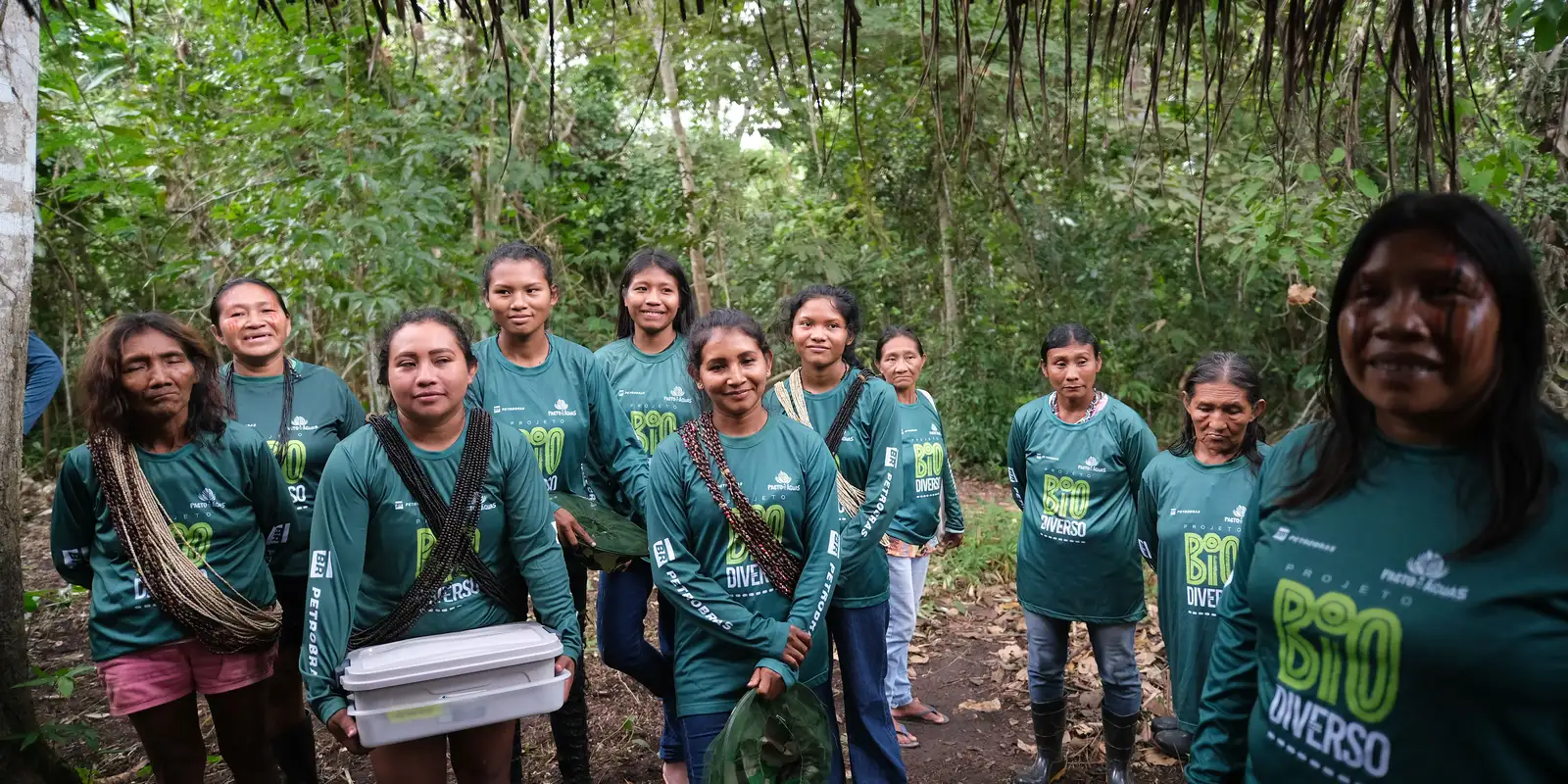
In Indigenous Land (IT) Erikpatsa, in the northwest of the state of Mato Grosso, Neiriane Taerik, 25, is the first woman’s president of the Indigenous Association of the Red Barranco Village (Asibv). It is she who is ahead, in the village, of the Brazil nut processing project, which takes income mainly to women in the community.
Castanheira is an abundant tree in the Amazon, and the Brazil nut is within a kind of coconut, called hedgehog. The community used to market the hedgehog and received little for it. Trade partnerships and social and environmental projects made it possible for the indigenous people to benefit, that is, the removal of the nuts and their sale, already without shell, ready for consumption. This added value to the product that leaves the villages and increased the gains.
“It’s generating income,” says Neiriane Taerik. “Women stay at home, depending on everything, taking care of their children. That’s why this idea came to put them to work and have their own resources,” he says.
In all, 16 women work in the processing of nuts. A shed was installed in the village with machines for the removal of the oilseed peel. And there is a queue of stakeholders to participate.
In one year, between 2024 and 2025, Asibv, which covers 12 villages, sold to the 2,500 pounds (kg), R $ 10 per kg, raising R $ 25,000 for the communities. The data are from the Biodiverse Project, which operates in the region and supports the chestnut production chain.
The Biodiverse Project offers protection equipment for chestnut collection and processing and this year will reform the shed where the product is made, placing air conditioning and installing toilets. With the expansion of the shed, the expectation is that all interested women can participate in the project.
Marinalva Kidy is the mother of Neiriane Taerik is already one of the members. “Before breaking nuts, we worked with handicrafts and collected nuts in the bush. Then this partnership came up, and we came here to the shed,” he says. “Since then, the financial part has improved a lot. You can pay the store bills, the debts, the energy, everything,” he says.
>>> Know more about the struggle of the Rikbaktsa people:
Income alternative
In the indigenous territory, surrounded by farms and disputed by loggers and mining, the activity arises as a way to keep indigenous people on earth and give financial return without having to leave the villages.
If the beneficiation is up to women, the collection and breach of the hedgehog is done by the whole family. Dauri Tsoimy, 48, is one of those who perform this activity.
“Today we are starting a mini factory within our IT. What we want is more expansion, and that within our community has a job to always be able to employ our people, without leaving our communities to go to work on the farm or elsewhere. This is very important for us to enjoy the wealth we have and what nature gives us,” he says.
Ermison Bybyimo, 38, works along with Dauri Tsoimy and explains that chestnut is part of Rikbaktsa culture. “We take care of the forest, the Castanheira. This food is what we use in breakfast, lunch. We prepare our traditional foods too, at traditional parties. It is one of the foods that are present in our daily lives. So we take care of the chestnut. From a young age, we are already careful to pass this knowledge to the children,” he says.
He stresses that, from the activity that is already traditionally practiced, it is now possible to withdraw livelihoods. “We have a lot of oppression of the loggers, the mining. And today, in our territory, we are no longer having the fish than for 20 years. So, this is our concern. And we are very concerned about the young people who are going out, for not having a job inside the village,” he says.
Unrivaled
According to biodiverse project, the idea is that indigenous people can guarantee income without middlemen, receiving all payment for the product produced. Along with production, the project also works in environmental education, in reinforcement and rescue of care with nature, showing that The forest standing is worth a lot and brings money to the community.
According to Biodiverse coordinator Sávio Gomes, the projects have generated changes. “Young people no longer go to the farms to work on employees, they own the community projects themselves. The tendency is for them to have a greater attractiveness in their territory,” he says.
Sávio Gomes knows closely the reality of the territories. In addition to having lived there for over a year with the indigenous people, he himself was born in the Extractive Reserve (Resex) Lago do Capanã Grande, in Amazonas, and, until 17, worked with the breaking of the nut. “One day I was breaking chestnut, I broke a kneeling nut, and a hedgehog of chestnut fell here, close to my head. Then I said: ‘This story is over, I’m after study, I go after something else,'” he says.
He graduated Forest Technician from the Federal Institute of Science and Technology of Amazonas and Environmental Manager from Estácio de Sá University. And with what you have learned, it seeks as coordinator of the biodiverse transforming this reality. Sávio Gomes says he always questioned the logic of extractive reserves. He felt as if, when they were created, people there were abandoned to their own, often without structure or without income generation contacts, something necessary to live in a capitalist world. One of the concerns he had was that people always said he had a lot of wealth at Resex, but he didn’t see this wealth.
“There is nature, there is all this here. But what do we do with all this wealth? What do I am rich and I am poor at the same time?” He asks.
“Within these communities, there are people, people who need health, need school, education, income generation,” he argues, who states that the intention of the biodiverse project is precisely to enable these contacts and provide improvements in the quality of life of indigenous and extractive peoples.
In addition to Ti Erikpatsa, the Biodiverse project, sponsored by Petrobras, is developed in the Tis Japuíra and hidden, from the Rikbaktsa people; Ti Aripuanã; Ti River Branco and Resex Guariba Roosevelt. Together, they produced 34.4 tons of nuts last year, generating R $ 366,750 to the communities.
Environmental Education
In addition to the beneficiation, another action of the Biodiverse project aimed at women is honey production. The project began to be implemented in the Pé de Mutum village, in Ti Japuíra, from the demand of the community itself. The action is part of an environmental education project, which seeks to understand the relationship with nature and develop sustainable forms of income and subsistence.
Honey is used to sweeten chicha, a fermented drink produced from potato, corn, banana and other traditional indigenous peoples in the region. The problem is that it was getting rarer and rarer as swarms are harder to find.
One of the project members, Genilda Madair Rikbaktatsa says that the activity is not just for her, but for the whole community “I am interested in learning new things. I know that going forward will not just serve me, it will serve other people, especially for our children who are coming now,” he says.
Biodiverse project
The biodiverse project is developed by the Civil Society Organization of Public Interest (OSCIP) Pact of Water and aims to promote the sustainable use of sociobiodiversity, with indigenous peoples and traditional communities in the northwest of the state of Mato Grosso, as a strategy to mitigate global warming and climate change by the defense of forest conservation standing. The project is sponsored by Petrobras.
Chestnut and environmental education are some of the actions developed under the project, which aims to support 300 extractivists in the production of 800 tons of chestnut, 90 tons of rubber and 15 tons of copaiba oil with good standard production practices and periodic technical assistance, by 2027.
At the invitation of Petrobras, the Brazil team visited the Village Red and Beira Rio villages, at TI Erikpatsa and Pé de Mutum, Ti Japuíra, on April 8 and 9.
*Agência Brasil team traveled at the invitation of Petrobras, sponsor of the Biodiverse Project