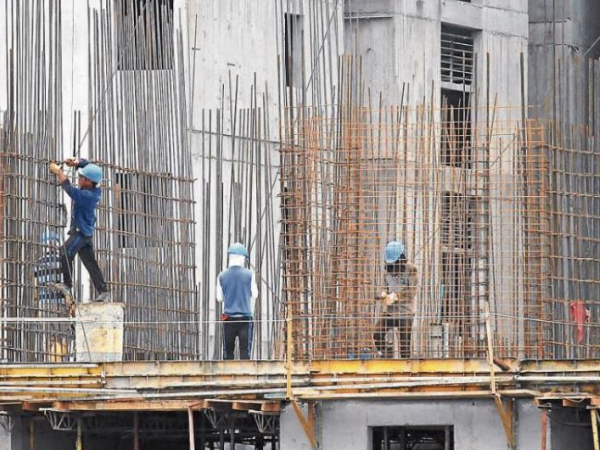
The Colombian economy advances in its recovery, and the construction sector begins to show clear reactivation signs. Although residential buildings still have lags, The non -residence segmentl – composed of commercial, industrial and public infrastructure projects – He is gaining prominence as an investment engine and economic dynamism.
You can see: Easy is contemplating a medium -term expansion plan
According to the Colombia Situation Report – March 2025 of BBVA Research, SE projects that investment in civil works and non -residential buildings will grow by 7.1% in 2025 and 7.4% in 2026promoted by greater productive and commercial activity that will increase the demand for physical spaces for companies, industries and logistics services.
“This acceleration of the non -residential segment reflects the country’s need to adapt its infrastructure to new ways of producing, working and consuming. Digitization, industrial expansion and electronic commerce are redefining the spaces required by the private sector. It is an opportunity to modernize the way we design and build”said Patricio Zapata, Customer Success Manager Latam de Graphisoft.
This growth reaches an environment of more favorable conditions for investment. According to BBVA Research, a gradual reduction is projected in the monetary policy interest rate, from 9.5% to 7.75% in 2025. This will reduce the cost of capital and facilitate access to financing for new developments, especially those with robust technical planning and leveraged in digital tools.
In the medium term, the report emphasizes that Colombia needs to improve its productivity to sustain economic growth. In this context, construction technology becomes a key tool to raise the efficiency of the capital invested. The use of BIM, energy modeling, work simulations and collaborative platforms allows to develop modern, adaptable and aligned infrastructure with the new global standards.
See also: Safe Decenal advances towards a 100% coverage in Colombia with 1,030 municipalities
Construction
Óscar Berrocal / Portafolio
“The implementation of tools such as BIM or intelligent constructive management systems not only reduce times and cost overrun Zapata added.
The BBVA Research document emphasizes that, given a growing demand for logistics spaces, industrial centers, offices adapted to hybrid work and public buildings with high standards of efficiency, Companies in the construction sector are adopting new planning and execution models.
The adoption of these technologies, together with the industrialization of processes and the digitalization of procedures, can further enhance the recovery of the sector and guarantee a more efficient structural growth. In addition, it promotes the competitiveness of Colombian construction companies in the face of an increasingly demanding market in productivity, traceability and sustainability.
Modernization in works planning also responds to the need to comply with new regulations for energy efficiency and sustainability. In this sense, The use of digital simulations to anticipate thermal behaviors, lighting needs or energy consumption is gaining prominence.
“Data -based design systems and simulations allow to anticipate design failures, make real -time settings and reduce the environmental footprint from the conceptual phase of the project,” Zapata pointed out.
The digital transformation of the sector is also impacting administrative and management processes. Collaborative platforms allow a more fluid interaction between architects, engineers, contractors and customers, reducing errors due to lack of communication and improving execution times.
It may interest you: The power and housing construction engine

Construction.
EFE
The report also indicates that, together with the investment in machinery and equipment, the non -residential construction will be one of the main engines of fixed investment in Colombia over the next two years. The articulation between public and private sector, as well as the technological adoption capacity of the construction companies, will be key to consolidating this new growth cycle.
The commitment to works with higher levels of technification is also reflected in bidding processes. The requirement of BIM models in public projects begins to be a constant, encouraging construction firms to train and update their technological infrastructure.
“The challenge is how this potential translates into viable, sustainable and aligned projects with the needs of the market. For that, technological integration is a basic condition,” Zapata pointed out.
Colombia is, according to the report, in a transition stage that can be used to reposition the construction sector as a pillar of competitiveness and economic modernization. With an environment of more favorable rates, new infrastructure demands and available digital tools, the non -residential segment appears as one of the main growth bets for the coming years.
Paula Galeano Balaguera
Portfolio journalist