This April 13, the 23rd anniversary of the National Dignity Day is commemorated, a moment that marked the history of Venezuela through the Civic-Military Union that managed to defeat the media coup against President Hugo Chávez in 2002. This date not only symbolizes the struggle for national sovereignty, but also highlights the resilience of a people who rose to preserve their democracy and claim their democracy and claim their democracy and claim their democracy rights.
Media manipulation and coup d’etat
On April 13, 2002, Venezuela lived a crucial chapter in its history. Media manipulation, orchestrated by opposition sectors and backed by the US government, sought to destabilize a legitimate government led by President Hugo Chávez, who had initiated a transformative process since his arrival at the presidency in 1998.
The crescendo pressure culminated on April 11, when television channels became instruments of misinformation, openly advocating the overthrow of Commander Chávez.

This was stated by President Chávez, during a speech in Turiamo, he said: “They offered me to leave, but I did not leave. I am not a man of resignations; I am a man of struggle” (April 12, 2002). Instead of giving in to coercion, Chavez represented a firm defense of the popular mandate he received in December 1998.
The power of the people and the patriotic force
On April 13 it was not only a day of claim for the eternal commander Hugo Chávez, but also a testament of the power of a united people.
“The people are dry leather, if you step on it, on the one hand, on the other it rises,” recites a verse from the first Ali that immortalizes the fervor and tenacity of Venezuelans. That day, thousands of citizens gathered in the streets, crying out “we want Chávez”, while the actors of the right-wing and traitorous military coup- they rushed to leave the Palace of Miraflores.

When rescuing President Chávez and returned to Miraflores, on April 13 he reaffirmed the link between the leader and his people, a link that began to be built years ago with the uprising of February 4, 1992. This peaceful resistance planted the seeds of a revolution that sought more than simple political stability: it yearned for social inclusion and the recovery of national sovereignty.
The lesson of April 13: sovereignty and self -determination
This historic day challenged those who wanted to silence the voices of millions, and also symbolized an act of self -determination.
The day when the leader of the Bolivarian Revolution, Hugo Chávez, returned to the Miraflores Palace, the then president of the National Assembly, William Lara, announced to the world: “The mandate of the people does not break”, highlighting the importance of respecting the constitution and democracy in the country.

President Chávez, when assuming his position again, addressed a message to the nation: “The people arrived in Miraflores to never leave,” proclaiming an irrefutable commitment to the will of the people and the defense of national sovereignty.
Under the lens of truth
To commemorate this date, we talked with two protagonists of these events in the communication world.
In an exclusive interview with the presidential press, Ernesto Morgado, an outstanding Venezuelan photographer, and Wendys Olivo, a photojournalist, shared his experience and vision of the events that marked the history of the country in April 2002. And clearly remembered the most moving and decisive moments he recorded through his lens.
Through his camera, Ernesto Morgado captured crucial moments of the coup d’etat and the vibrant return of Commander Chávez, offering a visual testimony that goes beyond the simple image, revealing the mobilization of the Venezuelan people and their resistance to adversities.
Witnesses of the town: Talking about the message that their images convey with respect to the civic-military mobilization, Morgado said: “The vast majority of the Venezuelan people are united to defend our territory of any empire and its lackeys sells homeland, and they did not let us snatch the country from any foreign force.” This powerful testimony highlights the determination of the people in times of attacks and defense.

Media influence: how private media impacted the international perception of conflict, the photographer said: «The performance of private media was to silence what was happening, inventing false news against the revolution and creating a climate of tension inside and outside our country. The alternative media, on the contrary, reported precisely, using videos, graphics and radio, which reached all corners of our country. »
His analysis highlighted the need for a truthful and accessible narrative thanks to alternative communication.
Emotional moments: Remembering on April, Morgado shared a moving image: “On April 13, the Venezuelan people took all the streets and the Miraflores palace, facing the onslaught of the empire, and who commands here is the town.” These words evoke the strength and hope of the people in an era of agitation.

Evolution in the struggle: finally, by reflecting on the contemporary struggle of the Venezuelan people, Morgado indicated: «Every day I see more united to the people struggling for their freedom, against economic war, attempts at coups and terrorism. Something that is very important are the communes, where you fight from the inside out for a good living of all these community members.
Thanks to Commander Chávez and President Nicolás Maduro, the communes have consolidated. »
The power of memory in photography
In the context of the anniversary of the 2002 coup d’etat in Venezuela, the photojournalist Wendys Olivo Navarro evoked the emotions and risks he faced, as well as his commitment to the truth and his people.
Moments that mark
The journalist begins the conversation by asking Olivo: “What are the most shocking moments that have been recorded in his memory of those days, and what motivated them to capture them through their lens?”

She replied: «It is a very deep question. 23 years after the coup in Venezuela, there are memories that are never erased. Sometimes, when I review everything lived, I feel that tears invade me and I can’t contain them. One of those moments was the situation on Avenida Baralt, where we lost lives in the midst of an imminent risk due to the snipes of the snipers and the intervention of the metropolitan police. I also remember Muñoz’s corner, when the police arrested me and I didn’t know what to do; Fortunately, I managed to escape. “
The capture of reality
Wendys recalled: «That day, they ordered the search of the agency where we worked, but we had already sent the photographic sequence that showed the police, armed and with gloves, shooting the Venezuelan people. These images were transmitted to the media and international agencies just when we were reorganizing our lives. “

All 11 has its 13
The photojournalist reviewed a moment that he can never forget during his exercise as a photographic on April 11 and 12. «I remember that the next day Colonel Pernía Guillén arrived at the news agency where he worked and treated us as criminals, signing up with 9 mm weapons and placing us against the wall. I will not forget that moment. But on the 13th it was a day of crying, but of joy, seeing how the constitutional thread in Venezuela was restored with the rescue of President Hugo Chávez. The people knew it, and that’s why he got out of the hills. Although we were unarmed and without cameras, we were part of that town that cried out for Chávez’s return. “
THE VOICE OF THE PEOPLE
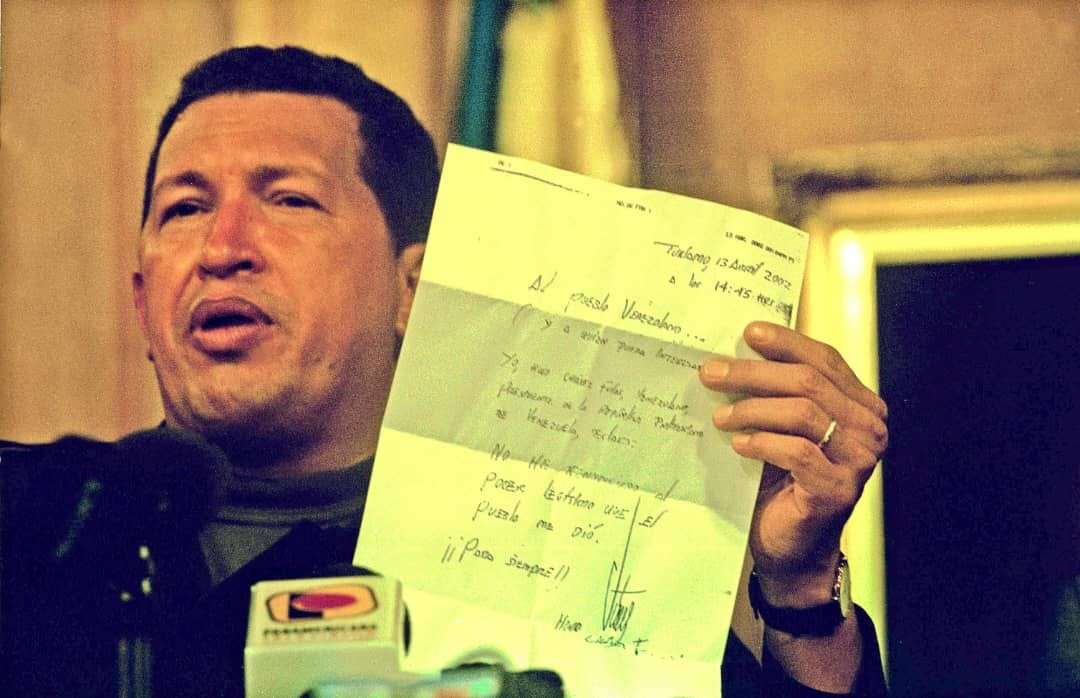
To conclude, Olivo Navarro emphasized the importance of alternative media in those difficult times: «Grateful, the alternative media also did a remarkable job in carrying the voice of the people. That cry of the Venezuelan people managed to resume the constitutional thread and reaffirm the mandate of the elected president. Seeing the letter written by Chavez, where he claimed that he had not renounced the power his people awarded, it was a moment of victory and tears of joy. The town of Bolívar, victorious, took to the streets with its president Hugo Chávez Frías. »

Dignity and resistance
23 years after this vital episode in the history of Venezuela, the day of national dignity continues to live in collective memory. The struggle for sovereignty and defense of the people’s right to choose their destiny are principles that endure.
This anniversary invites reflection on the role of the people in the construction of their future and the way to true independence of imperialist domain. Venezuela stands, remembering that dignity and sovereignty are inalienable rights, held every April 13.
Instead of giving in to coercion, Hugo Chávez represented a firm defense of the popular mandate he received in December 1998.
PRESIDENTIAL PRESS/ LUIS TAVERA