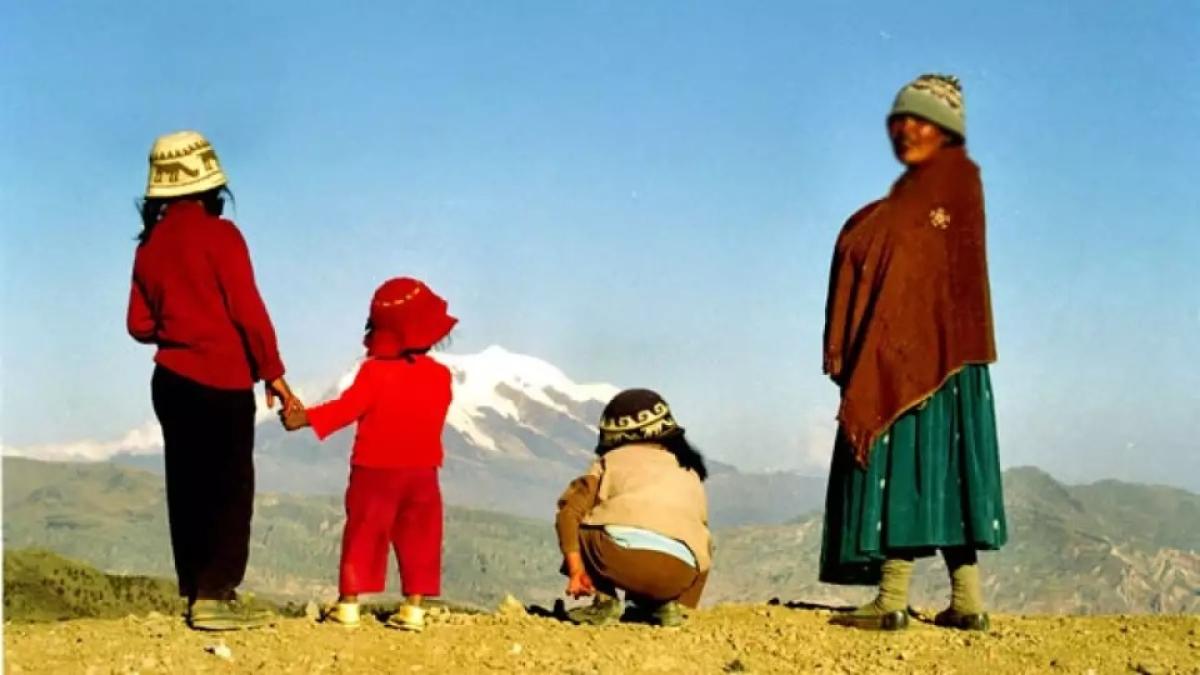
In Plan 3,000, a nine -year -old girl accommodates at the edge of a cement gardener, in front of her brick house. His mother works as an employee in a house in the center and her dad migrated to Chile, but she is not going as expected. Daily, she and her two little brothers walk ten blocks towards her school. They go and come back alone. “What I want most is learning to read well,” he says in a low tone and with a shy smile. Its history, although hard, is that of millions of children in Santa Cruz and in Bolivia, who carry responsibilities that do not touch them and that dream, despite everything, with continuing to study.
In Bolivia, 47% of children live in poverty and most of them are out of the political debate because they do not vote.
In a country that prepares to celebrate its bicentennial and key elections in 2025, UNICEF has launched a clear warning: the urgent agenda is with childhood. Not including 4 million children and adolescents – 38% of the population – in government plans, is mortgage the future of the country.
Child poverty: a structural debt
The data is devastating: one in two children in Bolivia lives in poverty and one in six in extreme poverty. But behind the number there is a cycle that is perpetuated. “The experience of living in poverty during childhood is deeper and more harmful than in adulthood. Mark all future development,” says UNICEF in its most recent report.
The effects are multiple: school dropout, malnutrition, child labor and, in many cases, intergenerational poverty reproduction. Bolivia invests 8.7% of GDP in childhood, but resources are usually diluted in fragmented and little effective systems. From UNICEF social budgets are requested to prevent tax cuts from hitting the most vulnerable.
Education without understanding: silent failure
Although the country has advanced in educational coverage – 86% of children access school – quality remains its greatest debt. According to data from the Plurinational Observatory of Educational Quality, 7 out of 10 third grade students and 8 out of 10 of sixth grade do not understand what they read. In mathematics, the results are still worse.
The gap between urban and rural schools is brutal. While in some urban areas there is talk of robotics and programming, in communities of the Altiplano or the Amazon children barely have desks. “Bolivia invests a lot in education (7.8% of GDP), but there are no clear results. The system needs urgent modernization,” said UNICEF Chief of Policies, Diego Pimentel.
Malnourished and overweight children: the food paradox
Child malnutrition in Bolivia is dual and contradictory. While 16% of children under five suffer chronic malnutrition, another 10% has overweight or obesity. To this is added an alarming fact: more than half of children under five have anemia.
The school breakfast, although universal, does not always meet the nutritional standards. “The menus are usually repetitive, not very nutritious and without supervision,” reveals a U-Report consultation. The lack of food regulation and poor nutritional education affect both rural and urban areas.
Invisible victims of violence
In 2024, 6,868 cases of sexual violence against girls, boys and adolescents, 84 femicides and 38 infanticides were reported. Behind those figures, there are stories of children who lose their mothers, while their parents end up in jail. It is a double orphanhood that remains silenced.
According to Virginia Pérez, a protection specialist at UNICEF Bolivia, “the country needs a more robust protection system, which prioritizes comprehensive care for children affected by violence, from the moment of the complaint until their full restitution of rights. Today, the defenders work with insufficient personnel, temporary contracts and low inter -institutional articulation, which limits real access to justice and reparation.”
The U-Report National Survey also reveals that 4 out of 10 adolescents do not feel safe even in their schools, and 2 out of 10 or in their own homes, which shows how extended the sensation of lack of protection is.
An urgent call to politics and citizenship
In the midst of electoral promises focused on macroeconomy or security, childhood remains invisible in the candidate’s agenda. “Historically it has not been included because it does not vote. But if you do not invest in them today, there will be no country that holds its development tomorrow,” says Gregor von Medeazza, Unicef’s deputy representative in Bolivia.
The organization asks that candidates assume concrete commitments: consolidate a childhood sensitive social protection system, modernize education, improve primary health and prevent all forms of violence.
Bolivia faces a crossroads: continue to postpone or build, with intergenerational vision, a more just and sustainable society. Because if you don’t hear those who have no voice, everyone’s future is condemned.
“Childhood does not vote, but it is the only one that can transform the country,” concludes the message of UNICEF. Who will dare to listen to her?