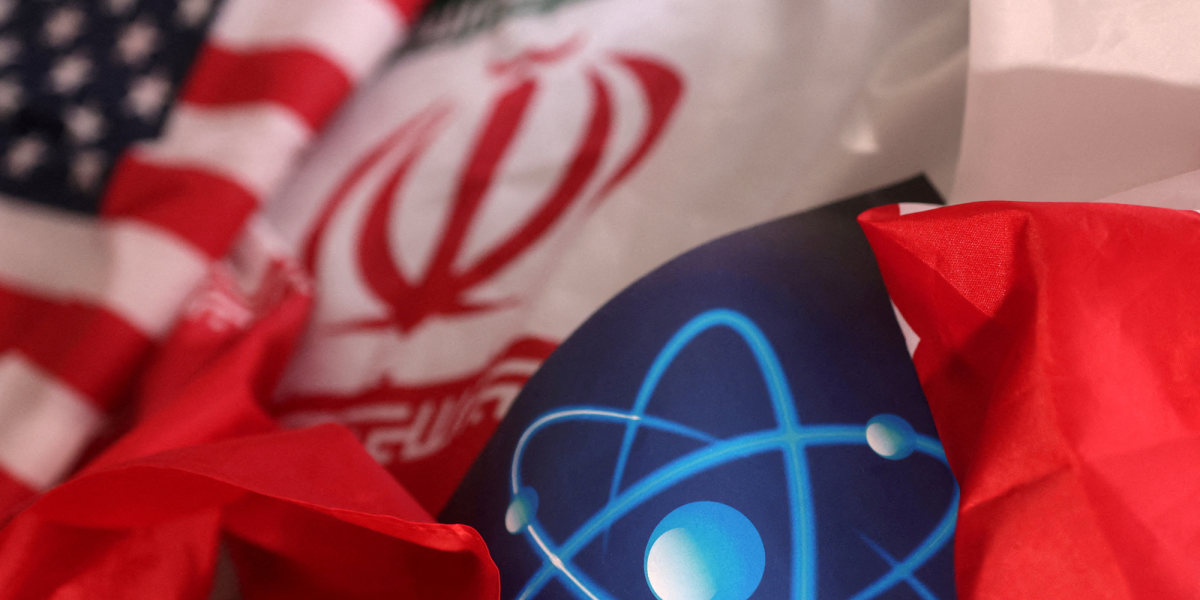
Iran He affirmed this Friday to seek a “real and fair” agreement with the United States in negotiations on their nuclear program that begin on Saturday with the mediation of Oman.
Conversations in Oman seek to negotiate a new agreement on the Iranian nuclear programdespite the growing pressure of US President Donald Trump who threatens to resort to the military road if dialogue fails.
“Far from setting up a show and just talking to the cameras, Tehran seeks a real and fair agreement, the important and applicable proposals are ready,” said Ali Shamjani, a high -level counselor of the supreme leader, Ayatolá Ali Jamenei.
The previous agreement, concluded in 2015 between Iran and the great powers, committed Tehran to limit its nuclear program for civil purposes, in exchange for the lifting of financial sanctions.
The United States announced in 2018 its withdrawal from the international agreement, unilaterally, during Trump’s first government and imposed hard sanctions against Iran again.
In response, Iran began to separate his commitments.
Shamjani confirmed that the Iranian Minister of Foreign Affairs, Abás Araqchi will travel to Oman for “indirect negotiations with the United States” and added that if Washington shows good will, the process will be “easy.”
Oman will exercise as a mediator in the negotiations, in which the United States will be represented by the emissary for the Middle East, Steve Witkoff.
In an interview with the newspaper The Wall Street JournalWitkoff released the following message to the Iranians: “Our position begins with the dismantling of its program.”
“That does not mean, by the way, we will not find other ways to find a commitment between the two countries,” he added.
Some negotiations under threats
There is no clarity about the format of conversations, since Iran rejects a direct dialogue and the United States insists on this point.
“These will be direct conversations with the Iranians, and I want to make that very clear,” Karoline Leavitt, a White House spokesman, told reporters.
“The president believes in diplomacy, in direct conversations, speaking directly in the same room.”
According to the Iranian news agency Tasnim, the delegations will arrive in Oman on Saturday and will begin indirect negotiations in the afternoon, with the mediation of the head of the Omaní diplomacy, Badr al Busaidi.
Iranian Foreign Ministry spokesman Esmail Baqai said Friday that his country is “giving a real opportunity to diplomacy, in good faith and with total surveillance.”
“The United States should appreciate this decision, which has been taken despite its hostile rhetoric,” Baqai said.
These negotiations take place after weeks of verbal clashes between the two countries, which do not have Diplomatic relations for 45 years.
Trump reiterated on Wednesday that a military action against Iran is possible, if there is no agreement on the nuclear program.
Iran warned Thursday that “persistent threats” can lead to deterrent measures, such as the expulsion of inspectors from the inspectors International Atomic Energy Agency (Oiea) that supervises the nuclear program.
The State Department responded by warning that expelling inspectors from the UN agency “would be an escalation” and “a calculation error.”
Iran suffered several setbacks in recent months, due to successive blows by Israel to his allies, Hamas in the Gaza and Hezbollah Strip In Lebanon.
This entailed reciprocal military attacks between Israel and Iran, an escalation after years of indirect confrontation through third parties.
The Western powers, led by the United States, have suspected for decades that Iran wants to endow nuclear weapons. Tehran rejects the accusations and states that its program is limited to civil purposes.