The Colombian government He launched The zero hunger program. The objective is to facilitate access to healthy foods of the population that is in a situation of poverty and extreme poverty. In this context, social prosperity specified Who will receive aid in this relaunch of the initiative.
Although it was not officially delimited, which population in particular will receive the assistance of the zero hunger strategy, Social prosperity He informed that families in poverty or extreme poverty will be beneficiariesin particular those that live in marginalized and excluded territories.
The implementation of this national impact program began in Cartagena and 12 municipalities of Bolívar, to gradually advance in the regions most affected by hunger, including La Guajira, Chocó, Vichada, Nariño, Cauca, Los Montes de María, Catatumbo, Amazonas, the Ariari region, the Paramillo knot; and capital cities such as Cartagena, Medellín, Bogotá, Cali, Buenaventura, Cúcuta, Popayán and Quibdó.
In a first stage, the initiative It will reach 142,459 households distributed in 89 municipalities from 12 different departments of Colombia, distributed as follows:
• 25,000 homes in northern Santander
• 35,150 households in Chocó, 23,250 in Nariño
• 11,944 households in Bogotá DC
• 3,575 households in Amazonas
• 518 households in Caquetá
• 6,400 homes in Cauca
• 7,000 homes in Cesar
• 3,678 households in Guainía
• 17,000 homes in Magdalena
• 3,294 households in Vaupés
• 5,650 homes in Vichada
(Read more: How and where to collect free TransMilenio tickets in April 2025?)
Zero hunger
Source: Social Prosperity – Official Facebook
What is the goal of zero hunger?
In charge of the Department for Social Prosperity, The new initiative is complementary and independent of current programs and subsidies, It is proposed to mitigate inequality and progressively guarantee the human right to adequate food of the entire population.
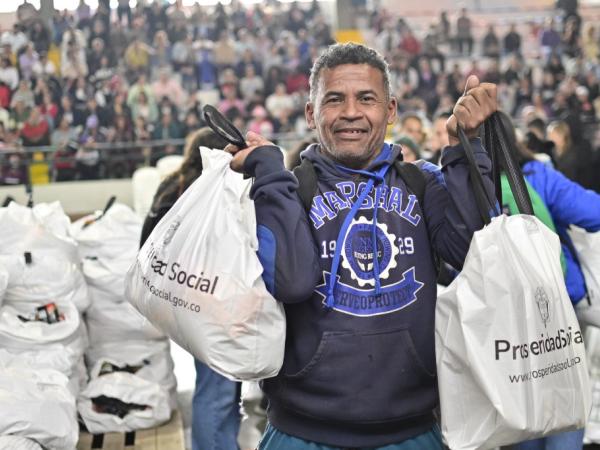
The director of Social Prosperity, Gustavo Bolívar, headed this month the first delivery of food packages in the town of Bosa (Bogotá), where he stressed that since the national government assumed 1.6 million people have left poverty, of which more than 1.1 million left extreme poverty.
(Read more: Colombian regions where ‘more than normal’ will rain ‘in 2025, according to Ideam)
How will food delivery be done?
Bolívar said that The zero hunger strategy aims to specify, in the short term, the delivery of food in more than 142 thousand markets in 89 municipalities in 12 departmentsin addition to contributing to medium term self -consumption units for 189 thousand families, to which seeds, tools and animals will be delivered to produce their own foods.
At the moment, food delivery will be given as follows:
1. The delivery of food packages.
2. Delivery of bonds exchanging for food.
3. SUPPLY OF RATION OF PREPARED FOODS.
4. Strengthening of market units.
In the long -term views, the initiative provides for the construction of 150 cookers and community canteens in the poorest areas of the country, as well as the granting of subsidized credits to cooperatives of the popular economy.