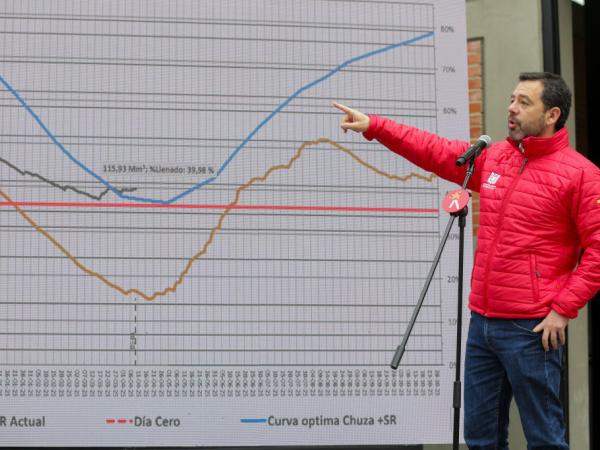
The Mayor of Bogotá, Carlos Fernando Galán, reported Friday that since Saturday April 12 The water rationing measure is raised in Bogotástarting at 8:00 am
(Read: The 4×1.000: the ‘curiosities’ of this tax that perhaps did not know).
“The rationing ends. Bogotá has overcome the most serious water crisis in its history. Thanks to the technical decisions and work of the operators of the Bogotá aqueduct, the collaboration and sacrifice of citizenship, and the long -term measures that we have taken as a district, from tomorrow the ration of water in the city is raised”Said Mayor Galán on Friday, at a press conference in which the balance was presented, at the time of the measure.
The rationing ends.
Bogotá has overcome the most serious water crisis in its history.
Thanks to the technical decisions and work of the operators of the @Acueductobogotathe collaboration and sacrifice of citizenship, and the long -term measures that we have taken as … pic.twitter.com/5phxbkglnm– Carlos F. Galán (@carlosfgalan) April 11, 2025
“After a year we can announce that tomorrow, at 8 am, the rationing of water in Bogotá ends. It has been one of the most complex crises that the city has faced in terms of water shortage,” The district president added.
Exactly one year ago, on April 11, 2024, Mayor Galán imposed the measure of making water cuts in the country’s capital.
(Here: Proven gas reserves in 2024 may not have exceeded 6 years).
Nearby municipalities like Cajicá, Chia, Cota, Funza, Gachancipá, La Calera, Madrid, Mosquera, Soacha, Sopó and Tocancipá also adopted this measuregiven the decline in reserves in the midst of a climatic situation that prevented them from rising.
During the last twelve months, This water ration was carried out every 9 days in a certain group of locations and neighborhoods, whose service suspension lasted 24 hours.
The measure was adopted due to the decrease in water in the reservoirs that feed Bogotá as a result of the El Niño phenomenon.
A year ago, these reservoirs were at very low levels. For example, the El Hato reservoir ended April 2024 by 81.7% of its total capacity. The Chingaza System (Chuza and San Rafael) ended the fourth month of last year in 16% of its total capacity and the north aggregate (Tominé, Neusa and Sisga) was at levels of 53% of its total capacity.
Keep up
According to Mayor Galán, in recent weeks the Chingaza system showed a historical recovery, thanks to the work of the aqueduct and the commitment of citizens.
The aqueduct reported that the Chingaza system, one of the main water suppliers in the capital, currently has 118 million cubic meters of stored water. This figure represents 9 million cubic meters above the guide curve, which marks a significant advance in the recovery of reservoir levels.
However, the local president called on those who live in Bogotá so as not to lower their guard and to maintain water -responsible consumption habits.
The Mayor of Bogotá, Carlos Fernando Galán, and the manager of the aqueduct, Natasha Avendaño.
Supply projections
The authorities estimate that by the end of 2024, Reservoir filling reaches 16.52%, and by 2025, 40.80%.
These data reflect institutional and community efforts to preserve water resource amid the challenges of climate change and increased consumption.
(Besides: Tax calendar 2025: These are the taxes that will overcome in April).
Natasha Avendaño, manager of the Bogotá Aqueduct, highlighted the importance of maintaining the efficient savings and use measures, despite the positive figures, to guarantee the sustainability of the service in the coming months.
“We save above 46 million cubic meters among all citizens with the mandatory reduction due to restriction, but also for the change in user behavior”Said the official.
Fight against water theft
During the presentation of the balance, the capital authorities highlighted the actions implemented to intensify the fight against the theft of water in the city.
According to these figures, 2,351 operations have been carried out for fluid fraud, through which 2,649,782 cubic meters of water were recovered, with an estimated value of more than $ 16,726 million pesos.
The actions are part of a control and surveillance strategy led by district entities, with the aim of curbing the illegal use of water resource and protecting the supply for Bogota.
The localities with the highest number of cases detected are: Teusaquillo, Kennedy, Fontibón, Puente Aranda, Engativá, Barrios Unidos, Suba and Tunjuelito.
Finally Natasha Avendaño called on citizens to denounce illegal connections and to become aware of the responsible use of water, a vital resource whose protection is everyone’s responsibility.
Portfolio