Havana.- The reading of two interesting books, “Havana for a deceased infant”, Dand Guillermo Cabrera Infanteand “Go to Havana”, by Leonardo Padura Fuentes, fueled my memories of the Capital neighborhood where I was born and in which I spent my childhood and part of adolescence.
I saw the first light, at 2:10 pm on August 19, 1947, in a small clinic called San Juan Bosco, located on Monte Street between Fernandina and Romay, in the neighborhood of Atarés. Some time later, that clinic expanded its building and was called Martínez Corpas Foundation, the divine protector, by the doctor and owner of it. The cause of this clinic was due, as my late mother told me, that a sister of her (who would later be my godmother) worked there.
Newborn led me to live in a passage, next to a quarter, in Zequeira # 61 E/ San Joaquín and Romay, in the neighborhood of El Pilar. There were 29 small apartments and 11 rooms. We occupied the number 30, the only one with an inner bath. Subsequently we move on to number 27.
There are two transcendental places for my life: my first school, the Alpízar Academy College, close to the Normal School, and of which I have indelible memories, and the other, the parish of El Pilar, governed by the priest Ismael testé, The founder of the City of Children, who was the one who baptized me and with whom I took the first communion.
Another significant point for me was “La Purísima”, in the mention of Barriada de Atarés, a kind of shelter for people who came from the countryside and had no family in Havana. It was there that my parents met: my father, who was a police officer, in one of his tours in the area, met what would be my mother, who was housed in the Purísima.
As a child I went in the company of my parents to purchases, and other functions they did for the home. This allowed me to know all the shops and places of the town.
A corner, otherwise historically famous, the corner of Texas, where four roads converge (the roads of Monte, del Cerro, Ten of October and Infanta), was visited by us on many occasions, to buy, especially Sundays, Sandwiches in the cafeteria bar of the same name, as a substitute for food. It was a full bread flute, with ham, cheese, cucumber and other ingredients, grilled toas, all by 1.50 pesos, divided into three portions, for each one, to which we added a malt, which cost 15 cents. It was so much that I could never ingest it all. Dinner came out in 65 cents per capita.
In the lateral corner was the Valentino cinema, a building that, by its design, called Bartolo’s Palomar in a burlesque way. ” In that cinema, the days during the week, watch two films, buy five salt cookies and take a soda cost 20 cents.
Behind the cinema was the crowd of Gallos, on the one hand the flower shop, and in front of the huge colonial house where the Cerro Assembly was established at the end of the War of Independence. They completed the other two parts of the quadrilateral, two cafeteria bars.
The first two blocks of Monte, from the aforementioned tile corner had hardware store, pharmacy, jewelry, coffee tostadero, dyer, tailoring, barbershop, pawns house, two bakeries, two fights, the furniture store house wicker, three bars-bodegas , the Havana Business Academy Commercial School, the Roosevelt cinema, and several small businesses.
In the rest of the mountain road, to the Four roadsthere were innumerable businesses of all kinds, including the very appointed square or unique market, the house of liquidations, several food stores, and other businesses or services through its parallel streets.
I can affirm that in a two kilometers radius, there was everything essential to acquire, and solve problems, without the need to go to the commercial areas of the center of Havana, except that it would look for something very specific.
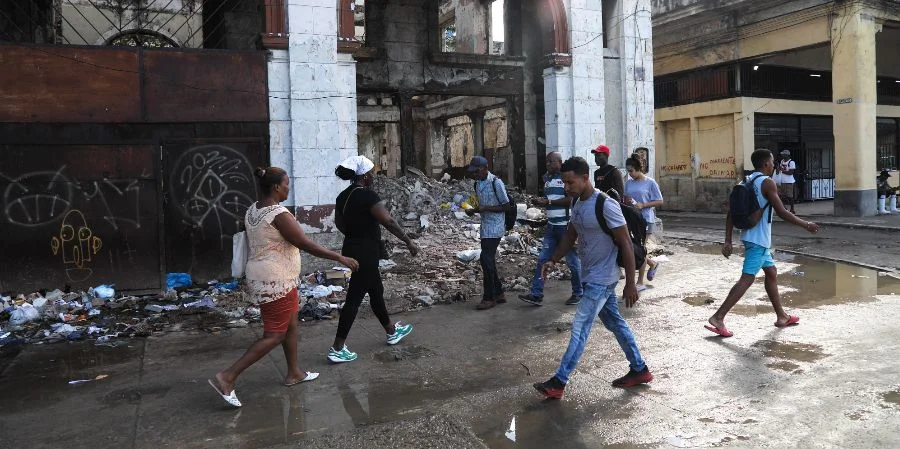
At present, every time I travel through these places, I feel a mixture of nostalgia and enormous sadness. Of all those places I met, the majority vanished. The revolution of Fidel Castrobetween 1959 and 1968, he eliminated all private businesses, were large or small. Today, the spaces occupied by those establishments are empty, or have different uses. The constructions have a high degree of destruction, with a danger of collapse. The markets and other sites are only in my memory. The only thing standing is the clinic where I was born, which now bears the name of Polyclinic Abel Santamaría.
There is a sign in the Ministry of Construction that says ironically: “Revolution is to build.” I should say: “Revolution is destroying.”













