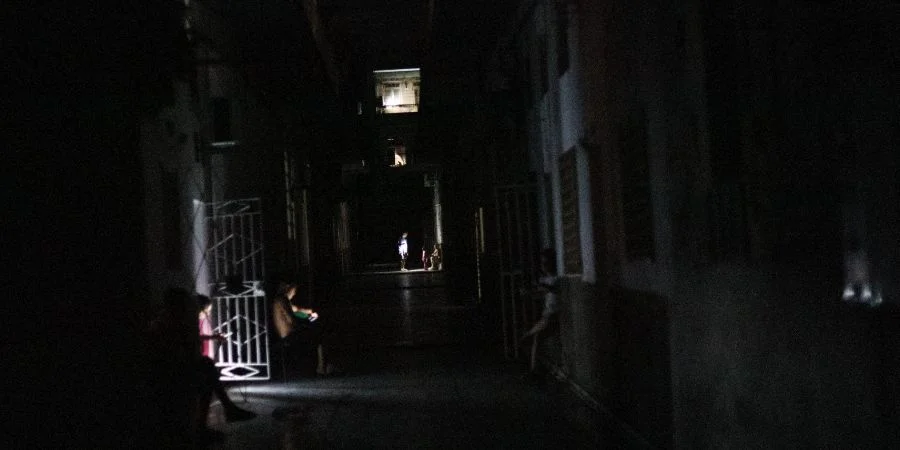
Miami, United States. – The Electric Union (UNE) of Cuba advertisement that the blackouts will simultaneously cover 52.5% of the national territory at peak (late-night) on Wednesday. The deficit will reach 1,680 megawatts (MW), a figure similar to that of the previous day, when it reached 1,709 MW.
The crisis of the National Electroenergetic System (SEN) of Cuba has intensified due to the operation output of Unit 1 of the Thermoelectric Central (CTE) Lidio Ramón Pérez, known as Felton.
Last week, UNE reported that unit 1 of Felton It presented a breakdown in the generator cooling system: specifically an internal leakage that represents a high risk for continuous functioning was detected. Therefore, a mandatory intervention is required that implies cooling the turbine for seven days before proceeding to the disarmament of the generator’s housing and locating the failure for its solution. It is estimated that the unit will be out of service for approximately 20 days.
This situation aggravates the already difficult conditions of electricity generation in the country and cancels the hopes of a reduction in the blackouts in the short term. Currently, some regions only have electricity supply for four hours a day, while Havana suffers daily cuts of up to five hours.
UNE also indicated that electrical service interruptions are due to the fuel deficit and maintenance faults and work in the units of operational terrestrial thermoelectric plants.
The state company specified that they are out of service, by breakdowns, Unit 3 of the Santa Cruz CTE, Unit 5 of the October Ten and Units 1 and 2 of the CTE Felton.
Likewise, this Wednesday there will be an affectation of 325 MW for “thermal limitations” and 585 per fuel deficit.
Specifically, UNE calculates a maximum electricity generation capacity of 1,590 MW and a maximum demand of 3,200 MW. The total affectation will reach 1,680 MW “with the highest incidence in the Eastern Central Zone”.
Before the total blackout of October 18, 2024, most of the provinces of the island only had three hours of electric service per day, a situation to which most of the Cuban territories have returned, except for Havana, Provincial headwaters and some localities linked to essential services.
After a slight improvement, in recent weeks the blackouts have recurled again and have affected up to almost 60% of the country simultaneously. However, the effects do not exceed October 2024, when it occurred The “total disconnection” of the National Electroenergetic System (SEN) for several days.
The blackouts further complicate the already tense energy situation of the country and not only deteriorate the economic performance of Cuba, which has been plunged into a serious crisis, but also the trigger for anti -government protests. The most notable July 11, 2021the largest in decades, and on March 17, 2024 in Santiago de Cuba and other locations.