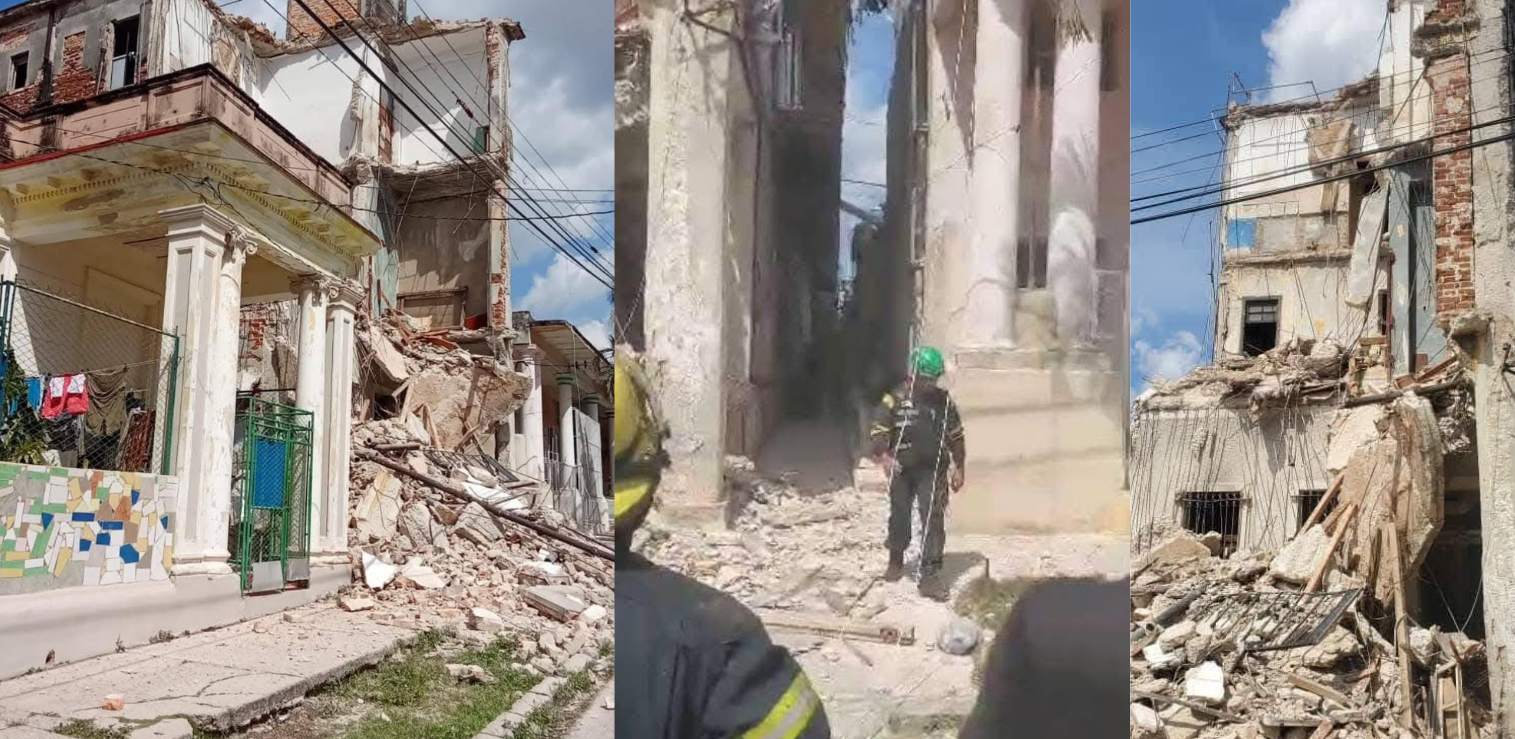
Miami.- This February 16, around 1:00 pm, the collapse From a building located on San Bernardino Street, between Durege and Serrano, in the Santos Suárez neighborhood, Havana. The property, located in front of the well -known Agro de San Bernardino, collapsed while he was inhabited. According to face -to -face witnesses, residents managed to evacuate in time, so no fatal victims were reported.
Shared images on social networks show firefighters working in the place that was in total collapse.
Cubanet journalist Angeth Bonne, a neighbor of the area, confirmed to the environment that the property was in danger of collapse more than 20 years, and that nine did not declared it uninhabitable. “I remember that once I could enter and so bad that the building was, it could be seen from the room of the house I visited, through the holes that were on the floor, the room on the bottom of the bottom,” Bonne said.
In those days, 9 years ago, they were evicting people because it was dangerous. They sent most families for a shelter with the aim of demolishing the building.
However, “most of the housed people returned to the building in less than two weeks because the abergue where they were housed were in worse conditions than the building,” Bonne added.
The situation of housing in Cuba is critical. According to official dataat the end of 2024, only 65% of homes in the country were in good technical condition, which implies that the remaining 35% were in regular or bad conditions.
The age of homes in Havana along with the lack of maintenance cause systematic collapses of real estate. The Government has recognized that some 1,000 homes are collapsed in the capital, a situation that has caused the death of adults and children.
The scarcity of adequate housing has led numerous families to live in collective shelters administered by the State, which lack the necessary basic conditions. Other people choose to return to buildings in poor condition, despite the risk of collapse, due to the bad conditions of the shelters.
On the other hand, the housing plan continues to decrease in Cuba. By August, the Cuban government had only managed to fulfill 39% of the construction plan of new houses, scheduled in some 13,492 units in 2024.
A year earlier they did not build what was promised. In 2023, it was projected to lift 24,715 homes, but only 65% of that figure was completed, with 16,065 built homes.
Among the provinces most affected by this low performance are Havana, Camagüey, Las Tunas, Santiago de Cuba and Guantanamo. The housing deficit in Cuba currently amounts to 856,500 homes.