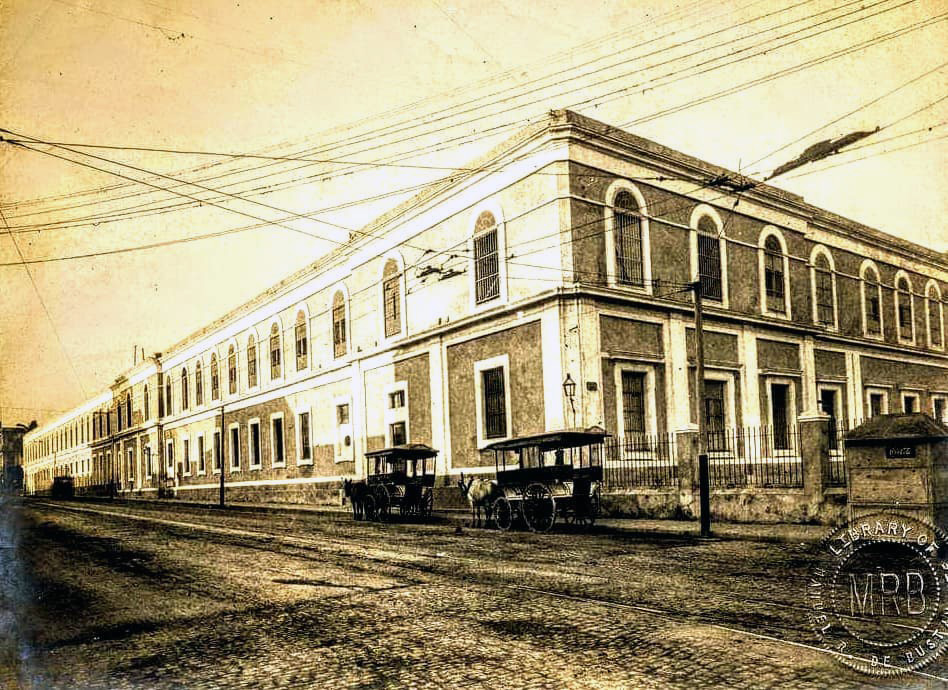
It is true that the Belascoaín road in Havana was not distinguished, if we compare it with Bishop, Galiano or Neptune, for example, as a commercial route. However, he had cinemas, hotels, fondas, bars and emblematic buildings that made it an attractive avenue for Cubans and foreigners, especially in the twentieth century. Although, from the previous century, it was a very popular and busy street, “with trees and beautiful houses to one side and another”, according to the Asturian traveler Antonio de las Bars Prado.
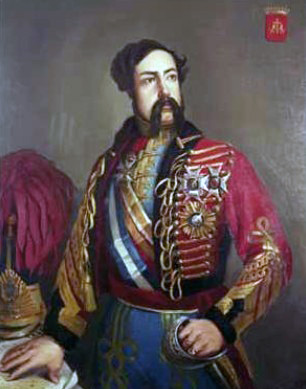
The name was decided by Captain General Leopoldo O’Donnell during his term (1843-1848) to pay tribute to his friend Diego de León Navarrete, count of Belascoaín, shot in Madrid, Spain, on October 15, 1841, by orders of the Regent Baldomero Espartero.
Already at that time, however, the street had had other denominations, as they had called it from Gutierrez because it was created by the Canarian immigrant Mateo Gutiérrez to access a tobacco mill of his property, in 1782. After cocal because there was there , in the rare of Gervasio and in another field, many coconuts, according to the historian José María de la Torre. It was also known as beneficence, because the house of that institution was located in it.
It is also said that at some point in its history they called it Calzada del Hospicio and from 1911, Father Varela, by decision of the City Council, in tribute to the illustrious patriot and intellectual Cuban. The Spanish historian Jacobo de la Pezuela in his Geographic, statistical, historical dictionary of the island of Cubaedited in 1863 thus described it:
Calzada de Belascoaín, one of the main routes of the extramural population of Havana. The Captain General O’Donnell was almost terraoplenada when he took command of the island, in October 1843 (…) This great perfectly rectilinear street (…) in its main and greater extension (…) is one of the healthiest localities, fresh and smiling of the capital (…) its width enlivened by two symmetrical rows of trees and the urban railway counts 65 rods (54 meters).
The apple of houses between the road and the streets of Concordia, Virtues and Lucena, was very famous in colonial Havana because there was a bullring. And in his corner to Virtus Street, he established a spa and health house in 1845, with the title of San Leopoldo, Dr. Marcial Dupierris, who was a brilliant specialist, distinguished as a member of academic institutions in Spain, France and the United States , and author of the book Memories about the medical topography of Havana and its surroundingspublished in 1857. In this work he offered details of one of the most emblematic institutions of Belascoaín, founded at the end of the 18th century by Governor Luis de las Casas and administered by the Royal Economic Society of Friends of the country:
The Royal Charity House, which is also in the San Lázaro neighborhood, is an immense building, whose front gives to the wide street of the North. Its E. side is on the Calzada de Belascoaín, and extends towards the S. until facing the San Leopoldo Health House. This real establishment is the shelter of the orphans of both sexes; In it they are educated and sustained until the age in which it allows them to be applied to any kind of jobs. In one of the departments of its dependence are the insane; in another the cradle house, that is to say of spós. These different departments are confident in the care of people who enjoy the best reputation. The girls, when they find occasion to marry, receive a dowry of five hundred pesos that gives them the house. When they are placed for the service of private houses, it is with the preceding report and recommendation of good reputation and morality of people to whose care they are delivered.
I found another testimony of the authorship of the Spanish writer and journalist José María de Andueza, who visited the institution of the 1830s. The novelist highlighted the good conditions in which the children lived, But he criticized the treatment, infrahuman and discriminatory, which the insane were received:
(…) They have not taken into account the conditions of those unhappy women, when they have been given asylum, whose dirty dungeons (since they deserve this name better than that of rooms) can be compared to those of the most criminal inmates. This is all the more sensitive, than for men there is a separate establishment, in a laugh and ventilated situation, in which cleaning and an inner arrangement that recommend it effectively.
They also visited the building of the House of Benefit and Maternity, which had been inaugurated in 1794, the infants Eulalia de Borbón and Antonio de Orleans, members of the Spanish Royal Family, in 1893.

Military and Business Institutions
At the beginning of the 1880s the movement of uniformed towards the Military Academy, in the corner of Estrella, heading to the Civil Guard Barracks, corner of Zanja or in the direction of the queen’s battery, corner of San Lázaro, was usual.
There were then two bathrooms: the public good, in No. 37 and social recess, number 2. They made the wholesale trade the Importers: Severo Balaguer; J. Fernández; Goya and Martínez. Very requested businesses were Then the Asturian, of wells for cleaning of wells and latrines, owned by José Arias and that of Lamparírías, Tisters and pipelines for gas and water pipes, by Joaquín Puente.
Francisco Sáenz de Nanclares had a hardware store that the clientele was played with the Cantabria, by José Tarno and La Squadra, by Ricardo O. Zorrilla. The stores were sold: the discussion, trade firefighters and a tailoring owned by José N. Flores. Shoes; Talabarería merchandise were acquired in the establishment of Jaimé Buxó; In the fate, by Pablo Tió or Flor de Valladolid, by Lucio Merino.
Of the pharmacies it transcended charity, regent by Mr. José Manrique and from 1888, that of Dr. Cj Penichet, in the corner with virtues. As in those days the use of horses and mules predominated for the transfer of passengers and products, it was not strange that they served, on Belascoaín street, three veterinarians’ businesses belonging to Francisco Gallegos y Ocampos, Juan M. Vilanova and Tomás Medina. There were also several stables.
Curious fact is that there were two establishments appointed battery, dedicated to the hospitality industry: the coffee of Manuel Suárez and the Fonda de Francisco Piñeyro. Of the industries, one of the most important was the Tivoli, liquor factory, brandy and vinegars, of Otermin, Otamendi and Cía.
Tobacco factories
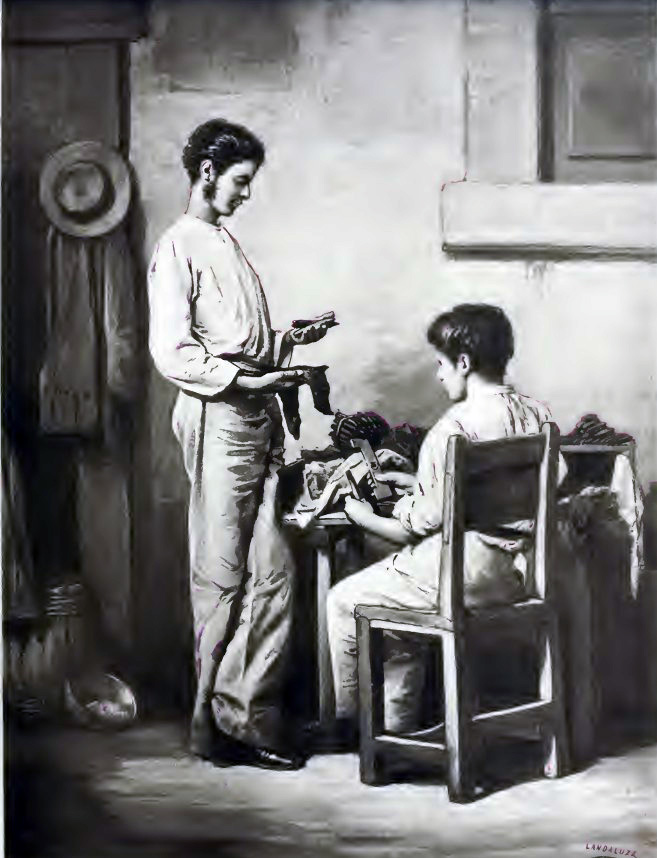
He counted at the beginning of this stamp that the origins of the street were related to a tobacco mill. Because during the second half of the century, factories to manufacture cigars continued to be encouraged. Antonio de Gordon in a book he published in 1897 referred to:
In 1845 he founded the crown to exploit the industry in all its phases, which the Messrs. Álvarez, López and in 1882 acquired, passing it from the Calzada de Belascoaín to the Palace of Aldama, friendship, between Queen and Star.
In 1874 there was another, from the Menéndez and Tuero commercial company. At the end of the 19th century, there were the factory named intimacy, in Belascoaín n. 34, belonging to Antonio Caruncho, Rosa de Santiago, of Rogert and Cía, at number 2, the road and for Larrañaga, owned by the children and the widow of Antonio Rivero.
Several neighbors exercised the tabaquero’s trade in their homes, a modest business, which had as a market, fundamentally, the neighborhood. Then famous factories would be encouraged, theme to which I will dedicate a picture in future editions.
Sources:
- Antonio de Gordon: Tobacco in Cuba, notes for its historyLiterary propaganda, Havana, 1897.
- Jacobo de la Pezuela: Geographic, statistical, historical dictionary of the island of CubaMadrid, 1863.
- José María de la Torre: What we were and what we are, Ancient and modern Havana, Cervantes Librería, 1913.
- José María de Andueza: Island of Cuba: picturesque, historical, political, literary, commercial and industrial, Madrid: Boix, 1841.
- Federico Caine: Hispanic-American directory1878.
- Archives of the History Office of the City of Havana.
- Antonio de las Bars Prado: Havana in the mid -nineteenth centuryPress of the Linear City, Madrid, 1926.
- Marina Diario