The United Nations Refugee Agency estimates that the crisis in the Catatumbo leaves 52,286 displaced, 19,000 with mobility restrictions, 8,668 confined and 4,667 Venezuelan refugees and migrants
The Colombian region of the Catatumbo has lived for a month the worst humanitarian crisis that the country remembers, caused by the clashes between the Guerrillas of the National Liberation Army (ELN) and the 33rd Front of the Dissidencies of the FARC, which affects almost 85,000 people, including indigenous communities and Venezuelan migrants.
This was assured this Sunday, February 16, the representative in Colombia of the United Nations Agency for Refugees (UNHCR), Mireille Girard, who said that, with a cut last February 14, those affected are 84,621 people who for the most part They have been displaced by guerrilla violence.
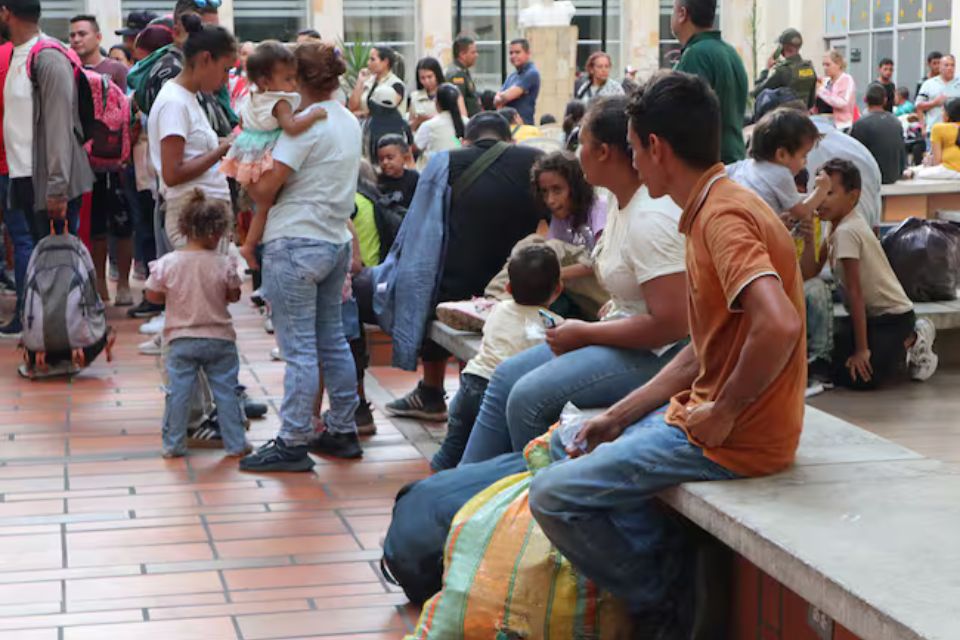
«Violence in Catatumbo has generated the greatest mass displacement since we have records in Colombia. There are confined communities and families, with restricted mobility and limited access to food, medical care and humanitarian aid, ”said Girard to EFE.
The figures collected by UNHCR are alarming: 52,286 displaced, 19,000 with mobility restrictions, 8,668 confined and 4,667 Venezuelan refugees and migrants.
Different authorities also talk about at least 56 dead Because of the confrontations that began more intensity on January 16 in the Catatumbo, region made up of the municipalities of Ábrego, Convention, El Carmen, El Tarra, Hazarí, La Beach, San Calixto, Sardinata, Theorama and Tibu, in the Department of Norte de Santander.
*Also read: points to regularize Venezuelan migrants in Colombia closed due to lack of resources
The ELN and the 33rd Front of the FARC dissidents dispute the territorial control of this border area with Venezuela, crucial for drug trafficking because it is one of the places of the country with more coca crops.
For Girard, armed clashes leave even more disadvantage the indigenous communities, such as the Yukpa, which are cross -border because they live and move in areas of Colombia and Venezuela, and the Bari, which are Colombians.
To that are added children who, due to violence, cannot go to their schools because the “teachers had to flee and children are unprotected, exposed to violations, possibly also to issues of gender violence and forced recruitment.”
“It is an extremely worrying situation for the communities of these areas, in particular the affectation to indigenous people and Afro who are disproportionately impacted because they live in areas that are disputed many armed groups,” said the UNHCR representative in Colombia.
Although he recognizes the efforts of local administrations to help the population, Girard says that the mayors were overwhelmed and their financial resources quickly exhausted themselves to the magnitude of the crisis.
*Journalism in Venezuela is exercised in a hostile environment for the press with dozens of legal instruments arranged for the punishment of the word, especially the laws “against hatred”, “against fascism” and “against blockade.” This content is being published taking into account the threats and limits that, consequently, have been imposed on the dissemination of information from within the country.
Post views: 414