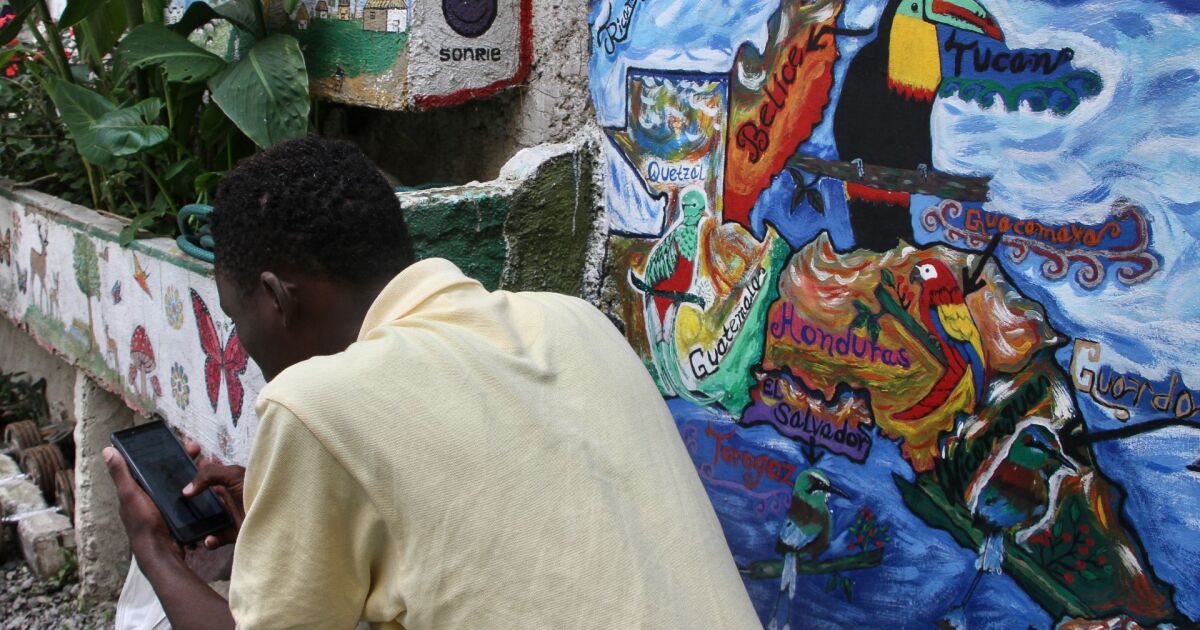
Stranded migrants … and shelters without help
Gabriela Hernández recalls that, given the measures and restrictions announced by Trump, migrants in transit have had no choice but to stay in Mexico, which has caused their stay in camps or shelters, as a house toso, extend indefinitely.
“People who are here as migrants do not come out because they want, they do not go out only to look for the American dream because it is not; They leave for security measures, leave the situations of their countries and obviously think of the United States, ”explains Hernández in an interview.
Casa Tochán has 50 beds, however, since 2021 remains above its capacity, only in December it accommodated around 100 people and currently in space inhabit around 68 migrants.
Hostels are needed, they need to give us help because civil society has organized and has helped the State to carry out the work that the State was obliged to carry out. ”
Gabriela Hernández, director of Casa Tochán.
“The responses then of the authorities were: ‘Why, if they pass?’ They are passing through, but there are five, six months, up to a year, it’s not so by the way. The fact that today the authorities, the head of government, has recognized us the experience we have when dealing with the issue and has specifically told us ‘help me’, it is already a great openness. ”
The director of Casa Tochan states that they have approached through the Secretariat of Capital Government to offer them a space in bailment to have a greater capacity for attention to migrants, however, she rejected that option for lacking human and economic resources.
In the citizen shelter, which is maintained thanks to donations of citizens and educational institutions, only five people receive a salary, the rest of those who work there do so voluntarily or are students who do social work.
“We have no economic capacity to have a new team, economic resources I believe that not even the government with so many cuts that they do, it has. We have all the willingness to support the city government to the extent they can, ”says the activist.
Given the possibility that some migrants decide to stay in Mexico when they see their desire to reach the United States, Hernández also considers a dialogue with the federal government to expand the 30 -day period that people have in transit to request refuge.
“People who are in Mexico City, have more than the stipulated time. If we are going to guide us for what the law says, they will reject them. We will continue to be the United States Migration Police and that is unfortunate because that happened in the last six -year term, ”says the activist.
The CDMX plan
The Head of Government, Clara Brugada, announced that migrants – more than 3,000 – who live in makeshift camps in the streets of the capital will be relocated to more appropriate spaces.
“At the latest people in mobility or who are occupying the public road – which are more than 3,000 people – they will be able to have decent spaces established by the city government, with spaces that the groups of the groups of the civil society and with the places we can generate, ”said the president on December 18, 2024.
According to the data collected by the capital government, between 3,000 and 4,000 migrants remain in camps of Gustavo A. Madero and Venustiano Carranza, although these figures vary daily due to the constant migratory flow.
Migrants living in city streets are mainly in three camps: Plaza La Soledadin Venustiano Carranza, as well as the Vallejo neighborhoods and the camellón of Central Axis Lázaro Cárdenasin front of the northern bus center, both in the mayor’s office Gustavo A. Madero.
The CDMX plan is to guarantee decent conditions for migrants, such as access to safety, water and food, preventing them from living in the streets. For this, the Government seeks to transfer 13 shelters to this population that will be administered by civil society organizations and the government itself, so that they receive better attention.
However, the capital government has had difficulties in the past to respond to the need for accommodation for migrants who travel through the city. In May 2023 was closed the migrant shelter installed in the Tláhuac forest per overlap, While it had space to serve 180 people, it came to host 4,000.