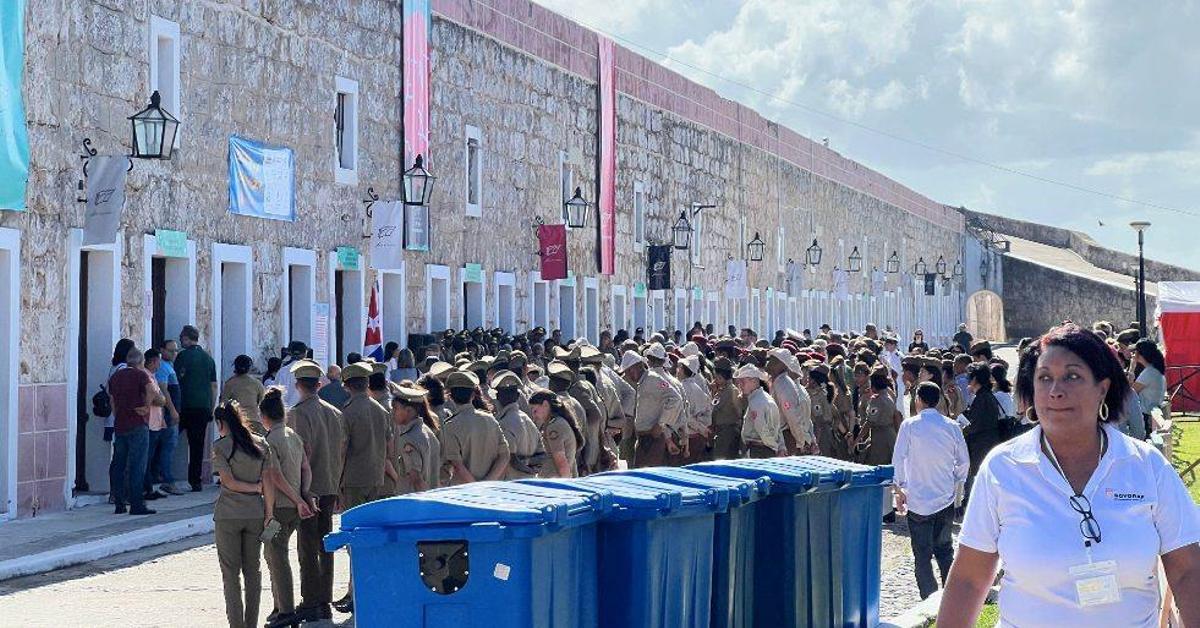
Havana/Dozens of soldiers of the Armed Forces, in a newspaper uniform, entered this Saturday through the great gate of the Morro-Cabaña enclosure with hundreds of habaneros readers. The two colonial strengths, whose walls were used for three centuries as a wall and jail, serve every February as the headquarters of the Book Fair, held this year in the midst of an overwhelming energy crisis.
The most important cultural event of the year was inaugurated despite the country’s total stoppage this weekend. With several days of blackouts of more than 24 hours, climbing both castles was for the Havana a maneuver of reality, rather than love for reading. However, the fair has made mediocrity a custom and the sun, which reverberates on the pavement with an August heat, makes the expedition a torture.
The managers of the fair were clear: to fill the pavilions, the stores of the Cuban Institute of the Book had to be “scraping” in search of printed specimens even decades ago. News, only those that – by the work and grace of the mules– Sell individuals, with titles of doubtful quality and always at exorbitant prices.
/ 14ymedio
For those who do want a book to take home, disappointment has been served for years. The rationing has also arrived at the pavilions and it is only possible to take a copy per person. The “star” of the event, the relaunch of the call Pueblo Librarystars the limited purchase: for 50 pesos, after push and dislikes, a single copy of The Golden Age either Winnie The Pooh.
“It looks like a Spanish-literature book of high school,” valued a young woman who managed to “hunt” the Black Tales of Cubaby Lydia Cabrera, the most wanted of the event because it is an author whom Fidel Castro censored for decades. “It is a book with special treatment,” the East Editorial Dependent told this newspaper.
Cabrera’s is one of the 10 books in the town library for sale. Some will have presentations, such as this – on Friday, February 21, two days after the closure -, in the José Martí Memorial, one of the sub -springs of the Fair. “It is a book with special treatment,” said the East Editorial.

/ 14ymedio
“This is not even the crushing of what it was,” said an old woman who left the cabin at full speed, with two school notebooks under her arm, at 11 in the morning. In the old drawbridge, others wait for their turn to enter. “This is torture,” said a woman who already accumulated 50 minutes of tail under the overwhelming Indian.
Custodians care little that accumulates more and more people in the vicinity of the castle. Ready to resist the siege, uniformed and immune to any plea, they manage the tail with droppers.
In the central tent – where, in theory, there are the few novelties of the people’s library – “there are only two cashiers, the others have not arrived by transport.” That is the explanation that runs in a voice under the no less agonizing blue light under the canvas. Everyone wonders how a book industry whose most valuable opportunity to sell the product is wasted with little personal and low resources can be paid.
No one looks at those who, jociously, are already known as the “template specimens”, those books that due to their content – generally memories of generals or anthologies of Fidel Castro – nobody wants to buy.
The other “permanent” are the books that embassies or the guest country carry in this edition, South Africa, almost decorative or prices that the Cuban automatically rules out. There were pavilions of Venezuela, Guatemala, Vietnam, Iran and the Saharawi Arab Republic.
/ 14ymedio
It has also become a habit to go to the fair to get the school supplies that children need and some colored box to spoil them. This year you can buy 10 notebooks at 250 pesos each. Delete tires are 200 pesos. To reach any of these stationery objects you have to overcome the tails and have patience.
Where readers feel unique at a book fair is in the Best Seller pavilion. There the language spoken is that of the dollar. A novel by the American Stephen King or a volume of Harry Potter – in addition to countless self -help pamphlets – can leave almost 40 dollars. “13,000 pesos for a book!” Translate a reader, carrying the price to the humble national currency.
“It would have to be a special edition or hard lid to cost that,” said a young woman, aware of the book market abroad. “Stephen King’s books sell you as if it were his last success, and those books they are selling are 40 years old.”
When the tours of the esplanade of the castles end, the readers face the last challenge of the fair: return to Havana. The operation is dignified, in effect, of a King horror novel, and is not resolved or with all the magic of Harry Potter.
/ 14ymedio