Statistical signatures Guarumo and Ecoanalitics They published on Friday their most recent measurement survey on the Electoral Panorama in the presidential race in 2026.
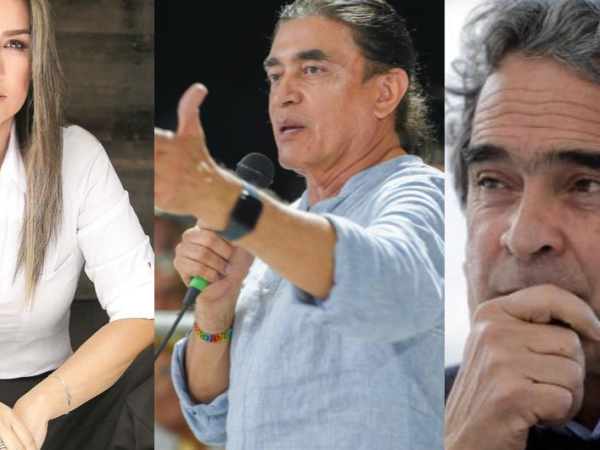
According to the final results, the journalist Vicky Dávilaand politicians Gustavo Bolívar and Sergio Fajardoin this order, lead the intention to vote for the next elections, in which the successor of Gustavo Petro In the Casa de Nariño.
(You can read: Court rejected request for clarification of the UPC submitted by the Ministry of Health).
This measurement, made between February 10 and 13 of the current year, asked who Colombians would vote for a hypothetical candidates for the Presidency of the Republic of Colombia in 2026 ‘.
Vicky Dávila
Facebook: Vicky Dávila
The results showed that Dávila, former director of the magazine ‘Week’, leads the intention to vote, with 15.1%; who is followed by Gustavo Bolívar, current director of Social Prosperity, with 11.9%, and former governor of Antioquia Sergio Fajardo, with 11.5%.
(Further: How much do VAT return in 2025?).
After the podium, the blank vote appears, with 7.1% of the claims, who replied that he would choose this option for next year’s presidentials.
NATIONAL GOVERNMENT PERFORMANCE IMAGE
In addition to the panorama for the 2026 elections, respondents were asked about his perception of President Petro’s government.
To the question ‘What qualification would you give to the performance and management of President Gustavo Petro?
(You may be interested: Court confirmed guardianship ruling against Minister of Environment for Santurban).

Gustavo Petro
Sergio Steel Yate / Portafolio
At the same time, 25.1% described the performance of the ‘bad’ government, 7% said the management is ‘excellent’ and 8% selected ‘do not know, it does not respond’.
About the Performance of Ministers36% described it as ‘bad’ and 27.1% as ‘lousy’. Another 22.4% said that the cabinet performance is ‘good’ and 4.2% described it as ‘excellent’.
This is how the intention to vote
1. Vicky Dávila: 15.1%.
2. Gustavo Bolívar: 11.9%.
3. Sergio Fajardo: 11.5%.
4. Germán Vargas Lleras: 5.2%.
5. Claudia López: 4.6%.
6. María José Pizarro: 4.1%.
7. Juan Manuel Galán: 4.0%.
8. María Fernanda Cabal: 3.5%.
9. Jota Pe Hernández: 3.3%.
10. Daniel Quintero: 3.1%.
11. Miguel Uribe Turbay: 3.0%.
12. Carolina Cork: 2.2%.
13. Iván Cepeda: 2.1%.
14. Juan Daniel Oviedo: 1.4%.
15. David Luna: 1.3%.
16. Paloma Valencia: 1.2%.
17. Susana Muhamad: 1.0%.
18. Francisco Barbosa: 0.9%.
19. Luis Gilberto Murillo: 0.8%.
20. Jaime Pumarejo: 0.7%.
21. Mauricio Cárdenas: 0.5%.
22. Juan Guillermo Zuluaga: 0.5%.
23. Juan Carlos Pinzón: 0.4%.
24. Carlos Caicedo: 0.4%.
25. José Manuel Restrepo: 0.3%.
26. Roy Barreras: 0.3%.
27. Daniel Palacios: 0.2%.
28. María Claudia Lacouture: 0.2%.
29. Alejandro Gaviria: 0.2%.
30. Paola Holguín: 0.2%.
31. Juan Fernando Cristo: 0.2%.
32. David Razo: 0.1%.
33. Andrés Guerra: 0.1%.
34. Héctor Olimpo Espinosa: 0.1%.
35. Other: 0.9%.
36. White: 7.1%.
37. None: 4.7%.
38. NS/NR: 2.7%.
Survey Technical Card
– Legal person who conducted the survey: Guarumo and Ecoanalitic Measurement and Economic Concepts SAS Resolution 4899 of 2023 of the CNE and resolution 4905 of 2023 of the CNE.
– Legal person who entrusted it: Guarumo
– Source of financing: own resources.
– General objective: Questions about favorability, perception and electoral hypothetical scenarios.
– Study Universe: Colombian men and women over 18, of all socioeconomic levels residing in the national territory except the so -called old national territories and the San Andrés archipelago and who have voted, for a total of 38,000,000 Colombians.
– Sample design: The design of the sample is probabilistic in stages.
– Sample size: 2140 Distributed surveys as follows: Armenia (46), Barranquilla (149), Bello (37), Bogotá (332), Bucaramanga (66), Buenaventura (43), Cajicá (43), Cali (129), Cartagena ( 95), Codazzi (56), Cúcuta (53), Dosquebradas (54), Envigado (41), Floridablanca (37), Funza (26), Girón (46), Ibagué (49), Itagüí (48), Jamundí (Jamundí (Jamundí (Jamundí (Jamundí (Jamundí (Jamundí (Jamundí ( 26), Madrid (33), Manizales (40), Medellín (107), Montelíbano (26), Mosquera (46), Neiva (17), Palmira (30), Pasto (32), Popayán (50), Riohacha ( 27), Santa Marta (35), Sincelejo (62), Soledad (40), Tolú (77), Turbaco (33), Villavicencio (38), Virginia (30), Yumbo (41).
– Collection technique: Face -to -face survey.
– Collection date: February 10 to February 13, 2025.
– characters for whom it was investigated: refer to the collection form.
– Margin of error: 95%confidence level. Total National Error Margin 2.2%
– Distribution of the sample: The surveys were conducted according to population census discriminated by municipalities, socioeconomic stratification, locality, neighborhood, apple, population over 18.
– Sample frameworks: National Population Census – Electoral Potential.
– Concrete questions that were asked: refer to the collection form.
Portfolio