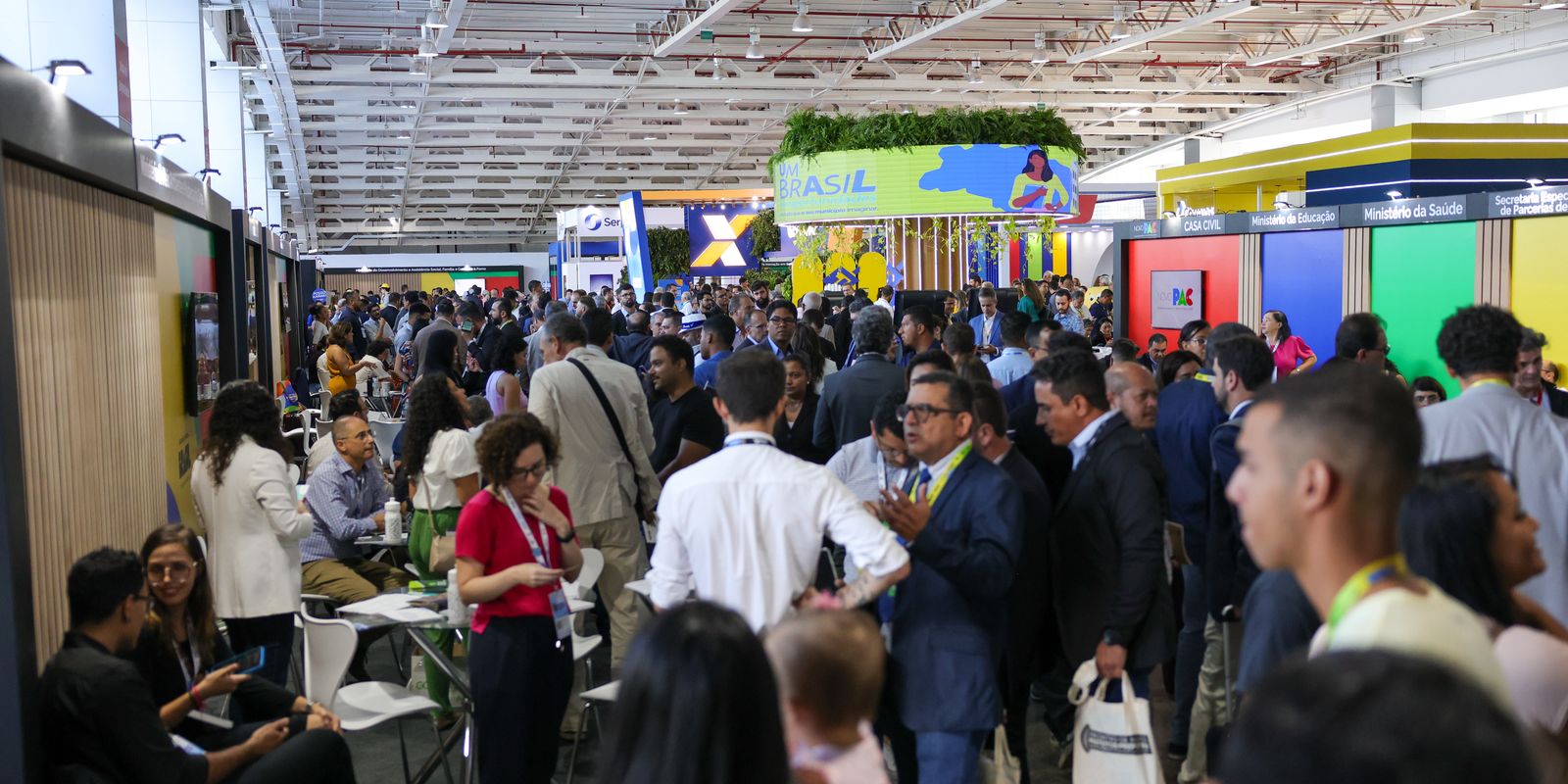
The meeting of new mayors and mayors, promoted by the federal government, ended on Thursday (13) with a final balance of more than 19,500 participants, 3,300 heads of municipal executives.
Over the course of three days, managers from Brazilian cities circulated by dozens of booths of ministries, municipalities and federal agencies, spread over an area of more than 6,200 square meters at the Ulysses Guimarães Convention Center, in the central area of Brasilia.
Among the services provided was the guidance for receiving resources, signing contracts and agreements, as well as training for crisis situations, including public calamities and budget crises.
Personalized service
Reelected Mayor of Orindiúva, a municipality of 7,000 inhabitants in the interior of São Paulo, Mireli Martins positively evaluated the meeting, which had not occurred for more than a decade.
“The small municipality really needs the resource for health, for education, the infrastructure. And it is the role of a good manager to seek these resources. And there is always something new to learn,” he said.
There were also lectures and various workshops, as well as personalized care to managers by technicians of organ, municipalities and federal folders. Virtually all Federal Government ministers were involved in the program at some point.
Municipalities such as the National Fund for the Development of Education (FNDE), which passes equipment and finances educational works to city halls, the Brazilian Institute of Environment and Renewable Natural Resources (Ibama), the Institute of National Historical and Artistic Heritage (IPHAN), In addition to the Civil Defense, services from the Ministry of Health and Federal Public Banks, for example, they offered advice and passed on information to managers about actions and programs in progress.
“It is important to have come here, not only to seek resources, but to know management models and have new ideas,” said Paulo Victor, mayor of Soure, on Marajó Island, Pará, which is in his first mandate as a municipal manager.
Federative pact
The last edition of the meeting had been held in 2013, during the government of Dilma Rousseff. Already the first edition was in 2009, still in the second term of President Luiz Inacio Lula da Silva. “This edition was undoubtedly the largest municipalist event ever held in the country,” celebrated Juliana Carneiro, Assistant Executive Secretary of the Secretariat of Institutional Relations (SRI) of the Presidency of the Republic.
“It’s not just a matter of the large numbers, with more than 19,000 participants present, but for the quality of participation. There was a lot of interest to the mayors in the lectures, many of whom were crowded,” added Carneiro.
According to her, the event resumes the federative pact between Union and Municipalities.
Coordinated by SRI, in partnership with the Brazilian Association of Municipalities (ABM), the meeting was also supported by the National Confederation of Municipalities (CNM), the National Front of Mayors (FNP) and the 26 state associations of municipalities.
“I traveled the booths of all ministries and was very well attended by the technicians. I received information on how to go after these federal government resources, the parliamentary amendments. The expectation that this feature reaches the tip is great,” commented Professor Adriano, Mayor of Amarante, Piauí, city of just over 17,000 inhabitants.