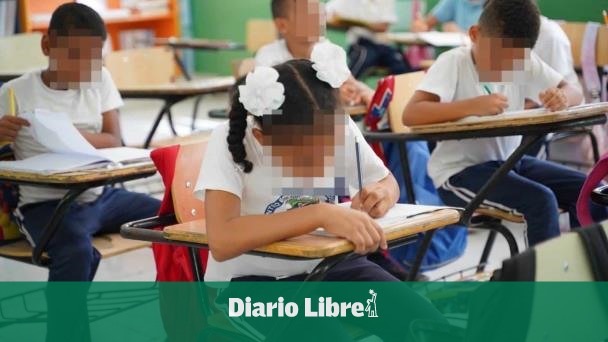
The Initiative Dominican for one Education quality (IDEC) See alarming rates of Repeat and abandonment school in the Dominican education system and stressed that the studies of the reprobation in the Education Primary warn the impact negative of this practice.
He pointed out that “the Repeatfar from improving the learningtends to perpetuate academic difficulties, negatively affecting self -esteem and increasing the probability of abandonment school”.
Contrary to what is thought, the IDEC indicates that the reprobation “It reflects deficiencies In the educational system, such as the lack of support adequate pedagogical, more than the student’s inability to learn. “
In turn, it indicates that forcing a student to repeat A degree increases school spending, that on average was in 2023 in 2,252 dollarsequivalent to approximately 139,624 Dominican pesos.
“Any effective intervention to avoid school repetition that has a unit cost per student lower than that figure is economically profitable,” he recommends.
In 1st and 2nd grade of primary school there can be no repeance
After a report of the UNESCO which recommends suppressing repetition policies and implementing the promotion automatic to the next grade along with a support Adequate school, the Ministry of Education The Ordinance No. 04-2023 issued in which it establishes that students cannot be failed in the first and second grade degrees and instructs teachers to “provide all the necessary pedagogical supports so that the student reaches the required performance level For the degree and monitoring its progress, as well as taking the necessary measures in terms of strategies, resources and actions that are required to achieve the literacy objective. “
The study “Towards a quality education“of the IDEC contemplate the situation of Overness, Repeat and abandonment school between 2016 and 2022. verifies the decrease in levels of reprobation in the first and second grade of primary school, but how it rises drastically in the third degree.
The rate of reprobation In the primary level courses (first to sixth) it went from 4.7 % in the 2016-2017 school year and stood at 5.1 in 2022-2023.
In the case of larger students, those of the secondary level, the study indicates that the situation of reprobation, Overness and abandonment It intensifies.
Just to compare, the Repeat in the secondary It went from 4.6 % in the 2016-2017 school year to 6.2 % in 2022-2023.
The report of IDEC It emphasizes that 30 % of teenagers Schooling at age 12 leaves the system before the 17. Recently, a publication was highlighted that indicates that 25 % of students between 15 and 17 years leave school.
The IDEC indicates that this phenomenon is linked to Repeat and the Overnesswhich generates demotivation in students.
Did the pandemic influence?
The pandemic of COVID-19 had an important impact in the rates of reprobation and abandonment of all educational levels, established the IDEC In your report.
He argued that in the 2019-2020 school year a positive effect was perceived foreseeably from the flexibility of the students’ evaluation standards, dictated in that school year. The rates of Repeat They fell sharply to almost half of those of 2018-2019. He abandonment school was also reduced: in Education Primary went from 2 % to 0.8 % and in the Education Secondary went from 3.3 % to 1.9 %.
However, “after the mirage of the year 2019-2020”, in the 2020-2021 school year, the rates of reprobation and abandonment They climbed again. In primary school reprobation It reached up to 6 % in 2021-2022, to be 5.1 % in the 2022-2023 school year. In high school, 10.5 % to be 6.2 %.
The rate of abandonment School was 4 % in primary and 6.3 % in secondary school in 2020-2021 and fell to 2.3 % and 4.8 %, respectively in 2022-2023. “The Overness decreased slightly in 2020-2021, as a consequence of the high level of people who abandoned school, and rates have increased again in the following years by decreasing the abandonment“He said.
IDEC
The Dominican initiative for a quality education (IDEC) emerged in 2012 as a space for dialogue and consultation between government, civil society, international organizations and the private sector. Since its creation, IDEC has worked with the purpose of monitoring and monitoring the pre -university education policy, in addition to promoting strategies that strengthen the quality of education in the country, promoting an evidence -based approach and the active participation of society .