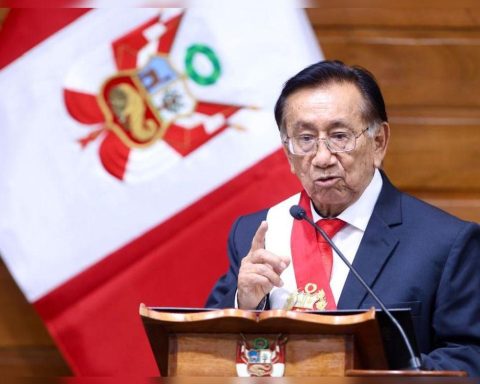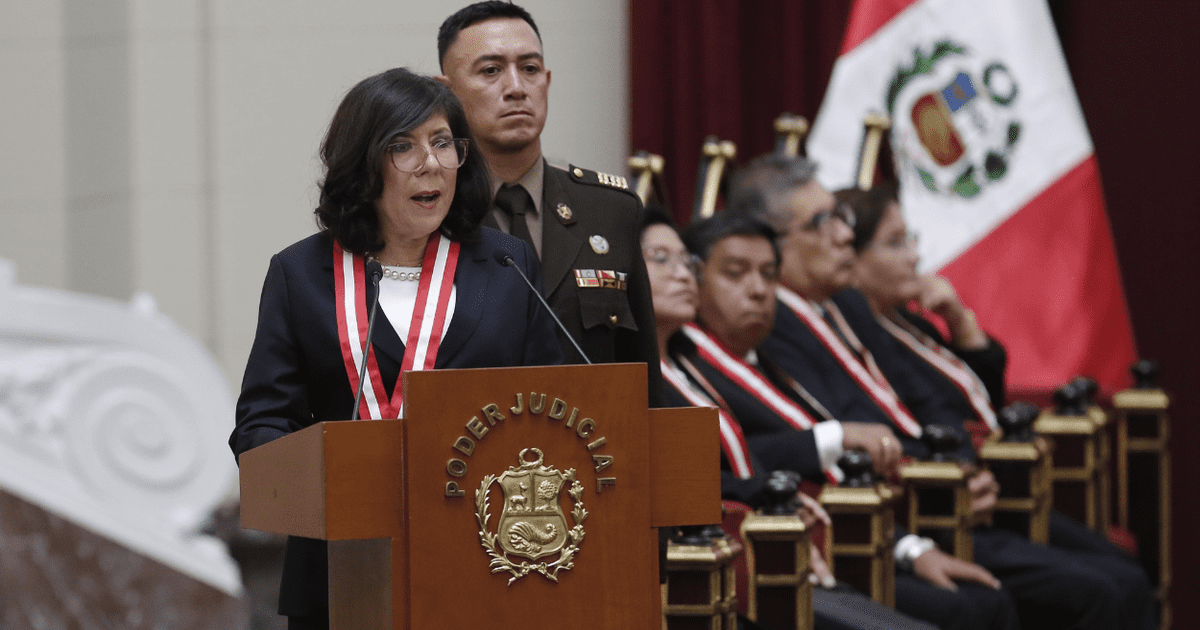
The immediate disciplinary process that the National Justice Board (JNJ) began to the President of the Judiciary, Janet Tello Gilardi and four other judges of the Supreme Court of Justicia, to which it would be sought to suspend their functions and dismiss, is based on the complaint filed by a colonel of the National Police that the year 2015 was passed to the retirement for a “serious infractions contest” to the police service.
The complaint was filed before the JNJ on November 4, 2024 by the citizen Julio Ramón Cadenillas Díaza former national police colonel who was passed to Retiro, on March 26, 2015 for the commission of various infractions he would have committed in August 2019 when he was sent to the city of Arequipa In an inspection, supervision, advice, talks and control of activities in the educational institutions of the PNP.
Cadenillas Díaz traveled accompanied by a delegation of three noncommissioned officers and had to remain in the city of Arequipa for 10 days, from August 8 to 16, 2013. However, the trip extended until August 19, 2013.
Political use of a denunciation without foundation
By majority, 4 to 3, the National Board decided the beginning of the immediate disciplinary process
Upon returning to Lima, the then PNP Colonel reported to his superiors that “the commission entrusted in the city of Arequipa of the Arequipa of the August 8 to 17, 2013but the expenses of tickets, accommodation and mobility could not be supported because the respective vouchers had been lost, as it accredits with the authenticated copy of the police complaint filed before the Pueblo Libre Police Station”
At the beginning of an investigation of what happened, the Petty Officer Robert Alejo Manzano He declared that on August 15 he transferred the delegation to the Terrestrial Terminal, but that he did not embark them and that “Colonel Cadenillas Díaz ordered him to carry out the control of the ballots on August 19, 2013”.
Meanwhile, The noncommissioned officer Carlos Pareja Rodríguez He declared that on August 19, the noncommissioned officer Alejo Manzano arrived at the Personnel Control Office of the South Police Region carrying the commission orders to control the exit, so he recorded the record book Date of arrival in Arequipa 9 August and departure date, August 19.
On March 26, 2015, the Police Discipline Court of the Ministry of Interior He ratified the sanction of passing to the retirement situation by the commission of various infractions: “Do not respect the established procedures, for no justified reason, (…) create, vary, omit, withdraw or insert causes, facts, proceedings, conclusions, conclusions, conclusions, documents or annexes carried out on the occasion of the police function and distort, adulterate or subscribe false information in report. ”
A appeal before the Supreme Court

The Judiciary defends its independence and autonomy against political power
Julio Cadenillas Ruíz questioned the decision of the police command before the Judiciary, without positive results in his favor. He appealed to all instances until the case arrived, via appeal, to the First Transitory and Social Law Chamber of the Supreme Court. This court was made up of supreme judges Janet Tello Gilardicurrent president of the Judiciary, Edwin Corrales Melgarejo, Carlos Calderón PuertasOmar Toledo Toribio and Rosa Dávila Broncano.
It is then that on July 19, 2024, the Supreme Court Nor did he prove him right. His claim was rejected flat due to lack of requirements. It is then, that on November 4, 2024, Ruiz chain resorts to the National Board of Justice denouncing that by rejecting their appeal, the supreme judges had made a “Defective motivation“Applied article 388 of the Civil Procedure Code, which was repealed by Law 31591, on the requirements for a appeal to be admitted.
That is, the supposed error of the judges occurs in the admissibility of the cassation. When considering that this appeal did not proceed, the judges no longer reviewed the reasons for their pass to retirement. The admission of a appeal only means that the judges have decided to evaluate the causes of the controversy. Then, you can reject cassation.
This fact is not a serious affectation to judicial service and does not require an urgent response. If the members of the Board decided that it was a disciplinary theme that should be investigated, they could initiate a Preliminary research giving time for the supreme judges to give their discharges without affecting the service.
The immediate disciplinary process

National Justice Board
However, on January 29, 2025, the President of the Jnj, Gino Ríos Patio proposes to the plenary of the Board the beginning of a disciplinary procedure of dismissal of magistrates Janet Tello, Edwin Corrales MelgarejoCarlos Calderon Puertas, Omar Toribio and Rosa Dávila Broncano for alleged lack of motivation in the resolution of July 19, 2024 that declares the appeal inadmissible.
The immediate disciplinary procedure is provided for serious cases of functional inconduct of supreme magistrates whose permanence in the administration of justice puts the entire judicial system at risk. The Supreme Court of Justice and the Court constitutionsl have already defined that the lack of motivation covers all the sustenance of a decision, not a possible erroneous appointment of a norm that has been repealed.
In addition, there is the principle of trust, so in cases that the erroneous appointment of legal norms is produced, the person responsible is the speaker magistrate of the resolution and not all the collegiate of five supreme magistrates. In addition, the immediate process only gives 10 days To those investigated present their discharges and during this period, at any time, the members of the JNJ given the seriousness of the facts under investigation, can dispose of the suspension of the judges investigated.
The suspension of the president of the Judicial Branch, Janet Tello Gillardi For the reasons expressed by the colonel in retirement, in reality, a direct message to all the judges of the country to submit to the political power that today controls the National Board of Justice, who seek submissive magistrates who do not oppose the government of Dina Boluartenor to a congress that legislates in favor of criminal organizations.