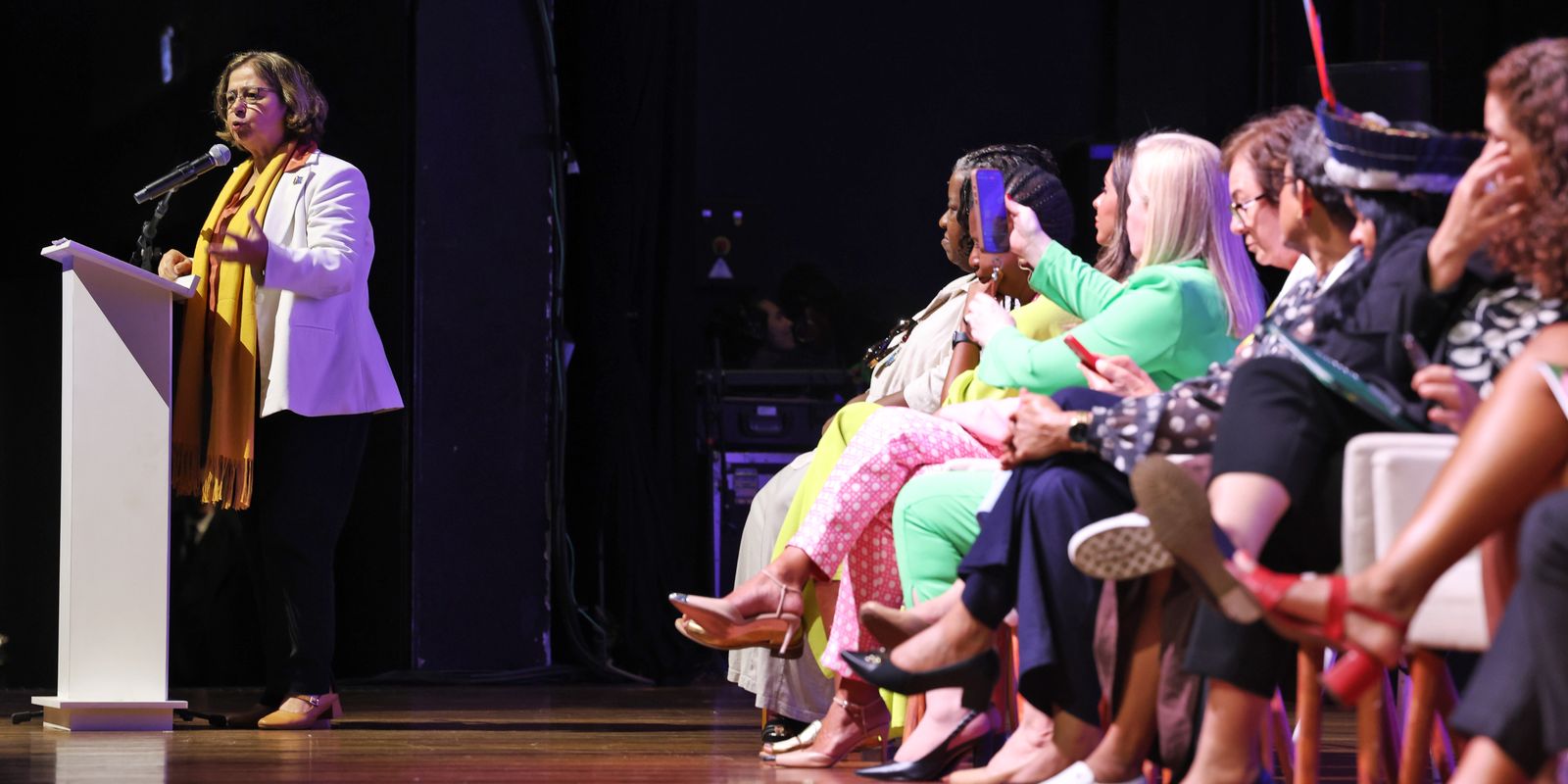
The Ministry of Women launched the guide to create and implement policy departments for women at the meeting of new mayors and mayors, which takes place in Brasilia until this Thursday (13). The guide is available at Ministry website. 
The purpose of the publication is to stimulate municipal managers and managers to create administrative structures that implement public policies in favor of more equity between men and women and the expansion of their rights.
Data from the Ministry of Women account for nine policies secretariats for women in each group of 50 municipalities, a total of 1,045 in 2024 – number four times above 2023: 258 secretariats.
The creation of policy secretariats for women should be one of the priorities of the 728 mayors who took office on January 1. The assessment is by the Minister of Women, Cida Gonçalves, in an interview with Agência Brasil.
According to her, “the second challenge is budgetary”, that is, having resources to fund policies to combat violence against women and finance initiatives to generate work, employment and income – “two strong demands” heard by the minister at the meeting with the new mayors on the afternoon of Wednesday (12).
First secretary
The agenda of public policies for women resembles the agenda in 2005 when Moema Gramacho (PT-BA) took over the first of the four mandates of mayor she held in the city of Lauro de Freitas, in the Salvador Metropolitan Region (BA). She was the first municipal manager to create a Women’s Policy Secretariat.
“It takes public policies that give women independence and autonomy,” argues Moema, who today participates in the directions of the Brazilian Association of Municipalities (ABM) and the National Front of Mayors and Mayors (FNP). For her, generation of work, employment and income is critical to avoid situations in which women need to denounce men because of gender violence, but aggressors are the companions themselves, family providers.
According to the Brazilian Public Security Forum, 63% of femicide authors in 2023 were intimate partners and 21.2% were former partner.
Moema Gramacho recalls that physical violence against women decreased after the implementation of the Maria da Penha Law in 2006. For her, however, other forms of violence last. “When I first applied to City Hall, I heard from one of our opponents that I ‘would not go anywhere’ and that woman ‘who only knows how to play stove, will not know how to play a city hall.’ ‘
Misological demonstrations also heard, twenty years after Moema Gramacho, the mayor of Mozarlândia (GO) Lucijane Freires Alencar (MDB-GO). During last year’s election campaign, she reports that she faced discrimination. “People said that women have no competence.”
Empathy
For Lucijane Freires Alencar, “the world lacks more women in politics because of the differentiated view, with more empathy.” She recommends “to all women who have the interest and courage to apply and make themselves available to politics. “We are capable and competent.”
Lucijane Freires Alencar and Moema Gramacho are in different political poles. But despite ideological and party distinctions, managers like them maintain dialogue and share initiatives, as in the Municipalist Women Movement (MMM), created in 2017 with the support of the National Confederation of Municipalities (CNM).
“The Municipalist Women Movement has been a fundamental space for this articulation. Through it, we were able to exchange experiences, strengthen our political participation and press for public policies that meet the demands of women in the municipalities, ”says Tania Ziulkoski founder of the movement and also Mayor of Pimenteiras (PI).
Despite being a majority in the population and the electorate, women are still under-displayed in politics, as the Superior Electoral Court (TSE) records. In the municipal elections of last year, in addition to the 728 mayors elected (13% of cities), 1,066 deputy presepts formed plates (19% of municipalities). The number of elected councilors (10,537) is almost five times lower than the number of elected men (47,189).
Only two women were elected as capital mayors: Emilia Corrêa (Aracaju-SE), from PL, and Adriane Lopes (Campo Grande-MS), PP.
Tania Ziulkoski cites a survey by CNM last year that accounted for other female sub-representation indicators: “2,311 candidates were registered to run for office in the municipalities of 1,947 cities, a number that corresponds to 15% of the total candidates of this year’s election. ”