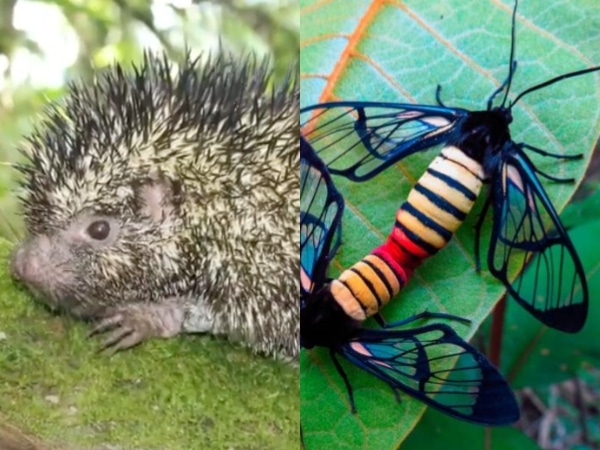
This week three discoveries of species that highlight the biological diversity of the nation were confirmed. A pork, a plant and an insect between the specimens.
News Colombia.
A pig, a plant and an insect are part of the new diversity of Colombia. The country, home of thousands of species yet to discover, is a reference in terms of fauna and flora.
Also read:
In the Magdalena Media mountains, a fascinating discovery took place thanks to the work of the biologist Julián Alzate. While doing his thesis at the University of Antioquia, focused on the review of moths stored in the University Entomology collection, Alzate found an unknown copy.
This finding led to the consultation with international experts, who confirmed that it was a new species for science, which received the name Tigridania Magdalenae.
The moth, With a wingspan between 6 and 7 centimeters, it has a yellow and red abdomen, and wings with black veins. His appearance mimics wasps, which serves as a mechanism for defense against predators.

The discovery was validated by analysis of the male genitals of the insect, which allowed it to confirm it as a different species.
ANDThis finding, published in the magazine ZOOTAXAunderlines the relevance of museums and collections in the conservation of species not yet described by science.
Coendou Vossi: A small Colombian Caribbean pork
According to the Caracol News report, in the Colombian Caribbean, a team of scientists led by Héctor E. Ramírez-Chaves identified a new species of porcupine, known as Coendou Vossi.
Although the porcupines of this region seemed common, the researchers noticed differences in some populations in the area. After an exhaustive analysis of DNA and morphology, it was concluded that these specimens represented a different species.
He Coendou Vossi It is smaller than other porcupines, measures between 26 and 33 centimeters and has a long tail, which represents more than 70% of its length, which allows it to quickly move through the trees.
With a dark brown coloration and bicolor or tricolor spines, this porcupine is endemic to Colombia and is essential to understand the biodiversity of the Caribbean regions and the Magdalena Valley.

Aphelandra Montis-Tusae: Single Plant in Cerro Tusa
According to information from El Colombiano, in December 2020, Saúl Hoyos, Biologist and Botanical, discovered an unpublished plant on the Tusa hill, in the southwest of Antioquia. During a field walk, Hoyos was surprised to find a plant with unusual characteristics.
After an exhaustive research process, which included morphological studies and consultation with international experts, it was determined that the plant belonged to a new species: Aphelandra Montis-Tusae.

This discovery not only highlights the biodiversity of Cerro Tusa, a sacred place for indigenous communities, but also the importance of collaboration between academics, local communities and conservation organizations.