Russia and Ukraine: the reasons why the Russian convoy has "little progress" on his way to Kiev
The huge Russian military convoy near Kiev, the Ukrainian capital, has hardly moved in three days, the UK Defense Ministry said.
However, US analysts said that Russia still intends to surround and seize the city where some three million people live, using siege tactics if necessary.
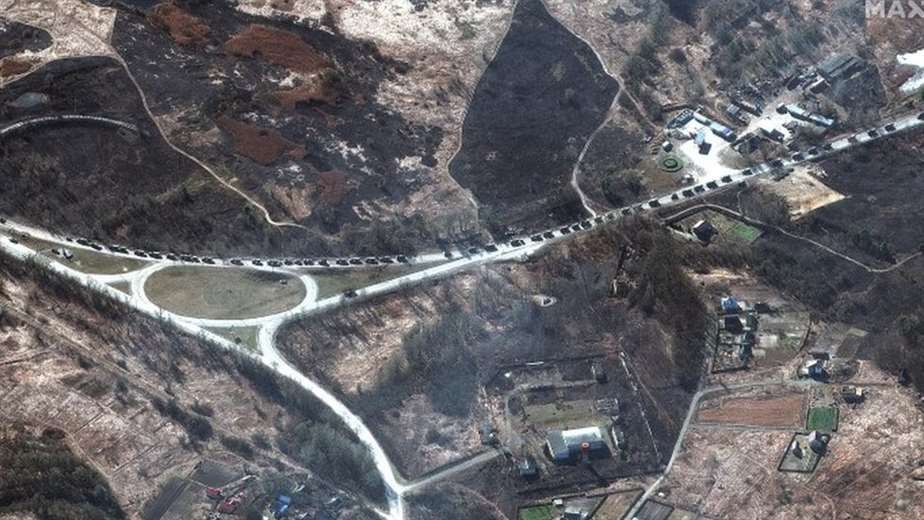
Recent satellite images showing the size of the convoy raised fears that an attack could be imminent.
But British and US officials say logistical problems may slow their progress.
A satellite image taken on February 28 showing the Russian convoy near Kiev.
In an intelligence update Thursday morning, the British Ministry of Defense said the column did “little perceptible progress over three days” and remained more than 30 km from Kiev.
Why has the convoy stalled?
Several reasons could explain why the huge column, which includes armored vehicles, tanks and towed artillery, has stopped its advance on the capital.
Among them, there is talk of logistical problems, mechanical failures, unexpected Ukrainian resistance and low morale of the Russian troops.
“There is a massive logistical failure to provide fuel, food, spare parts and tires…they got stuck in the mud in a way that makes it difficult to get the vehicles out,” the general told him. Richard Barronsformer commander of the United Kingdom Joint Forces, to the program Today from BBC Radio 4.
However, he added that command and control issues, for example faulty radio networks and communication on open networks, can cause bigger problems.
The Pentagon also said that Russia was having logistical problems and made the decision to deliberately regroup and reassess the “progress they have not made.”
Ukrainian resistance is also believed to be hampering the convoy’s progress, according to the Pentagon, though the agency said it could not independently verify that claim.
Local resistance, stronger than expected, could also affect Russian morale.
“The general morale of the people sitting in this convoy is falling every day,” Oleksandr Danylyuk, former secretary of Ukraine’s National Security and Defense Council, told the BBC, comparing this to the strong motivation of the Ukrainian army to defend its capital. .
On Tuesday, a US defense official told reporters there were signs of morale problems in the Russian force, which uses a large number of conscript soldiers.
“Not everyone was… they were not even aware that they were going to be sent on a combat operation“Commented the official, as the BBC learned.
Could the convoy be destroyed?
Ukraine has some air capability and has been using powerful Turkish-made drones to destroy other Russian convoys. But according to General Barrons, Kiev simply does not have the military strength to destroy a column of this size.
“They’ve been good at attacking the convoy from the front and the sides,” he said, but any damage inflicted from the air would be too localized.
Russia will also have air defenses around the convoy that could shoot down Ukrainian targets, General Barrons added. So an airstrike would put Ukraine’s already limited air force at risk.
Some commentators have suggested that NATO should consider destroying the convoy, but that could spark a war between nuclear powers.
Western governments have repeatedly said that they have no intention of getting directly involved in the conflict.
The huge Russian military convoy near Kiev, the Ukrainian capital, has hardly moved in three days, the UK Defense Ministry said.
However, US analysts said that Russia still intends to surround and seize the city where some three million people live, using siege tactics if necessary.
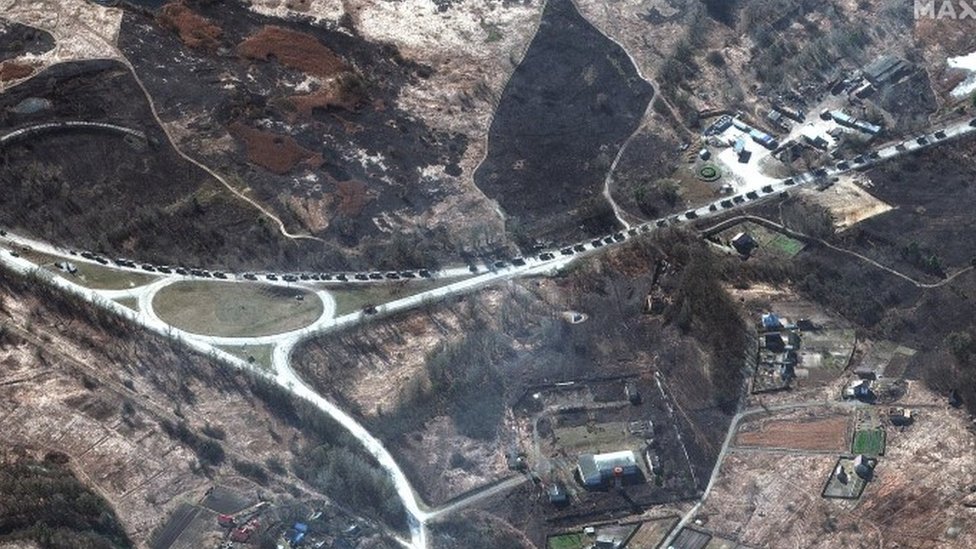
Recent satellite images showing the size of the convoy raised fears that an attack could be imminent.
But British and US officials say logistical problems may slow their progress.
A satellite image taken on February 28 showing the Russian convoy near Kiev.
In an intelligence update Thursday morning, the British Ministry of Defense said the column did “little perceptible progress over three days” and remained more than 30 km from Kiev.
Why has the convoy stalled?
Several reasons could explain why the huge column, which includes armored vehicles, tanks and towed artillery, has stopped its advance on the capital.
Among them, there is talk of logistical problems, mechanical failures, unexpected Ukrainian resistance and low morale of the Russian troops.
“There is a massive logistical failure to provide fuel, food, spare parts and tires…they got stuck in the mud in a way that makes it difficult to get the vehicles out,” the general told him. Richard Barronsformer commander of the United Kingdom Joint Forces, to the program Today from BBC Radio 4.
However, he added that command and control issues, for example faulty radio networks and communication on open networks, can cause bigger problems.
The Pentagon also said that Russia was having logistical problems and made the decision to deliberately regroup and reassess the “progress they have not made.”
Ukrainian resistance is also believed to be hampering the convoy’s progress, according to the Pentagon, though the agency said it could not independently verify that claim.
Local resistance, stronger than expected, could also affect Russian morale.
“The general morale of the people sitting in this convoy is falling every day,” Oleksandr Danylyuk, former secretary of Ukraine’s National Security and Defense Council, told the BBC, comparing this to the strong motivation of the Ukrainian army to defend its capital. .
On Tuesday, a US defense official told reporters there were signs of morale problems in the Russian force, which uses a large number of conscript soldiers.
“Not everyone was… they were not even aware that they were going to be sent on a combat operation“Commented the official, as the BBC learned.
Could the convoy be destroyed?
Ukraine has some air capability and has been using powerful Turkish-made drones to destroy other Russian convoys. But according to General Barrons, Kiev simply does not have the military strength to destroy a column of this size.
“They’ve been good at attacking the convoy from the front and the sides,” he said, but any damage inflicted from the air would be too localized.
Russia will also have air defenses around the convoy that could shoot down Ukrainian targets, General Barrons added. So an airstrike would put Ukraine’s already limited air force at risk.
Some commentators have suggested that NATO should consider destroying the convoy, but that could spark a war between nuclear powers.
Western governments have repeatedly said that they have no intention of getting directly involved in the conflict.
The Dominican Government is holding talks with investment banks to acquire financial insurance that will mitigate the impact on the public finances of possible increases in crude oil, given the recent increase
Caixa Econômica Federal announced this Tuesday (3) the resumption of financing for the purchase of residential properties above R$2.25 million with resources from the savings account. The modality, framed in the Real
On February 11, a federal jury convicted Earl Richard Clouser, 55, of Burnham, Pennsylvania, for attempting to produce child sexual abuse material with a 15-year-old teenager in Cuba. According to the United
Havana/On the corner of 23rd and L, where for decades Havana waited in line to enjoy a five-scoop salad, this Tuesday the only possible taste was the bitter aftertaste of frustration. The
“PDVSA has signed supply contracts with companies marketing oil and derivatives destined for the United States market,” the state-run company reported without identifying the companies or offering more details of the contracts.