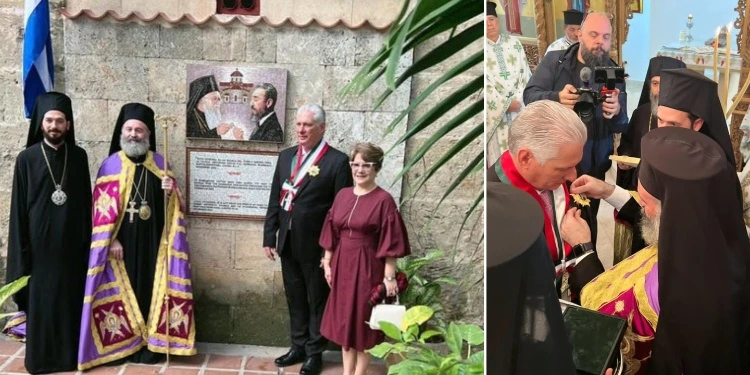
SLP, Mexico.- The representative of Ecumenical Patriarchy and the Greek Orthodox Archdiocese in Australia He decorated To Miguel Díaz-Canel with the order of the Ecumenical Patriarch Bartolomé “Estrella”.
At the ceremony, the archbishop of the Australian Greek Orthodox Church, visiting Cuba, referred to Fidel Castro as a man of “ecumenical vision”, despite the fact that, under his dictatorshippeople were persecuted for professing some religion.
“Cuba is a place of ecumenism and, as we all know, the leader of this great nation, Fidel, had a very ecumenical vision. He, his collaborators, Eusebio Leal, built this temple and delivered it to the Ecumenical Patriarch. It was a gesture of revolution for the situation of the moment, ”said Makarios, according to the official site Cubainformation.
As part of the activities for the two decades of the encounter between the commander in chief and Ecumenical patriarch Bartolomeo, I received from the archbishop Makarios of Australia, sent from his all holiness, the order of the Ecumenical Patriarch Bartolomeo “star”.
1/2 pic.twitter.com/lriayww81X
-Miguel Díaz-Canel Bermúdez (@diazcanelb) January 27, 2025
In addition, he said: “Commemoro and veneer in a simple, humble way, the memory of Fidel Castro. The fact and history of the previous Metropolitan, Athenagoras, who was also a participant and promoter of this work ”also commemorated.”
In the sacred Greek Orthodox Cathedral San Nicolás de Myra, located in the historic center of Old Havana, the archbishop commented that the order delivered to the ruler Díaz-Canel was a recognition for the “collaboration” of the Cuban state with the patriarchy of Constantinople.
“Cuba is small and that’s why it’s so big. Cuba is a place of ecumenism, there are very few that exist in the world just like Cuba. Therefore, despite the difficulties we face in these times, I want to tell you to be proud to be Cuban, ”he said.
Díaz-Canel, on the other hand, thanked the support given by the Ecumenical Patriarchy to the Cuban regime “against the coercive measures against the major of the Antilles.”
According to the official media, his eminence Makarios stressed that Cuba is an ecumenical island “where respect for the Religious diversity”
However, Cuban legislation, including Social Communication Lawworks as a tool to severely limit any religious expression that criticizes the government.
Besides, The current Cuban Criminal Code Penalizes acts of “contempt,” “public disorder” and “resistance”, which can be arbitrarily applied against religious leaders and faithful.
According to a annual report of the US International Religious Freedom Commission (USCIRF, for its acronym in English), the State Security Apparatus, composed of the State Security Department, the National Revolutionary Police (PNR) and the Revolution Defense Committees (CDR)play a central role in the surveillance and repression of religious activity.
“For example, the Cuban authorities have regulated and arbitrarily prevented that individuals gather peacefully in religious places and events,” said the document, which refers to incidents in which mothers of political prisoners were prevented from attending masses and other acts of faith.
Dagoberto Valdés Hernández, Catholic layman, director of the Center for Coexistence Studies, writer and speaker, acknowledged that in Cuba There is no freedom of religion because “everyone who tries to be consistent with their faith in social, political and economic spheres is repressed and threatened.”
Alberto Reyes, Catholic priest, admitted that they allow religious cult in the country but spy them. “Everything that could cause mass awareness effect to cut it from the root because there cannot be allowed to have a discordant voice, much less when that voice puts its foundation in God. The system in Cuba is totalitarian, the Church, by definition, is a school of freedom; That makes us antagonistic. That is, the government in Cuba You need to have control above all, therefore it will not allow the Church to display a whole range of actions that can influence the mentality of the people and help them think. ”