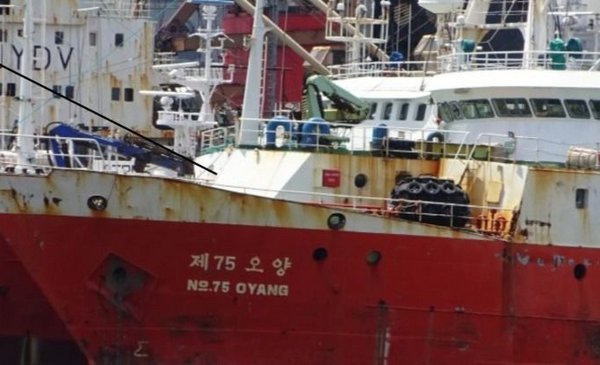
The presence of the Chinese vessel Lu Rong Yuan Yu 606 on Thursday night in the Port of Montevideo alerted environmental groups that from different perspectives have been calling for a fundamental solution to the problem of illegal foreign fishing and the use of the Port of Montevideo. Montevideo with few resources for inspections.
Thanks to real-time monitoring, it was possible to detect that the Lu Rong Yuan Yu 606 had been on the Uruguayan coast near the port since at least Thursday. She is the same ship that was captured by the Navy on July 3 after she did not comply with the “order to stop.”
Location of the Lu Rong Yuan Yu 606 ship according to https://www.marinetraffic.com/en/a
consulted by The Observer Regarding the presence of the Chinese ship in Uruguayan waters, the Uruguayan Navy did not deny the presence of Lu Rong Yuan Yu 606, but pointed out that the Chinese ship was not breaking the law.
Vessels that were detained by the Navy can return to the Port of Montevideo without any problem due to the existing legal vacuum in terms of laws that prevent it.
But even more worrying is the lack of infrastructure for inspections of the hundreds of vessels flying Chinese, Taiwanese or European flags that are considered illegal, unregulated and unreported (IUU) fishing activities.
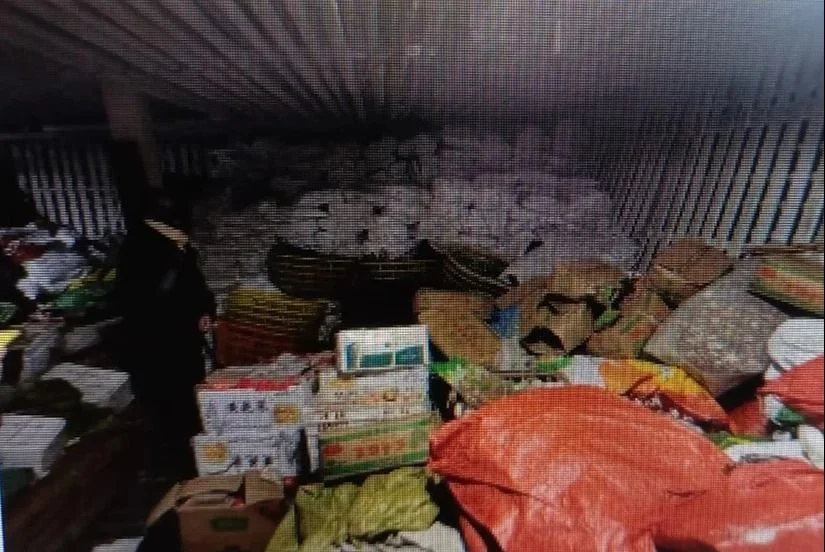
Interior photo of the Lu Rong Yuan Yu 606 ship. Prefecture
According to the laws of Uruguay, the Chinese ship was released and does not have a record, which allows it to sail again in Uruguayan waters. The prosecutor of Flagrancia of seventh, Silvia Naupp, filed the investigation after the National Directorate of Aquatic Resources (Dinara) indicated that there was “no conclusive evidence” to determine that the Chinese vessel “incurred in illegal fishing in territorial waters”.
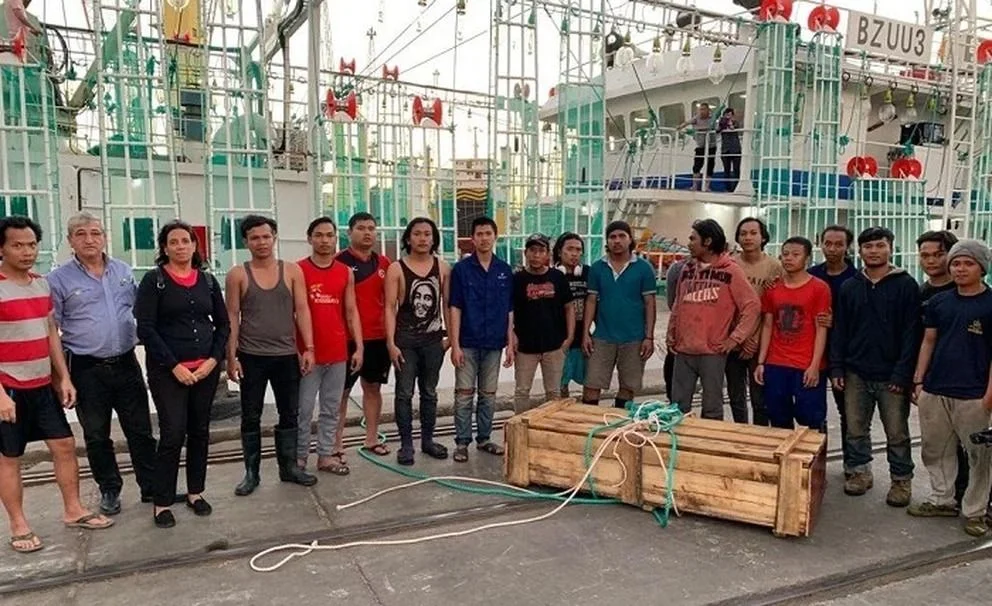
Crew of a Chinese ship. photo by Milko Schvartzmann
The incident with the Chinese ship revived the controversy over the use of the port of Montevideo by foreign ships considered unregulated and unreported (IUU). The port of Montevideo, thanks to the agreements signed with the Food and Agriculture Organization of the United Nations (FAO), is the port destined for the anchorage of international ships.
However, as described by the environmentalist himself, Andres Milessi, a marine biologist and coordinator of the Un Solo Mar project, said agreement establishes that the ships “have to be inspected by the national authority,” he pointed out.
Milessi explained that foreign vessels “use the port of Montevideo to unload when they do not transship in international waters or for repairs or in some cases even to disembark deceased.”
He also indicated that when the vessels request authorization to enter the port, an inspection protocol is generated and he assured: “We know that this situation has improved in recent times and (as an NGO) we are working together with the Uruguayan government” to perfect the protocols.
The defunct Uruguayan project known as Oceános Sanos reported, based on data from the National Ports Administration, that between 2020 and 2021 more than 300 foreign ships docked in the port of Montevideo, the majority of Taiwanese and Chinese origin.
The State Department itself warned that the ships arrive at the port to leave dead crew members on dry land. Cases have even been reported in which the workers on these boats do not want to continue their journey due to the ill-treatment received on the boats.
Milko Schvartzman, an Argentine specialist in marine conservation and a member of the NGO Circle of Environmental Policies, was consulted in the same vein. In statements to The Observer He pointed out that the importance of the Port of Montevideo with respect to the Chilean, Brazilian and Argentine ports, he said “it gives logistical support and unloads to ships that have carried out or carry out illegal fishing.”
It also emphasizes undeclared or unregulated vessels that do not comply with international regulations. “The main difference is that the Port of Montevideo does not control these vessels. For example, any ship that goes to the port of Chile receives an inspection from the Navy on the legal conditions of navigation, if they comply with Chilean and international legislation. In Montevideo no inspections are carried out by the Navy on any ship”.
Why Montevideo?
The port of Montevideo is one of the 15 main ports in the world where foreign ships prefer to dock and serves as a hub for unloading, transshipment, processing and re-export.
A presentation on the situation of fishing in Uruguay, made by the white senator Gustavo Penadés, in 2012, assured that it is false that “Montevideo is the second port in the world in unloading illegal fishing.”
If confirmed that in 2015, the port of Montevideo was the second most visited port in the world by reefer ships (vessels that function as large freezers where the fishing of other ships is stored) and that in 2019, 284 ships entered the port of Montevideo foreign fishing boats and 21 reefers.
That Montevideo has been the second in the world to receive reefers raises suspicions in line with criticism from environmental organizations. The reefers receive the fishing of other boats. Many times these transshipments take place on the high seas. In 2015, there were 1,500 unloadings in Montevideo, more than half corresponding to ships that transshipped on the high seas.
Distant-water fishing fleets use the transshipment system to fish for months on end outside the countries’ 200-nautical-mile Exclusive Economic Zone (EEZ), all specialists point out.
In this regard, Schvartzman affirms that in the Port of Montevideo there are foreign vessels that do not even have a name: “I have seen them myself, I have taken photos. It is as if a vehicle travels without a license plate, ”he emphasized. “These are boats that do not have life jackets, fire extinguishers, no minimum security measures that meet international standards.”
The agency that authorizes the entry of these ships to the port of Montevideo is the Dinara. The shipping companies that want to enter must present certain documentation, from the name or distinctive sign of the vessel to what they caught; and it is checked that they do not appear on illegal lists.
“There are more than 320 unregulated undeclared vessels” that dock in the port of Montevideo. “Just about the cargo we are talking about between 500 million dollars and 1 billion dollars,” Schvartzman said.
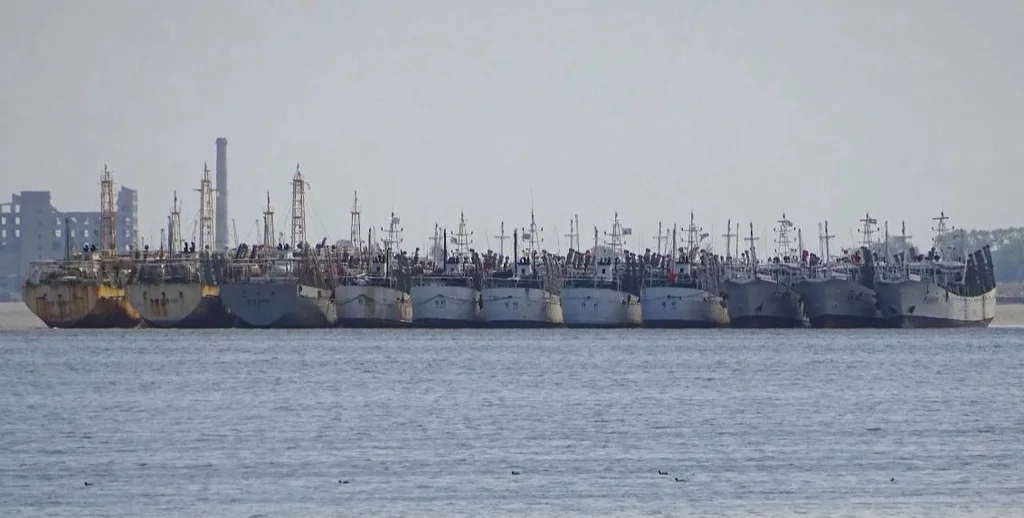
Chinese ships in the port of Montevideo. Photo by Milko Schvartzmann
Although Montevideo is the port for foreign ships, Dinara has only five inspectors. Milessi maintains that some of these foreign fishing vessels that arrive in the country manipulate the Automatic Identification System (AIS), which allows knowing the location of vessels that exceed a certain length and their cargo, among other data. “Any of all the navigation systems, some ships so that they are not identified turn off the system with the consequent danger, they can even have a ban,” he pointed out.
The dead crew members arriving in Montevideo
“The Government of Uruguay does not fully meet the minimum standards for the elimination of trafficking, but is making significant efforts to do so,” the United States Department of State presented in its conclusions in 2021 on Human Trafficking and Trafficking. .
The United States granted the country level 2, with which “countries whose governments are not complying with the minimum standards, but are making efforts to achieve them” are identified.
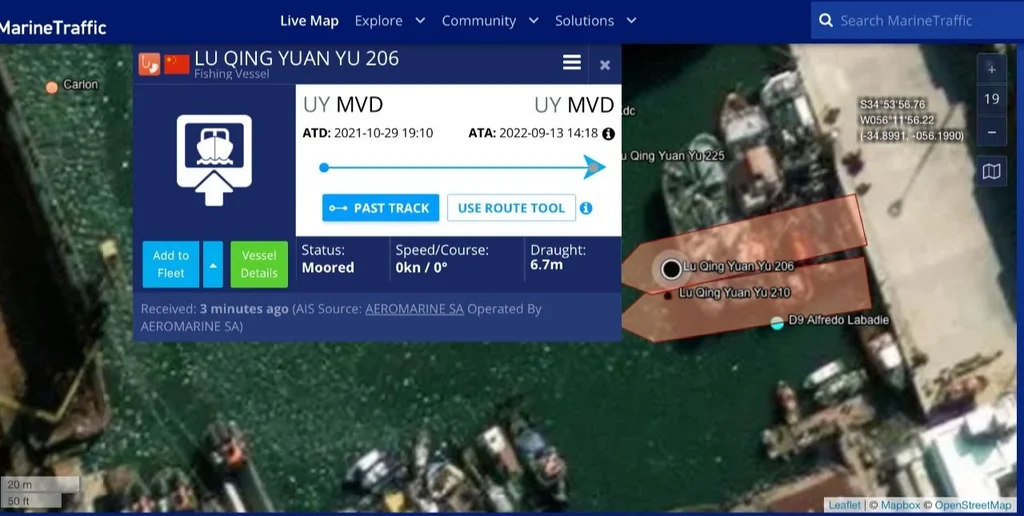
Screenshot from https://www.marinetraffic.com/en/a
In its recommendations, the State Department asks Uruguay to “proactively evaluate foreign workers for traffic indicators, including through inspections on board foreign-flagged vessels in Uruguayan waters and docked at the port.”
The request is not innocent. The few official data indicate that between 2013 and 2021, Montevideo was the final destination of 59 crew members who died on fishing boats, that is, one every month and a half, according to figures provided by the Montevideo Port Prefecture, the body in charge of enforcing the law in the port.
Environmental and human rights organizations have long accused the port of receiving ships known to have committed abuses at sea. Crew members are often beaten, locked on ships, starved and forced to work for days without sleep.
The American discovered that between 2018 and 2020, there were 17 deaths of crew members of Chinese-flagged fishing vessels and other countries that docked in the port of Montevideo and in Uruguayan waters. The document indicates that, prior to 2018, observers reported an average of 11 crewmember deaths per year, on average 1 crewmember killed per month.
According to the US Department of State, foreign workers aboard these ships are subject to abuses indicative of forced labor, including unpaid wages, confiscated identification documents, and physical abuse. There are even anecdotal reports of murders at sea. The trafficking report also indicates that citizens of other countries, including China and the Dominican Republic, may transit through Uruguay en route to other destinations, particularly Argentina, where some are exploited.
fishing in numbers
The 2018 Fishing Statistical Bulletin belonging to Dinara indicated that from 2003 to 2018 the fleet was reduced from 124 boats to only 53 boats. “Between 2016 and 2018, the number of permits granted varied from 52 in 2016 to 53 in 2017 and 2018. However, these values correspond to the lowest number of permits registered for the Uruguayan industrial fleet since 2002,” says the official report.
Returning to the report by Senator Blanco Penadés, he points out that “in the 7-year period from 2008 to 2015, more than 2,300 jobs were lost in the processing plant sector. Of the 4,116 workers we had in 2008, in 2015 there were 1,738 left. Today they are of the order of 1600 jobs”.
Another striking fact is how the incidence of fishing in the GDP fell over the years: In 2005 the incidence between agricultural and fishing activity was the same of 100 points while in 2018 it is 117 of agricultural activity against 23 of the fishing activity.
The data is part of a report prepared by the Ministry of Agriculture, Livestock and Fisheries from 2009 to 2018, “as of 2006 the decoupling is manifested and deepens until 2016. During that period negative annual variation rates are observed”, concludes the document.