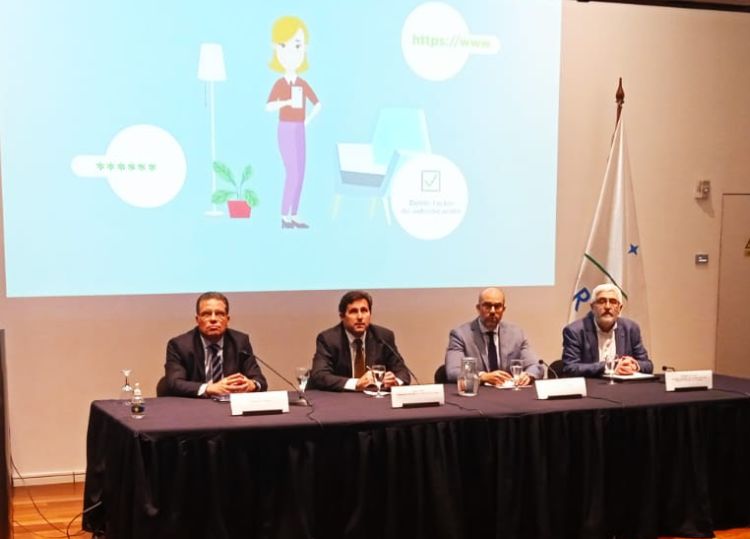
Due to the increase in fraud through digital media and based on coordinated work between the Central Bank of Uruguay (BCU), the Association of Private Banks of Uruguay (ABPU) and the Banco República (BROU), a series of animations to address topics such as: phishing, online shopping, ATMs and debit, credit and prepaid cards. These animations will be shared on institutional networks during October, cybersecurity awareness month.
On the occasion, the president of Banco República, Salvador Ferrer, said that the cases of phishing complaints have doubled compared to a year ago, but they represent a tiny amount for the institution, but it affects the scammed person. Phishing is a technique that consists of deceiving the user to steal confidential information, passwords, etc., making him believe that he is on a completely trustworthy site. The Central Bank reported that in 2021 there were 33 complaints related to this type of scam.
They are due to actions of the banks’ own clients who, for example, disclose their personal data, through links that reach their emails or WhatsApp. In most cases, scammers pose as a bank and ask for information such as a password, or link people to fake pages where they are asked to change their password.
“It is a very high percentage of fraud attempts that we managed to stop, with the collaboration between all the banks. And on the other hand we promote, for example, instant transfers, where we should go. In those cases there is much less possibility of stopping the frauds» said Ferrer.
For his part, the president of the Central Bank, Diego Labat, said that promoting instant transfers is on the BCU’s roadmap. “But there is that balance. If I have an instant transfer, if it was fraudulent, who receives it and took the money. When a transfer takes 24 hours, it is easier to stop it along the way, but that is not why we should take everything to 24 hours in order to stop the scams. We must have a good instantaneous system, which has the appropriate locks to make it work.
He added that at that point a working group within the banking industry. One of the changes must be normative, because a person who tries to carry out this type of scam can be detected, but does not succeed, but the law does not require that bank to inform the rest of the financial system about this attempted scam.
Phishing cases have doubled: in 2021, 33 cases of this type of scam were reported to the BCU




Latest Posts

Government evaluates contracting insurance against rise in oil prices
The Dominican Government is holding talks with investment banks to

Caixa resumes financing for properties above R$2.25 million
Caixa Econômica Federal announced this Tuesday (3) the resumption of
American convicted of trying to produce child pornography with a minor in Cuba
On February 11, a federal jury convicted Earl Richard Clouser,

In Coppelia they no longer sell ice cream, only dry wine
Havana/On the corner of 23rd and L, where for decades



Latest from Blog

Government evaluates contracting insurance against rise in oil prices
The Dominican Government is holding talks with investment banks to acquire financial insurance that will mitigate the impact on the public finances of possible increases in crude oil, given the recent increase

Caixa resumes financing for properties above R$2.25 million
Caixa Econômica Federal announced this Tuesday (3) the resumption of financing for the purchase of residential properties above R$2.25 million with resources from the savings account. The modality, framed in the Real
American convicted of trying to produce child pornography with a minor in Cuba
On February 11, a federal jury convicted Earl Richard Clouser, 55, of Burnham, Pennsylvania, for attempting to produce child sexual abuse material with a 15-year-old teenager in Cuba. According to the United

In Coppelia they no longer sell ice cream, only dry wine
Havana/On the corner of 23rd and L, where for decades Havana waited in line to enjoy a five-scoop salad, this Tuesday the only possible taste was the bitter aftertaste of frustration. The

Venezuela announces new oil sales contracts for the United States market
“PDVSA has signed supply contracts with companies marketing oil and derivatives destined for the United States market,” the state-run company reported without identifying the companies or offering more details of the contracts.