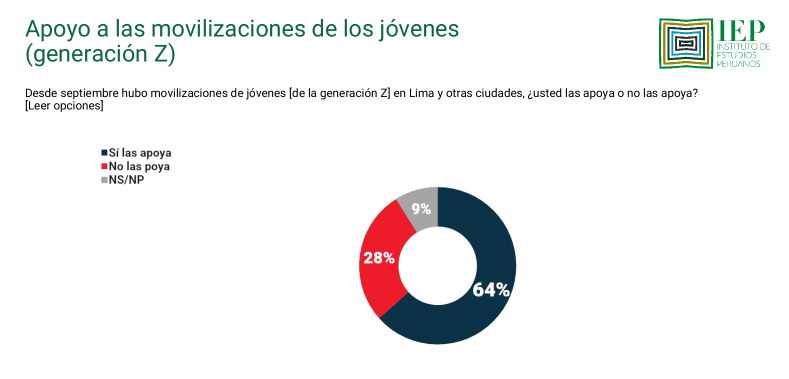
The latest report from October Institute of Peruvian Studies (IEP) reveals that 64% of Peruvians support the mobilizations of the youth of the Generation Zwhile only 28% do not support them.
This series of demonstrations were carried out against the Government of José Jeríhe Congress and at the time towards the former president Dina Boluarte. These mobilizations have as their main banner the repeal of the procrime laws as a measure to combat the high wave of citizen insecurity and extortion.
The main support that young people have is centered in Metropolitan Lima (59%), in the southern zone (70%) and Center (68%) in citizens between 18 and 29 (68%) and 30 to 49 years old (68%).
It is important to note that this study was carried out post vacancy against Boluarte for its poor management in the fight against crime and has a confidence level of 95%.
YOU CAN SEE: Eduardo Ruiz Case: Judiciary will evaluate exit impediment against Luis Magallanes on November 4
Peruvians identify with the protests of October 15
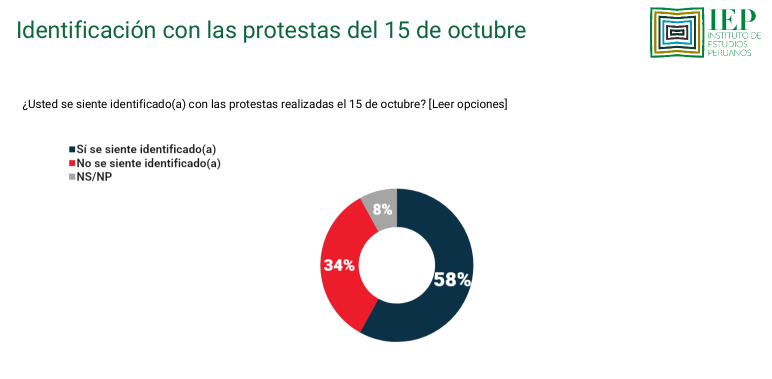
The young people of the Generation Z They not only have the support of Peruvians. The majority identifies with their protests. This is revealed by the surveys, indicating that 58% of the country feels identified with their struggle, while 34% does not. That is, 6 out of 10 citizens support and identify with their demonstrations.
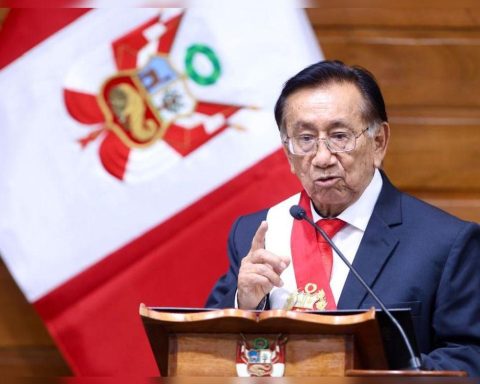
These figures would be related to people’s rejection of the president José Jerí (53%) and that they consider that in their administration everything will remain the same in terms of citizen security (41%). Likewise, the disapproval of Congress and the former president Boluarte They would also align with this identification of the protests. 62% thought that the Legislature had influence in the last government of Boluarte.
In order to seek justice for Eduardo Ruizknown as Tvrkowho lost his life on October 15, the Generation Z called for the November 14 for a new mobilization. This date coincides with the day on which Inti Sotelo and Bryan Pintado They lost their lives when they marched against the government of Manuel Merino in 2020.
The youth group denounced that the authorities have responded with repression and arbitrary arrests, and highlighted that young people lack legitimate institutional channels to express their demands.
The PNP mishandled the protests, citizens assure
On the other hand, the figures reveal more: 62% considered that, in the October mobilizations, the National Police of Peru (PNP) had excesses to control citizen protests.
On the 15th of this month, the artist Eduardo Ruizknown as Tvrko, was killed with a shot to the chest. The bullet, according to the commander general, Oscar Arriolacame out of the police officer’s gun Luis Magellanwho is being investigated for the alleged crime of simple homicide.
Unlike January 2023, citizen perception of the PNP’s behavior increased. At that time, 56% said that there were excesses in these demonstrations in which more than 50 Peruvians lost their lives.
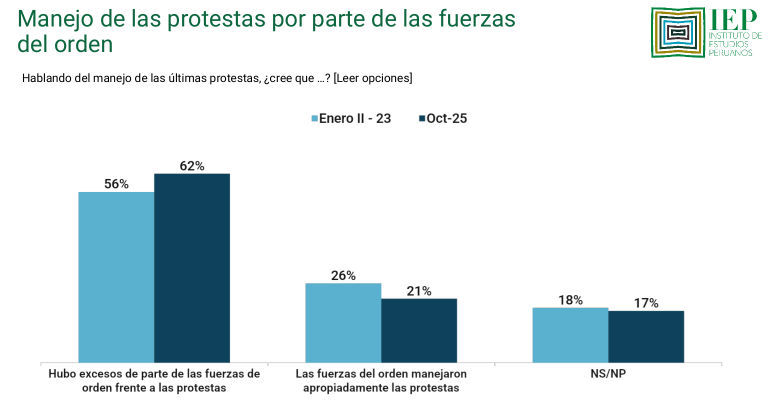
Only 21% said that the PNP He handled the protests well. This sector belongs to the A/B socioeconomic group (27%) with little or no interest in politics (22%) and with right-wing ideology (31%).
YOU CAN SEE: Ballistics report concludes that Eduardo Ruiz died from a “rebound” shot
The little interest in politics and the feeling of sadness in Peruvians
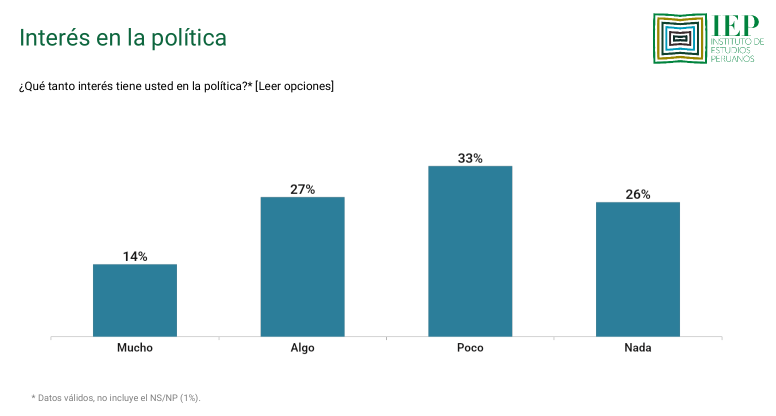
Little or nothing, 33% and 26% respectively, is the interest of citizens in Peruvian politics. This majority of people belong to Metropolitan Lima and the rural area of the Peru. The majority, according to the study, are men between the ages of 18 and 29 and 50 with more than a D/E socioeconomic level.
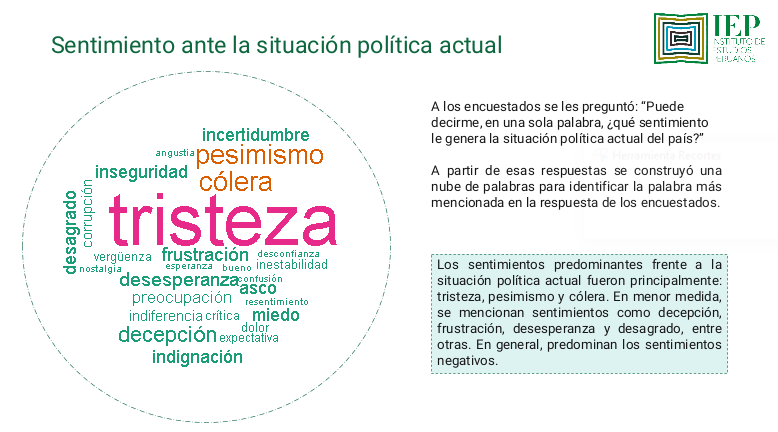
This disinterest goes hand in hand with the majority of respondents who feel sadness, pessimism, anger, uncertainty, insecurity, frustration, and hopelessness about the current political situation in the country.
Feelings of disappointment, indignation, fear, disgust, disgust, worry and indifference do not go unnoticed.
On the other hand, only 14% and 27% of the country cares much or somewhat about politics. This group belongs to the urban area of Peru and Metropolitan Lima, distributed between men and women aged 18 to 29 (generation Z) of socioeconomic level A/B and, with a lower percentage, C.
Peruvians identify with the center and right
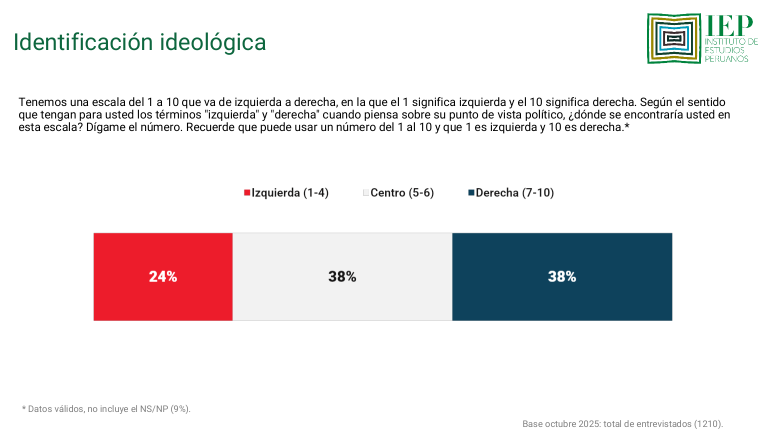
Of the total number of interviewees, 38% stated that they have an ideological identification with the center and right. While only 24% leaned left.
Metropolitan Lima is where the majority of citizens with an ideological identification of the right (44%) as well as the center (41%) are located. For its part, the left predominates in rural Peru (31%).