What could have been another civil war on the African continent became a conflict of international scope.
HAVANA.- This November, wasting dithyrambs and high-sounding phrases, official Cuba commemorates the 50 years of the beginning, in 1975, of the Cuban military intervention in Angola. On such a great anniversary it is appropriate to review some aspects of the history, greatly distorted by Castroism, of that conflict.
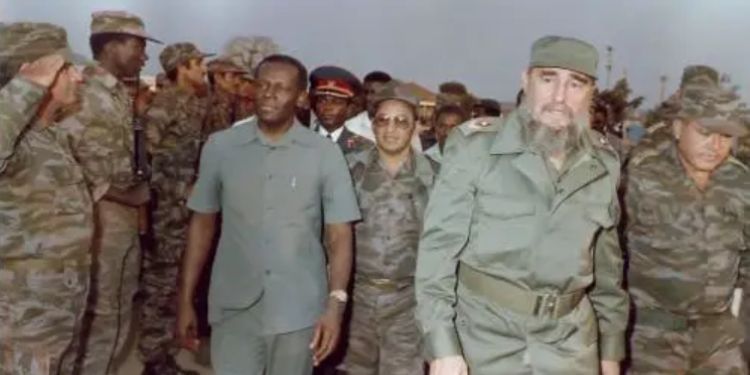
The first hundreds of troops of the Special Troops of the Ministry of the Interior sent to Angola with the greatest secrecy, in November 1975, within the framework of the so-called Operation Charlottemanaged to impose Agostinho Neto, of the communist Popular Movement for the Liberation of Angola (MPLA), in the government, by defeating Cabinda and Quifandongo and preventing their rivals, UNITA and FNLA, the other two independence guerrillas that had fought the Portuguese, from taking Luanda.
To support the MPLA regime, Cubans would have to remain in Angola for more than fourteen years. By 1976, Cuba had 70,000 soldiers in Angola. Between 1975 and 1989, 350,000 Cuban soldiers passed through Angola, a country eleven times larger than Cuba and 11,000 kilometers away, with the Atlantic Ocean in between. A military endeavor of such magnitude, the likes of which had never been undertaken beyond its borders by a Third World country, was possible thanks to the totalitarian control of Cuban society by Fidel Castro’s regime and the enormous Soviet logistical equipment.
What could have been yet another civil war on the African continent became an international conflict, where the Soviet Union and Cuba supported the MPLA, and the United States, South Africa and China supported UNITA.
Cuban and MPLA forces never achieved full control of Angolan territory. Jonás Savimbi’s guerrillas became the most terrible nightmare of the best Cuban generals. The antipersonnel mines and UNITA ambushes are terrifying memories present in the stories of the Cubans who fought in Angola. They say that a large part of the local population helped UNITA; many who during the day showed themselves as MPLA sympathizers, when night fell they became followers of Savimbi, who, for ethnic reasons, had deep roots in the south.
Castro historiography has exaggerated the magnitude of the South African forces they had to face at various times during their stay in Angola. For example, in Cuito Cuanavale, where the Cubans and the FAPLA, locked in a defensive perimeter, resisted the push of the South Africans from December 1987 to July 1988. Not counting the Cubans, only the FAPLA soldiers outnumbered the South Africans 4 to 1.
The 61st Mechanized Battalion, the only conventional unit of the South African regular army that fought at Cuito Cuanavale, had a few Leopard tanks and 55 armored cars. The infantry was the 32 Buffalo Battalion, made up of former Angolan FNLA insurgents led by South African officers.
The Cuban regime considers that in Cuito Cuanavale it had a great victory. But in reality it was a pyrrhic victory. Just look at the losses on both sides. While the South Africans had 31 deaths, until April 1988 alone, the FAPLA had 4,785 deaths. The number of Cuban fatalities is unknown. Cuban forces lost 94 tanks, hundreds of armored vehicles and nine MIG-23s.
It also exaggerates Castro’s historiography regarding the Cuban contribution to the independence of Namibia and the end of apartheid in South Africa.
The combined Cuban forces, FAPLA and the South West Africa People’s Organization (SWAPO) advanced up to 20 kilometers from the border between Namibia and Angola, but were unable to cross it. South Africa had already accepted UN Security Council Resolution 435 to grant independence to Namibia.
Regarding the end of the apartheid regime, more than the Cuban presence in Angola, the international embargo to which South Africa was subject and the rise of black nationalist movements weighed.
Both South African President Pieter Botha, Fidel Castro and the Soviets were eager to leave Angola and avoid a larger conventional war with unforeseeable consequences. Let us remember that, as Fidel Castro revealed in 2006, the South African government, faced with its critical military situation in southern Angola, came to analyze the use of nuclear weapons against Cuban troops, and that the Cuban contingency plan, in the event of such an eventuality, would have been to blow up a gigantic dam on the border, which would have caused millions of cubic liters of water to devastate several cities in Angola and South Africa.
The signing of the peace agreements between Cuba, South Africa, Angola, the United States and the Soviet Union in 1988 was one of the last episodes of the Cold War.
According to official figures, 2,655 Cubans died in Angola. But other sources claim that there were thousands more. Thousands of Cubans returned from Angola mutilated, with their nerves destroyed and victims of strange pathologies, to a country that was entering a serious crisis after the collapse of the Soviet Union.
Beyond satisfying the craving for Fidel Castro of playing war, what was all that suffering for?
Following the withdrawal of Cuban troops from Angola, UNITA continued the war against the government of Eduardo Dos Santos, Neto’s corrupt successor. The 1994 Lusaka peace agreements between the MPLA and UNITA could not be put into practice until eight years later. The civil war did not end until after the death of Savimbi, who was killed by a government patrol that chanced upon him in the jungle in February 2002. After his death, UNITA agreed to become a political party. Angola, which has amended the constitution five times, since 1992 renounced Marxism-Leninism and embraced multipartyism and a market economy.